902-second window · 3 observations · Measured Oct 10, 2026, 4:56 AM UTC · Provider: go_recent_snapshot_v2
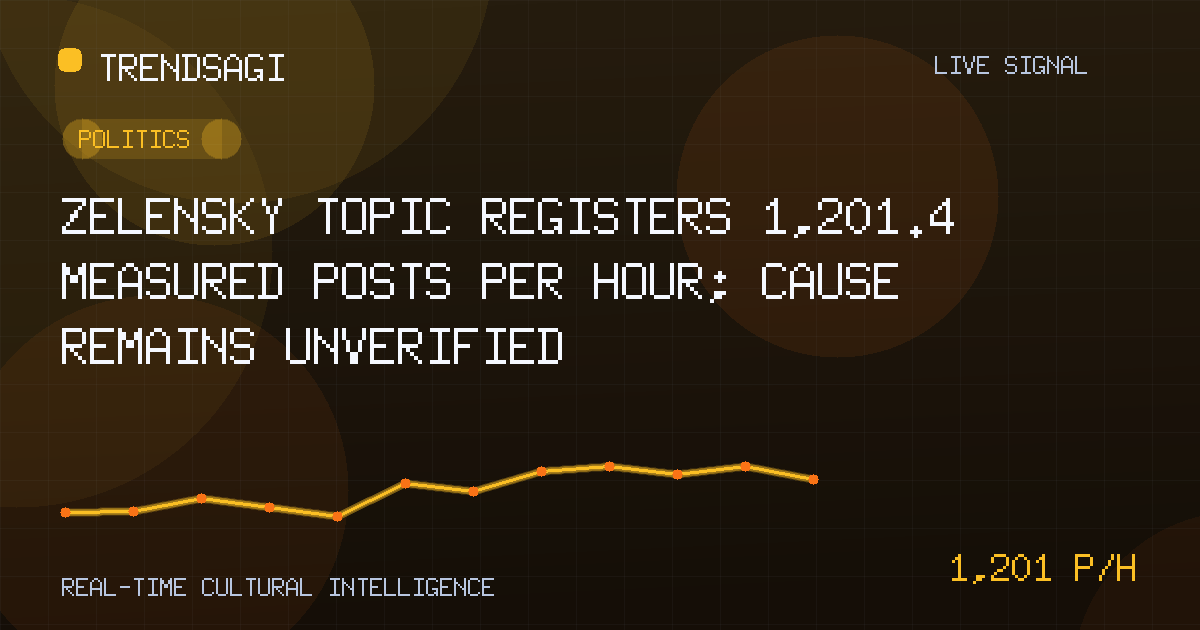
Zelensky topic registers 1,201.4 measured posts per hour; cause remains unverified
The Zelensky topic registered 1,201.4 measured posts per hour; this briefing explains the snapshot, evidence gap, and next checks.
Automated briefing. Generated from stored signal measurements and source-backed research; it is not manually reviewed. Read the methodology and limitations.
Metrics in this briefing are a snapshot associated with its publication date and may not reflect current conditions.
What changed
The Zelensky topic is moving quickly in the latest snapshot, but its cause has not been verified. The snapshot is timestamped 2026-10-10T04:56:31Z and has a measured change rate of 1,201.4 posts per hour across an exact 902-second window, using three stored observations. This is a measured snapshot rate, not a live or current rate, forecast, reach, engagement, or count of unique people.
The snapshot contains 808 posts. That volume and the posts-per-hour figure are separate measures and should not be treated as interchangeable. The immediate editorial conclusion is narrow: the label shows enough measured posting activity to justify a rapid check for a trigger. It does not show whether the response was spontaneous or coordinated, favorable or unfavorable, reliable or unreliable, or representative beyond the observed collection. The available verified public context does not identify a timestamp-matched report or first-party statement behind the movement, so naming a cause now would be speculation.
| Measure | Value |
|---|---|
| Observation time | 2026-10-10T04:56:31Z |
| Measured snapshot rate | 1,201.4 posts/hour |
| Snapshot volume | 808 posts |
The practical question is therefore not “is the signal large?” but “what verifiable event, if any, aligns with it?”
Why this topic may be moving
Possible triggers include a new statement, interview, political development, conflict-related report, diplomatic development, controversy, or the resurfacing of older material. The available evidence does not distinguish among them. A high-volume cluster may contain many reactions to one item, repeated reposting of a claim, or a broader mix of original commentary. Posting frequency alone cannot separate those patterns.
No verified context links this snapshot to a specific event. The stored category, Politics, indicates how the topic was classified; it does not verify the content of the 808 posts or the motives of their authors. It would therefore be misleading to turn the rate into a narrative such as “a particular event triggered the spike” until that chain is documented.
A measured rate shows the speed of observed posting activity; it does not identify the event behind it or show what people believe.
To establish a plausible explanation, look for a verifiable event that occurred before the burst and public reporting or a first-party statement with compatible timestamps. Even a close match would demonstrate attention around an event, not agreement with it or a causal effect.
Why it matters
A fast signal changes editorial priority, but not the standard of evidence. The people most likely to be affected by a mistaken interpretation include newsrooms, public-affairs teams, platform analysts, researchers, and readers deciding how much confidence to place in the apparent surge.
- Newsrooms: A fast signal can justify checking timestamped coverage and first-party statements before publishing a breaking-news explanation. It is not evidence that any specific claim is true.
- Public-affairs and communications teams: They should distinguish a broad audience response from repetition by a narrower set of accounts and monitor whether verified reporting expands the conversation.
- Platform and trust teams: The useful follow-up is content-level: repeated text, shared links, coordinated timing, and reports that conflict with verified material.
- Researchers: The timestamp, window, observation count, and distinction between rate and snapshot volume must remain attached to the figure to prevent misuse.
For general readers, the main risk is false precision. A large number of posts can create the appearance of consensus even when the posts are repetitive, contradictory, or drawn from a limited collection.
What to watch next
A useful follow-up sequence should prioritize evidence that can confirm—or weaken—the connection.
- Check persistence: Collect subsequent observations using the same definition and compare direction, not merely whether another large snapshot exists. Do not present 1,201.4 posts per hour as the current rate after a newer measurement is available.
- Find the earliest substantive posts: Review timestamps, original text, quoted material, and cited links. Establish whether the earliest items point to an event, a reaction to earlier coverage, or an unsupported claim.
- Verify a candidate trigger: Look for public reporting or a first-party statement published before the burst. Attribute any external fact to its publisher and omit details that cannot be confirmed.
- Measure breadth rather than repetition: If data are available, compare unique accounts, languages, regions, account types, and original posts with copied or near-identical content. The signal does not provide those breakdowns.
- Classify the conversation: Separate questions, factual reporting, criticism, support, and unverified claims. This prevents sentiment or topic labels from standing in for actual content analysis.
- Watch the second wave: Note whether credible outlets pick up the same event, whether official sources respond, and whether discussion shifts from a specific claim to a broader issue.
The strongest confirming signal would be timestamp-aligned public evidence plus original posts that repeatedly reference it. A weaker signal would be a later article explaining the burst without showing that the event or claim preceded the measured activity.
Methodology and limitations
The reported rate comes from three observations across an exact 902-second window and is associated with the snapshot at 2026-10-10T04:56:31Z. The 808-post figure is the snapshot volume. Neither number should be used as the other, and the rate should always be described as historical and measured rather than live.
Important gaps remain. No baseline or prior rate is provided, so this briefing does not calculate a percentage increase or claim how unusual the rate is. No post-level sample, unique-account count, geography, language, platform mix, collection method, or duplication measure is supplied. The signal cannot establish organic versus coordinated activity, sentiment, accuracy, or causation. The cause of the movement remains unclear until time-matched public evidence and relevant posts are verified.
Track This Topic for New Signals
Set alerts for future velocity or sentiment changes around this topic.
Explore Tracking PlansAbout TrendsAGI research
TrendsAGI's automated research pipeline publishes dated signal snapshots, methodology notes, and practical workflows for teams evaluating cultural momentum. Read how signals are scoped, scored, and limited in our research methodology.


