806-second window · 3 observations · Measured Oct 4, 2026, 7:54 PM UTC · Provider: go_recent_snapshot_v2
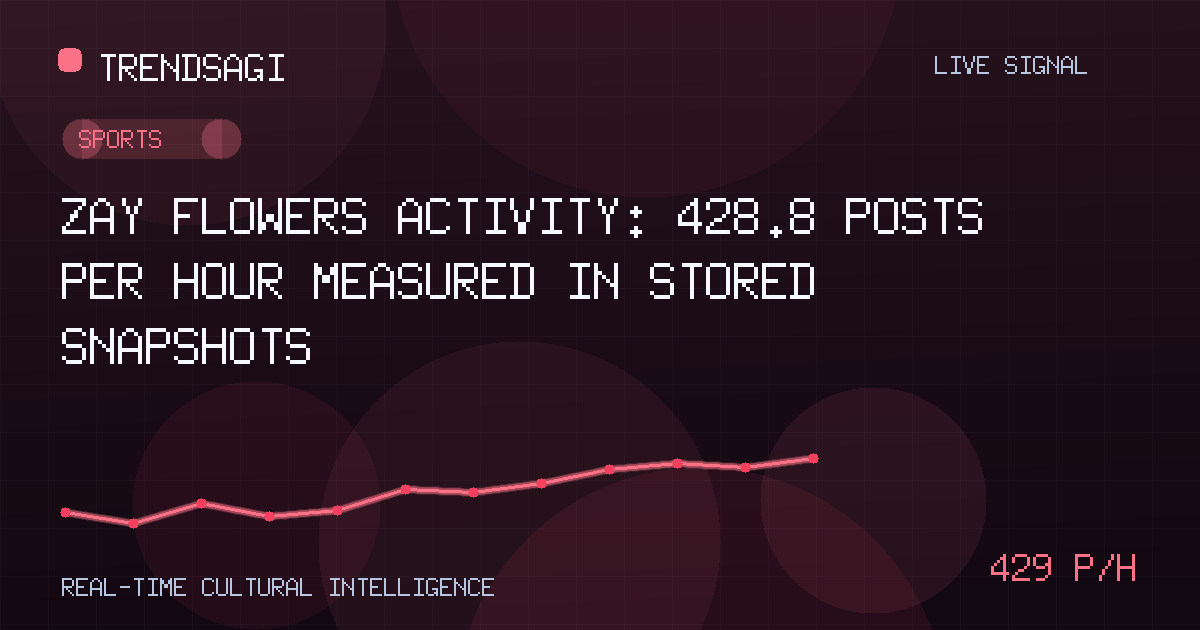
Zay Flowers activity: 428.8 posts per hour measured in stored snapshots
Zay Flowers activity measured 428.8 posts per hour over an 806-second window; the cause is unverified, and the figures do not establish reach or audience size.
Automated briefing. Generated from stored signal measurements and source-backed research; it is not manually reviewed. Read the methodology and limitations.
Metrics in this briefing are a snapshot associated with its publication date and may not reflect current conditions.
What changed
The clearest supported conclusion is that tracked activity around Zay Flowers was moving rapidly in the stored observation series, which recorded a measured snapshot rate of 428.8 posts/hour. That is a historical, window-specific measure of change; it does not identify a trigger or show how many distinct people were involved.
The measurement was recorded at 2026-10-04T19:54:03Z across an exact 806-second window using 3 stored observations. The latest snapshot contained 155 posts. These are separate measures: 428.8 posts/hour is the measured snapshot rate, while 155 posts is the volume captured in the latest snapshot, not a rate, reach estimate, engagement measure, or audience count.
| Observation time | Measured snapshot rate | Snapshot volume |
|---|---|---|
| 2026-10-04T19:54:03Z | 428.8 posts/hour | 155 posts |
Why this topic may be moving
No external cause is verified in the material available for this briefing, so the trigger remains unclear. It would be premature to attribute the burst to a game, performance, injury, roster event, controversy, interview, or announcement without a timestamped public source connecting that event to the observation period.
- Event-driven discussion: A game, performance, availability update, team decision, or award could concentrate posts around a specific moment. This is a hypothesis, not a verified explanation.
- News or announcement: A release, interview, quote, or rumor could produce repeated posts and follow-up commentary. The key test is whether reliable public reporting and a primary source align with the observation time.
- Replay-driven conversation: A clip, prior play, retrospective, or criticism could resurface without a new event. This would require evidence in the post content, which is not available here.
- Collection effects: Duplicate posts, quoting accounts, automated activity, or changes in collection coverage can raise post counts without representing equivalent new discussion.
Until a contemporaneous, verifiable report or first-party statement connects the burst to a specific event, the responsible conclusion is simply that post activity was changing rapidly in this measured window. The absence of a verified cause does not show that no event occurred; it means this signal alone cannot establish one.
Why it matters
Velocity is useful because it can show where verification deserves attention before a conversation cools. But the signal is an alert, not an explanation. The stored Sports category provides broad context; it does not prove that a sports event caused the activity.
Who should care
- Fans and followers: Check the timestamp and original source before treating rapidly accumulating posts as breaking news.
- Sports editors and reporters: Verify the development before assigning significance. A high posting rate alone is not a news event.
- Analysts and audience teams: Preserve the collection method and compare equivalent windows rather than mixing snapshot volume with a rate.
- Organizations monitoring the name: Separate new reporting from recycled clips, duplicate posts, and reactions so any response is based on confirmed facts.
A measured post rate answers how quickly tracked volume changed. It does not, by itself, answer what happened, who posted, whether the participants were unique, or how far the discussion spread.
What to watch next
The next checks should distinguish a sustained development from a short-lived burst:
- Persistence: Determine whether later observations under the same query and collection rules show continued activity, a reversal, or an isolated spike.
- Event convergence: Check whether posts repeatedly reference the same event, phrase, quote, clip, or announcement. Convergence across independent posts is more informative than repeated copying.
- Primary-source confirmation: Look for a timestamped first-party account, document, transcript, or direct statement close to the measured window.
- Distribution: Examine whether activity spans multiple reputable outlets, regions, languages, or communities rather than originating from one feed.
- Originality: Look for repeated text, quote-posting, or templated patterns that could inflate the count without adding distinct discussion.
- Follow-through: Check whether reputable reporting explains a development and subsequent snapshots confirm whether attention persists or recedes. Future movement should not be treated as guaranteed.
Methodology and limitations
The measured rate of 428.8 posts/hour was calculated over the exact 806-second window from 3 stored observations, with the measurement recorded at 2026-10-04T19:54:03Z. Snapshot volume of 155 posts describes only the latest captured set. A post count is not automatically a count of people: one person can publish repeatedly, and many posts can refer to the same underlying event.
- Posts may include duplicates, copied text, reactions, quotations, or automated activity; the signal does not distinguish among them.
- The underlying post texts, earlier observation values, query scope, geography, language, and detailed collection rules are not included, so the rate cannot be independently reconstructed from this briefing alone.
- The rate does not establish unique-person count, engagement, reach, sentiment, or importance.
- The snapshot rate is historical and window-specific. It is not a live or current rate, a forecast, or a measure of future demand.
- The Sports classification is a broad stored category, not evidence about the cause of the activity.
The defensible bottom line is that Zay Flowers warrants verification attention because tracked post activity was rapid in the recorded window. Confirming a broader trend or tying it to a particular event requires comparable follow-up observations and timestamped public corroboration.
Track This Topic for New Signals
Set alerts for future velocity or sentiment changes around this topic.
Explore Tracking PlansAbout TrendsAGI research
TrendsAGI's automated research pipeline publishes dated signal snapshots, methodology notes, and practical workflows for teams evaluating cultural momentum. Read how signals are scoped, scored, and limited in our research methodology.