15-minute window · 3 observations · Measured Oct 9, 2026, 6:36 AM UTC · Provider: go_recent_snapshot_v2
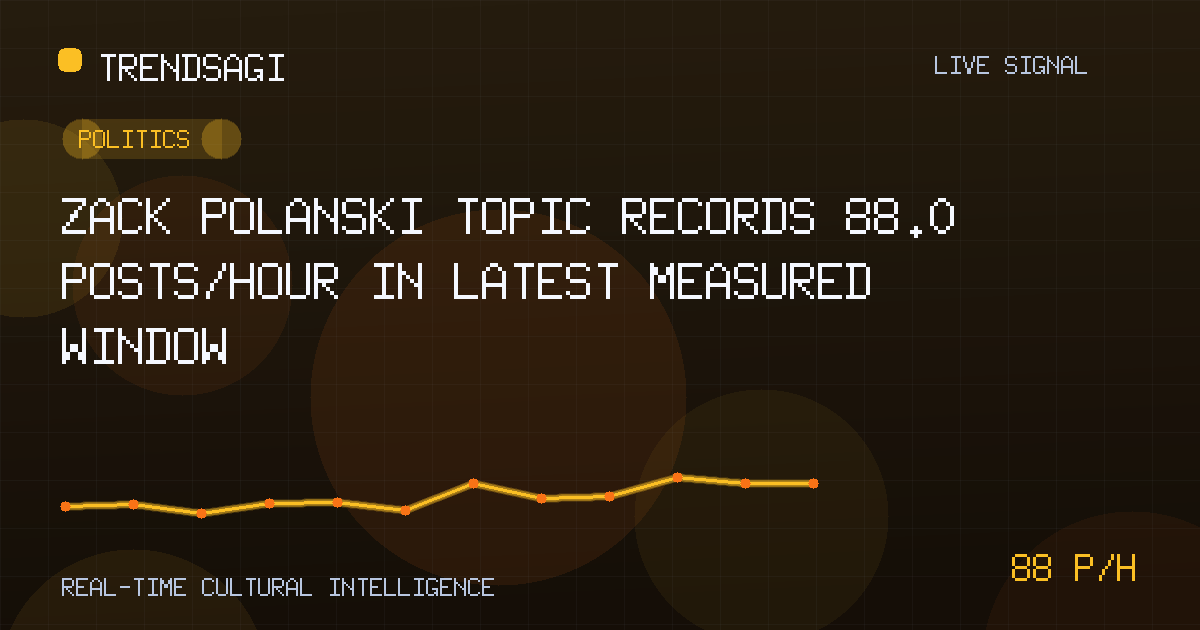
Zack Polanski topic records 88.0 posts/hour in latest measured window
A Zack Polanski snapshot records 134 posts and an 88.0 posts/hour measured change rate, helping readers avoid treating an unverified cause as fact.
Automated briefing. Generated from stored signal measurements and source-backed research; it is not manually reviewed. Read the methodology and limitations.
Metrics in this briefing are a snapshot associated with its publication date and may not reflect current conditions.
What changed
The stored signal labeled “Zack Polanski” shows a measured short-window rise in posting activity, but the available record does not establish what triggered it. For readers and editors, the defensible conclusion is narrow: the topic was moving in the monitored post stream at the stated rate, while any connection to a particular event remains unverified.
At 2026-10-09T06:36:31Z, the latest snapshot contained 134 posts. Across an exact 900-second window built from 3 stored observations, the measured change rate was 88.0 posts/hour. This is a measured snapshot rate, not a live or current rate, forecast, reach figure, engagement total, or count of unique people.
| Observation time | Measured posts/hour | Snapshot volume |
|---|---|---|
| 2026-10-09T06:36:31Z | 88.0 posts/hour | 134 posts |
The distinction matters. The 134-post figure is the size of the latest snapshot; the 88.0 figure describes the measured pace of change in the stated window. Neither establishes how many people saw the posts, how often they were viewed, or whether distinct accounts produced them. The activity also cannot be compared with a longer-term baseline because none is supplied.
Why this topic may be moving
No verified public context accompanies the stored signal, so the cause cannot responsibly be assigned. “Politics” is the stored category, not evidence that a political event caused the movement. The label does not identify the underlying facts, the accounts posting, or the scale and direction of public opinion.
A short-window increase in a post stream can have several non-exclusive explanations:
- A verifiable statement, document, controversy, or political development prompted reaction.
- A media item or interview introduced the name to an audience already following the topic.
- A platform recommendation, debate, or posting surge redistributed older material.
- A high-volume account or coordinated reposting pattern lifted counts without equivalent public reach.
The available record does not show which explanation, if any, is operating. Naming one as fact would turn a monitoring signal into an unsupported causal claim.
The record establishes that the monitored post stream registered a measured increase in the stated window. It does not establish who initiated the activity, what event caused it, or whether the volume represented broad public attention.
Why it matters
For newsrooms, the immediate question is whether the movement reflects a reportable development or merely a burst in the monitored stream. Verification should precede a breaking-news label, especially because the stored description contains no event account.
For people tracking political conversation, the signal is a prompt to inspect source mix and timing, not a stand-in for popularity. A fast rate can result from a narrow group posting repeatedly, while a smaller rate can accompany broad discussion elsewhere. The stored data cannot distinguish those cases.
- Newsrooms should seek attributable confirmation before explaining the increase.
- Researchers should preserve the measurement method and inspect original posts rather than relying on aggregate volume.
- Readers should treat the rate as evidence of activity, not evidence of support, opposition, or significance.
Most importantly, posts do not equal voters, supporters, opponents, or consensus. They may be replies, quotations, reposts, or automated activity; the record provides no account-level classification. Interpreting the movement as endorsement, backlash, or crisis would therefore exceed the evidence.
What to watch next
A useful follow-up should move from volume to provenance, causality, and persistence.
- Identify the source surface. Determine the platform, collection method, geography, and language represented; these details are absent from the stored record.
- Find the origin. Inspect the earliest substantive posts and trace whether later items quote, reply to, or repost an identifiable source.
- Verify the claimed event. Locate a primary statement or document and check whether reputable reporting places it before the observed activity. Attribute any confirmed facts to their publisher.
- Separate content types. Distinguish original posts from quotations, replies, and reposts. Check account overlap and repeated wording without converting post counts into people counts.
- Check disputes and corrections. Look for a denial, clarification, correction, or competing account that could change the interpretation of the movement.
- Collect comparable observations. Use the same window and collection method to determine whether the activity persists, recedes, or immediately rebounds.
- Test wider context. Compare adjacent monitored topics to see whether the increase reflects the named topic or a broader change in posting activity.
Concrete watch signals
- Later comparable snapshots show whether activity persists under the same collection method.
- An identifiable primary source publishes a statement or document tied to the timing.
- Several independent, reputable publishers converge on the same basic event.
- Original citations increasingly replace generic reactions or repeated wording.
- A correction, denial, or clarification materially changes the account of the issue.
A verified event could explain the timing, but it would not automatically validate every post. Likewise, persistence across comparable observations would strengthen a trend description, while a single later spike would remain another snapshot rather than proof of a durable shift.
Methodology and limitations
This briefing uses the canonical stored signal observed at 2026-10-09T06:36:31Z. It preserves the supplied figures exactly: 134 posts for snapshot volume and 88.0 posts/hour as the measured change rate. The rate was measured over the stated 900-second window using 3 stored observations; it is not presented as a live rate or forecast.
The raw observation sequence, calculation method, and longer-term baseline are not supplied, so the rate cannot be independently audited or characterized as exceptional relative to normal activity. Snapshot volume also does not indicate whether the collection is complete.
The record provides no platform, geography, language, source distribution, account identities, engagement data, or information about automated behavior. It therefore cannot establish audience size, sentiment, authenticity, or public consensus. No verified external context identifies a triggering event, so the cause remains unclear and should not be inferred from the topic label or posting speed alone.
Track This Topic for New Signals
Set alerts for future velocity or sentiment changes around this topic.
Explore Tracking PlansAbout TrendsAGI research
TrendsAGI's automated research pipeline publishes dated signal snapshots, methodology notes, and practical workflows for teams evaluating cultural momentum. Read how signals are scoped, scored, and limited in our research methodology.