907-second window · 3 observations · Measured Oct 3, 2026, 2:11 AM UTC · Provider: go_recent_snapshot_v2
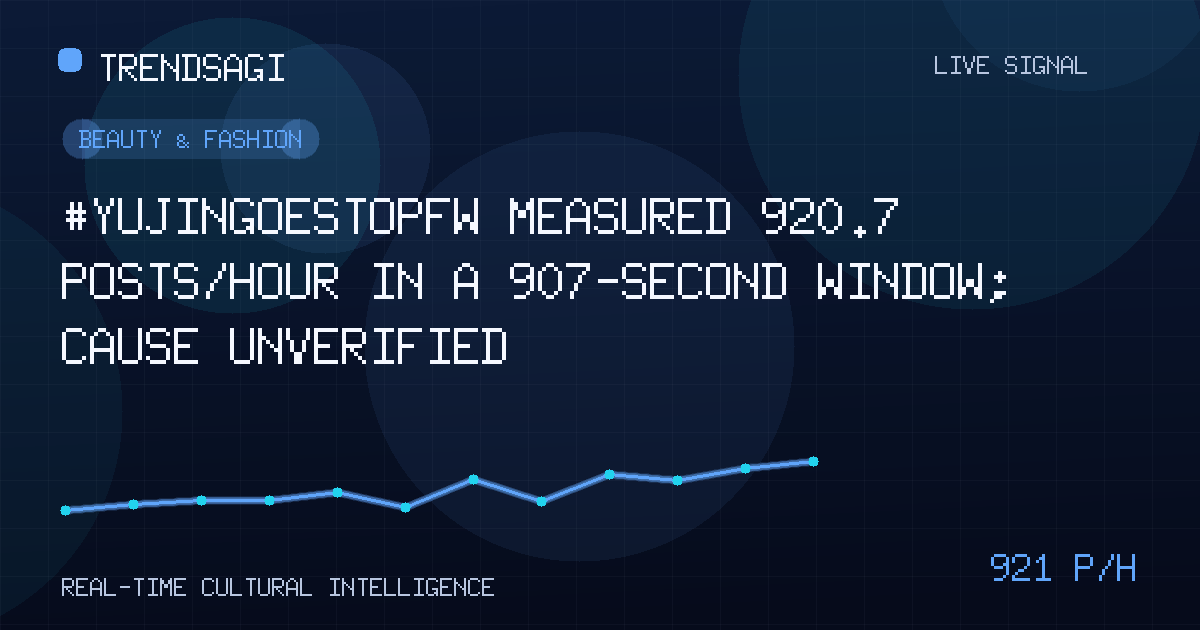
#YUJINgoestoPFW measured 920.7 posts/hour in a 907-second window; cause unverified
The topic logged 1565 posts and a measured snapshot rate of 920.7 posts/hour; this briefing separates the observed burst from still-unverified causes.
Automated briefing. Generated from stored signal measurements and source-backed research; it is not manually reviewed. Read the methodology and limitations.
Metrics in this briefing are a snapshot associated with its publication date and may not reflect current conditions.
What changed
The strongest defensible conclusion is that #YUJINgoestoPFW produced a concentrated burst of posts. At the observation time, the latest stored snapshot contained 1565 posts. Across an exact 907-second window based on 3 stored observations, the measured change was 920.7 posts/hour. That figure is a measured snapshot rate, not a live or current rate, forecast, reach, engagement, or unique-person count.
Why the topic moved remains unverified. The available public context does not establish a confirmed announcement, event connection, controversy, or originating post. The label alone also does not establish who “Yujin” is or what “PFW” denotes in this usage. It is therefore reasonable to report a rapid increase in posting activity, but not to present a proposed trigger as fact.
| Signal measure | Stored value |
|---|---|
| Observation time | 2026-10-03T02:11:49Z |
| Measured snapshot rate | 920.7 posts/hour |
| Exact measurement window | 907 seconds |
| Stored observations | 3 |
| Latest snapshot volume | 1565 posts |
Why this topic may be moving
Several mechanisms could produce this pattern, but the available evidence does not allow them to be ranked responsibly.
- A specific event connection: If “Yujin” identifies a person and “PFW” refers to an event, a confirmed announcement or appearance could trigger discussion. Neither connection has been verified here.
- Audience mobilization: Fan communities, creators, or coordinated accounts could accelerate a label by circulating the same message or prompting a mass response.
- A reaction to existing content: A quotation, clip, controversy, or prior announcement might have prompted users to adopt the label. No originating item is established in the signal.
- Duplication rather than new discussion: Reposts and repeated wording can increase posting velocity without representing broad participation or independent reactions.
- Temporary distribution effects: Recommendation, repost clustering, or cross-platform pickup could shorten the window in which activity appears concentrated.
These are testable hypotheses, not findings. Choosing among them requires the underlying posts, their timestamps, and verified context preceding the increase.
Why it matters
For editors, the signal is timely but incomplete. The exact observation time and measured window provide a useful starting point for reconstructing what happened. A high-velocity label with an unresolved meaning warrants monitoring, not an invented explanatory headline.
For brand, talent, community, and social-listening teams, posting velocity should not be treated as evidence of consumer demand, public sentiment, or broad awareness. The stored Beauty & Fashion category helps route the signal editorially, but it does not identify participants or explain the cause.
- News and social editors should verify the trigger before publishing an explanation.
- Talent and publicity teams should check the identity, event reference, and any official confirmation.
- Researchers should compare the burst with surrounding activity and test whether it persists.
- Readers should distinguish a large conversation from a broad or meaningful one.
A measured posting rate shows velocity, not significance. The same 920.7 posts/hour could reflect broad participation, repeated material, or a narrow group amplifying one message; the stored record cannot distinguish among them.
What to watch next
The next useful work is to verify identity, reconstruct sequence, and test whether the activity persists.
- Resolve what the label refers to. Establish who or what “Yujin” means, what “PFW” denotes, and whether the spelling identifies one person, organization, event, or several unrelated subjects.
- Rebuild the beginning of the burst. Review posts around the exact 907-second window to identify the earliest substantive item, replies, quotations, and reposts rather than relying only on widely circulated later posts.
- Look for primary confirmation. Check an official account, event organizer, statement, or original creator. Confirm that its publication time aligns with the observed cluster.
- Examine authorship and originality. Determine whether participating accounts are distinct, historically active, and adding original material or repeatedly copying the same wording.
- Test timing and sequence. Check whether a confirmed catalyst appeared before the surge. Later articles may explain the trend but may not have caused it.
- Check persistence. Compare later stored snapshots. Activity remaining elevated across additional observations would support a sustained signal; a quick return to surrounding levels would indicate a shorter-lived burst.
- Map spread and context. Look across relevant languages, locations, and platforms, while separating support, criticism, curiosity, coordination, and misinformation.
- Watch for disconfirming evidence. Corrections, denials, identity confusion, deleted posts, or clarification that the label refers to something unrelated would weaken any proposed explanation.
Concrete decision signals: Treat the cause as supported when a primary source and independent timestamped posts align. Treat the activity as broader when distinct accounts contribute original material and later snapshots remain elevated. Repeated wording concentrated among a narrow account set would instead raise a coordination question. If activity subsides without confirmation, the defensible classification is a transient burst, not a sustained trend.
Methodology and limitations
This briefing uses the latest stored observation at 2026-10-03T02:11:49Z. Snapshot volume and the measured rate answer different questions: 1565 is the post count in the stored snapshot, while 920.7 posts/hour describes posting velocity over the separate 907-second measurement window. The two figures should not be substituted for one another.
The rate is based on 3 stored observations. That summary does not expose the full trajectory, surrounding baseline, individual account counts, sentiment, engagement, geography, or duration. It also cannot distinguish unique authors from repeated posts or coordinated amplification.
The Beauty & Fashion label is stored metadata, not proof that the activity came from a fashion event or that the audience consisted of beauty and fashion consumers. Because no external trigger could be verified in the context available, the reason for the increase remains explicitly unresolved.
Track This Topic for New Signals
Set alerts for future velocity or sentiment changes around this topic.
Explore Tracking PlansAbout TrendsAGI research
TrendsAGI's automated research pipeline publishes dated signal snapshots, methodology notes, and practical workflows for teams evaluating cultural momentum. Read how signals are scoped, scored, and limited in our research methodology.


