901-second window · 3 observations · Measured Sep 26, 2026, 1:55 PM UTC · Provider: go_recent_snapshot_v2
#YouManiacSeriesEP5 posting spike measured; cause remains unverified
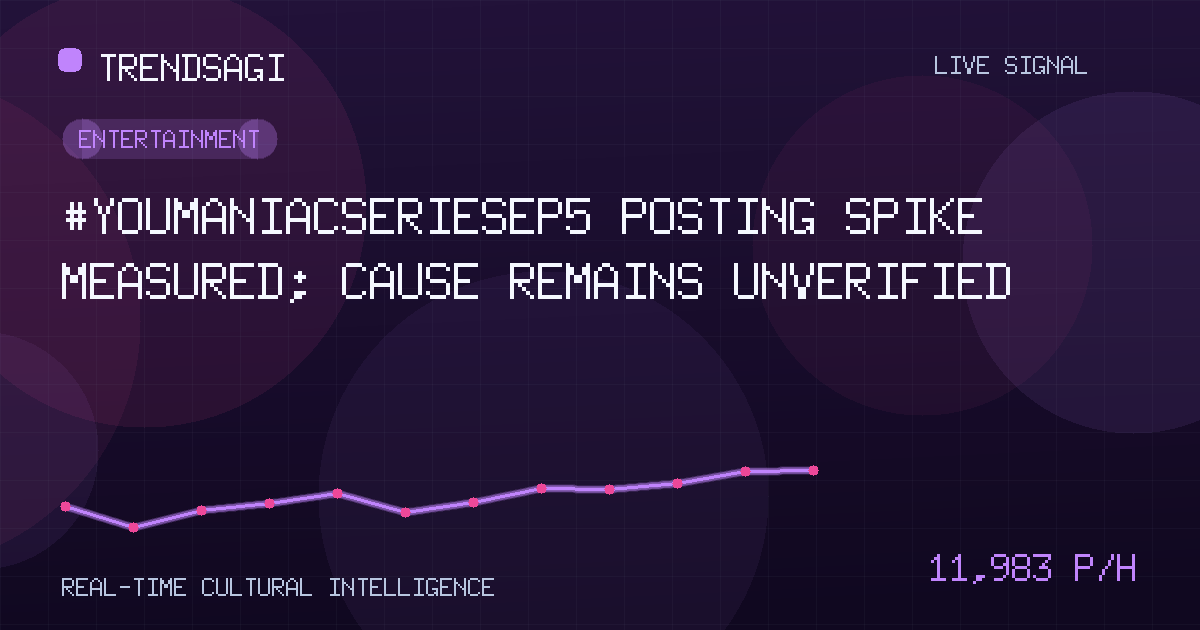
The #YouManiacSeriesEP5 snapshot measured 11982.8 posts/hour across 901 seconds, while verified public evidence has not established the cause.
Automated briefing. Generated from stored signal measurements and source-backed research; it is not manually reviewed. Read the methodology and limitations.
Metrics in this briefing are a snapshot associated with its publication date and may not reflect current conditions.
What changed
#YouManiacSeriesEP5 shows a concentrated spike in observed posting, but the reason for the activity is not established. No verified public context ties the increase to a specific episode release, announcement, controversy, promotion, or platform event, so the defensible conclusion is movement without a confirmed cause.
The measured snapshot rate was 11982.8 posts/hour over an exact 901-second window using 3 stored observations, measured at 2026-09-26T13:55:37Z. The latest snapshot volume was 12000 posts; it is not another rate and does not represent reach, engagement, or unique people.
| Observation time | Measured snapshot rate | Latest snapshot volume |
|---|---|---|
| 2026-09-26T13:55:37Z | 11982.8 posts/hour | 12000 posts |
Why this topic may be moving
The label offers clues, not evidence. Its wording appears consistent with a series-and-episode tag, but the exact subject and whether an official entertainment property uses the label have not been independently confirmed in the available material. Several ordinary pathways could create this pattern, and each requires a dated public trigger.
- Content release: an episode, clip, or related item may have become available near the start of the posting burst.
- Official promotion: a creator, publisher, cast member, or platform account may have posted a link, image, or announcement.
- Audience response: viewers may be reacting to a reveal, plot point, performance, or disputed interpretation.
- Repetition or coordination: a network of accounts may be repeating the same label or phrase, producing substantial volume without equivalent participation.
These are hypotheses, not findings. No verified public context was available to select among them. In particular, EP5 in the label is not proof that a new episode launched at the time of the spike, and the record does not support assigning the movement to a named person or event.
The signal establishes a measured posting rate around a label at a specific time. It does not establish who posted, what they felt, whether the activity was organic, or what caused it.
Why it matters
As an Entertainment-category signal, the immediate value is prioritization: this label merits a cause check before it is treated as a durable entertainment trend. The raw pace is large enough to investigate, but the short observation window and missing trigger make interpretation fragile.
- Entertainment editors should look for a dated, attributable event before linking the spike to a release or story development.
- Social and audience teams should separate meaningful discussion from repeated tagging, because post volume alone does not reveal sentiment or unique interest.
- Marketing teams should avoid treating the snapshot as campaign performance, consumer demand, or evidence of organic reach.
- Researchers and community managers should preserve the timestamp and collection method so the burst can be compared with later activity on the same basis.
What the signal can and cannot establish
It can establish that the monitored label registered 12000 posts in the latest snapshot and that the supplied calculation produced a measured snapshot rate of 11982.8 posts/hour over 901 seconds using 3 observations. That is useful evidence of concentrated posting at the recorded time.
It cannot establish the full size of the active audience, the number of people involved, sentiment, geography, platform, or whether posts were original, replies, reposts, or coordinated. It also cannot prove why the rate occurred. The individual observation values and a longer comparison series are not included, so the aggregate rate cannot be independently reconstructed or judged against a normal baseline from this briefing alone.
What to watch next
The next step is not to amplify the label blindly, but to run a compact verification sequence:
- Collect comparable observations: use the next stored snapshots with the same label scope and counting rules. Persistence across observations would support a sustained conversation; disappearance would support interpreting the original observation as a short burst.
- Inspect the onset: review the earliest substantive posts around the measured window for cited links, quoted media, or a common announcement. The first verified item that predates the burst is more useful than a later summary.
- Run a targeted Google Search: search the exact label, then any officially confirmed title or account names. A dated publisher, creator, or platform result that clearly matches the onset could establish a trigger; unrelated search results should not.
- Check content composition: separate original commentary, replies, reposts, media shares, and generic label use. Specific reactions would support substantive audience interest; near-identical text would raise a repetition question.
- Examine account behavior: compare unique accounts, repeated phrasing, timing clusters, and reused media. This does not prove automation, but it can show whether the post total overstates distinct participation.
- Establish a baseline: compare the same measure across a longer period and with nearby confirmed topics. Do not mix differently scoped post counts as if they were directly comparable.
Concrete confirmation signals
- An attributable public item appears before the surge and directly explains EP5.
- Subsequent comparable observations remain active rather than collapsing immediately.
- Distinct accounts discuss the same specific content, rather than only repeating the label.
- No large cluster of near-duplicate posts accounts for most of the volume.
Methodology and limitations
The measured 11982.8 posts/hour figure is a stored snapshot rate calculated across an exact 901-second window from 3 observations, with the result measured at 2026-09-26T13:55:37Z. It is not a live rate, a forecast, or an audience estimate. The 12000 posts figure is the latest snapshot volume and must not be described as a rate.
The window is short enough for a sudden burst, scheduled posting, or repetition pattern to dominate. A post count may include multiple contributions from the same account, and the available aggregate does not expose duplicates or unique authors. The topic label's exact identity also remains unconfirmed.
No cause is assigned because no verified public context established a triggering event. The sound editorial description is therefore a measured posting spike with an unclear driver, followed by verification of timing, attribution, content, and persistence.
Track This Topic for New Signals
Set alerts for future velocity or sentiment changes around this topic.
Explore Tracking PlansAbout TrendsAGI research
TrendsAGI's automated research pipeline publishes dated signal snapshots, methodology notes, and practical workflows for teams evaluating cultural momentum. Read how signals are scoped, scored, and limited in our research methodology.


