899-second window · 3 observations · Measured Sep 25, 2026, 5:52 AM UTC · Provider: go_recent_snapshot_v2
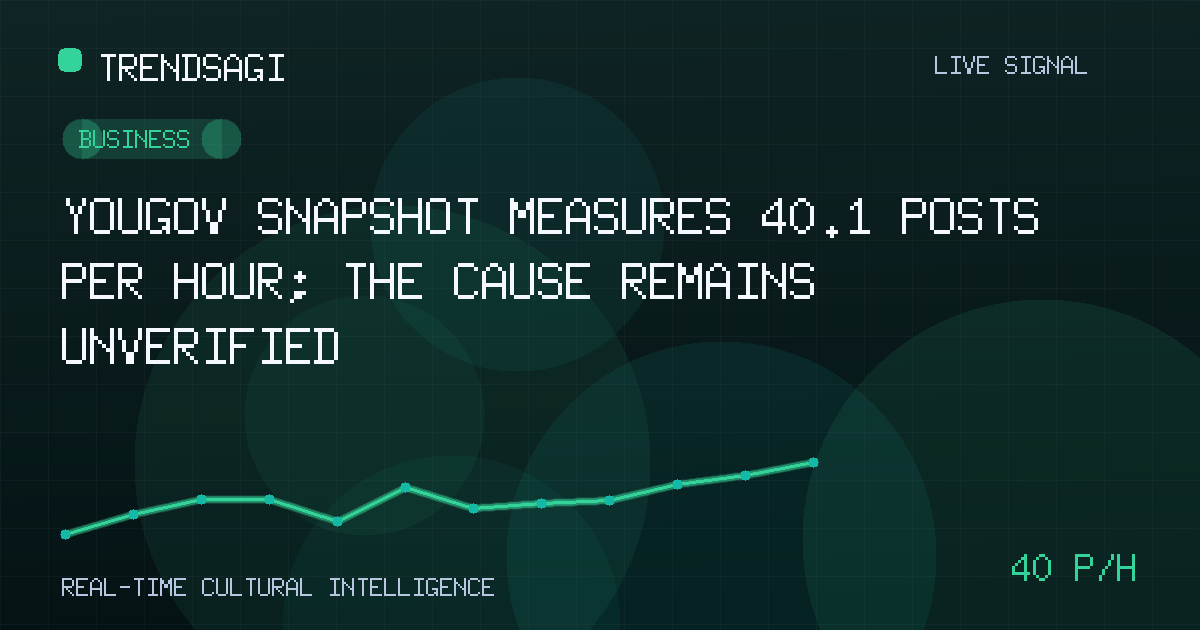
YouGov snapshot measures 40.1 posts per hour; the cause remains unverified
The YouGov signal’s measured snapshot rate was 40.1 posts/hour, with 26 posts in the latest volume; the trigger remains unverified.
Automated briefing. Generated from stored signal measurements and source-backed research; it is not manually reviewed. Read the methodology and limitations.
Metrics in this briefing are a snapshot associated with its publication date and may not reflect current conditions.
What changed
The stored business-category signal labelled YouGov recorded a measured snapshot rate of 40.1 posts/hour, based on 3 stored observations over an exact 899-second window. This is a retrospective measurement of short-window posting activity, not a live rate, forecast, or estimate of reach.
The latest snapshot contained 26 posts. The available evidence does not identify a verified news trigger, so attributing the change to a poll release, controversy, corporate announcement, or wider change in public opinion would be premature.
| Observation time | 2026-09-25T05:52:07Z |
|---|---|
| Measured snapshot rate | 40.1 posts/hour |
| Latest snapshot volume | 26 posts |
| Rate window | 899 seconds |
| Stored observations used | 3 |
Why this topic may be moving
A topic label and a measured post rate cannot reveal what people are discussing or why they started posting. The available stored metrics provide no post text, named event, or verified external explanation. The defensible conclusion is that posting activity is measurable while its cause remains unconfirmed.
Checks needed before naming a catalyst
- Poll-related explanation: Look for an original, dated release and inspect the poll’s question wording, fieldwork period, sample, weighting, and uncertainty. A wave of reactions to a poll is not, by itself, evidence that public opinion has changed.
- Company-related explanation: Verify a dated corporate announcement, executive appearance, published report, or documented commercial event through the relevant original publisher. Repeated reposts should not be mistaken for independent confirmation.
- Broader news explanation: Look for contemporaneous reporting from identifiable publishers and establish whether the coverage actually concerns YouGov. An incidental mention in a larger story is weaker evidence than reporting directly built around new research.
- Controversy or coordination explanation: Inspect original claims, sourcing, and corrections. Shared wording may indicate amplification rather than separate events, but repetition alone cannot establish organised activity.
Why it matters
For communications and public-affairs teams, this signal is a prompt to identify the underlying item and assess its audience—not a substitute for reading the research. A new poll, a reused excerpt, and an individual reaction can produce similar posting patterns while carrying very different significance.
For analysts, any poll claim behind the discussion must be checked against the original question and method. A prominent name does not remove the need to inspect wording, fieldwork timing, sample construction, weighting, subgroup definitions, and margins of error. Posting volume cannot answer those methodological questions.
For investors, partners, and suppliers, conversation volume is not a business-performance indicator. It does not establish demand, revenue, customer wins, reputational damage, or a stock-market response. Each of those claims requires separate, verified evidence.
Post volume measures mentions; it does not establish that the underlying research—or public opinion—has changed.
The practical value of monitoring is triage: determine whether the activity concerns fresh research, a business announcement, a reputational issue, or unrelated use of the name. A team can then route the item for appropriate review instead of treating every mention as equally important.
What to watch next
The immediate priority is to identify what the retained posts reference, because the stored summary does not include their content. Review all available observations and matching records, preserving timestamps, source labels, and item identifiers where available.
- Content concentration: Determine whether the items repeatedly mention the same release, question, interview, or claim. A shared subject suggests a focused response; a broad mixture suggests looser attention to the name.
- Original-source match: Use Google Search to look for contemporaneous, dated public pages that could explain the monitored items. Open the underlying pages to verify their subject and timing; search-result counts are not verification.
- Evidence quality: Prioritise original documents and direct quotations over reaction posts. Label claims as confirmed, disputed, corrected, or unsupported rather than collapsing those categories.
- Continuation: Compare subsequent available observations with comparable monitored windows. Lasting attention would require repeated measurements; a short burst should not be presented as sustained momentum.
- Content and engagement: Assess sentiment only if post text is available, keeping it separate from volume. Distinguish impressions, reactions, reposts, and unique accounts rather than treating them as interchangeable.
A more specific explanation requires a verified source connecting the monitored items to a dated event. Without that match, the defensible conclusion remains short-window attention under the YouGov label, with the trigger unresolved.
Methodology and limitations
This briefing uses the supplied stored observation ending at 2026-09-25T05:52:07Z. The reported 40.1 posts/hour figure is a measured snapshot rate based on 3 stored observations over the specified 899-second window. It is not a live rate, extrapolation, reach estimate, engagement measure, or count of unique people.
The 26-post figure describes latest snapshot volume only. It is not a rate, a cumulative total, or a count of participating people. No earlier comparison window, underlying post content, author identities, platform mix, or verified external trigger is supplied. The signal therefore cannot establish a historical baseline, duplication patterns, sentiment, audience representativeness, causation, or persistence beyond the measured window.
The supported conclusion is deliberately narrow: a business-category signal labelled YouGov recorded short-window posting activity. Whether that activity reflected a substantive event, routine attention, or repeated sharing remains an open question requiring source-level verification.
Track This Topic for New Signals
Set alerts for future velocity or sentiment changes around this topic.
Explore Tracking PlansAbout TrendsAGI research
TrendsAGI's automated research pipeline publishes dated signal snapshots, methodology notes, and practical workflows for teams evaluating cultural momentum. Read how signals are scoped, scored, and limited in our research methodology.