4509-second window · 3 observations · Measured Oct 4, 2026, 9:51 AM UTC · Provider: go_recent_snapshot_v2
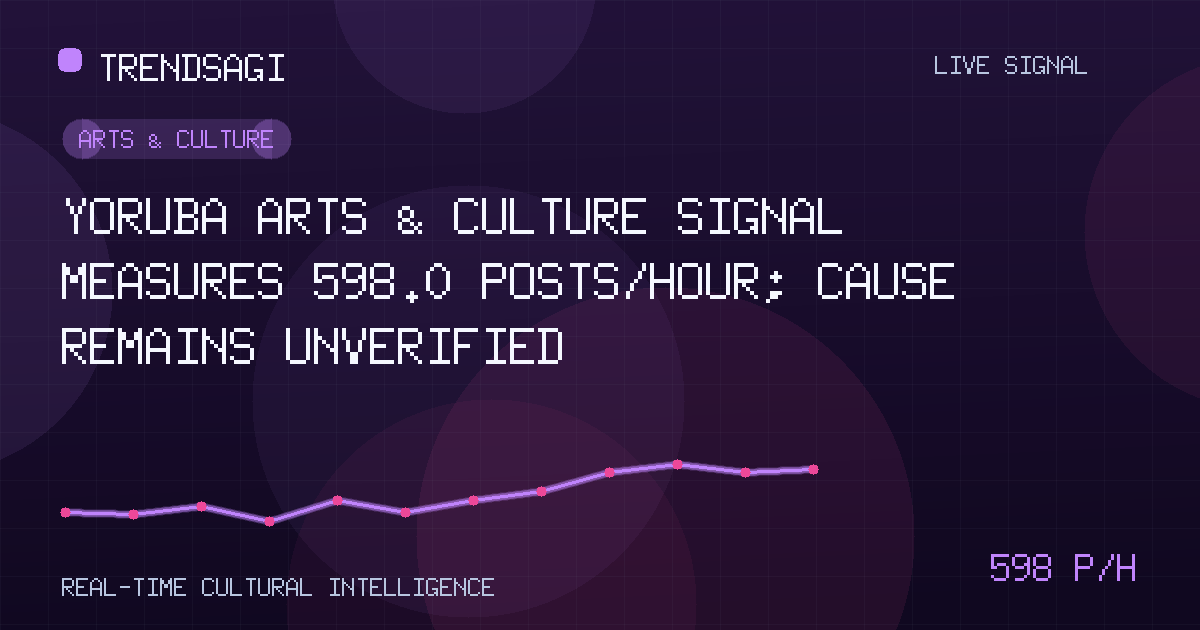
Yoruba Arts & Culture signal measures 598.0 posts/hour; cause remains unverified
Yoruba’s latest Arts & Culture snapshot has 1469 posts and a measured 598.0 posts/hour rate; see what is known and what needs checking.
Automated briefing. Generated from stored signal measurements and source-backed research; it is not manually reviewed. Read the methodology and limitations.
Metrics in this briefing are a snapshot associated with its publication date and may not reflect current conditions.
What changed
The latest stored Yoruba signal shows concentrated short-window posting activity, but not a verified event behind it. Its Arts & Culture snapshot contains 1469 posts, while the topic label is too broad to determine whether the activity concerns Yoruba-language content, Yoruba identity, named people, places, or another use of the term. No public development has been verified as the cause, so an event-level explanation would be premature.
Across an exact 4509-second window using 3 stored observations, the measured snapshot rate was 598.0 posts/hour. That figure describes the pace recorded for this measurement; it is not a live or current rate, a forecast, total reach, engagement, or a count of unique people. The 1469-post snapshot volume is a separate count and should not be treated as the hourly rate.
| Observation time | Measured posts/hour | Snapshot volume |
|---|---|---|
| 2026-10-04T09:51:58Z | 598.0 posts/hour | 1469 posts |
Why this topic may be moving
Because no dated, corroborated public trigger is established, the cause remains unclear. The monitoring category may combine several otherwise separate conversations. The following are hypotheses to test, not claims about what happened:
- Music or screen release: A Yoruba artist, film, series, or song could generate a rapid cluster of posts. This would need a dated first-party announcement or reliable reporting before being treated as the driver.
- Identity or public affairs: A political, social, or sporting development could bring Yoruba regional, national, or diaspora identity into a wider conversation without making the underlying subject exclusively Yoruba culture.
- Language and cultural activity: A language initiative, commemoration, festival, academic discussion, or debate about representation could produce posts under the same broad label.
- Platform or collection effects: A breakout account, repeated reposting, a coordinated campaign, or changes in how posts were collected could raise the count without representing a new cultural event.
These possibilities are not interchangeable. A volume spike tied to a verified announcement is different from a language mix becoming more diverse or a group of accounts repeatedly amplifying one claim. Until the underlying posts are sampled and a public trigger is corroborated, the safest conclusion is broad topical momentum with an unknown driver.
What the signal can establish
The signal establishes two things: the size of the latest matched snapshot and the measured pace of change across the stated window. It does not establish what prompted the activity, whether the posts were original, who posted them, where they came from, how many people participated, or what they believed. The topic name alone also cannot show that every item is in Yoruba or about Yoruba culture.
The strongest defensible finding is not that a particular event caused the activity, but that a broad monitoring category registered a measured short-window rate of 598.0 posts/hour; any event-level explanation still needs post-level and public-source corroboration.
Three observations support the supplied measured rate, but they are too few to reveal a full daily pattern, recurring peak, or durable trend. A snapshot is also a collection boundary, not proof that every matching public post was captured. The Arts & Culture classification provides useful context, yet it cannot replace post-level review.
Why it matters
The immediate value is triage: this signal says where a closer look may be warranted, not what the public should conclude. Several groups have a practical interest.
- Yoruba cultural and language organizations: They can check whether the discussion reflects a community priority, a terminology debate, or an external event being mislabeled.
- Music, publishing, film, and event teams: They can distinguish a broad audience response from repetition around a small number of high-output accounts.
- Journalists and editors: They can avoid treating a broad label as proof of a specific event and seek first-party confirmation before explaining the movement.
- Researchers and community monitors: They can test whether conversation about Yoruba identity is being conflated with conversation in the Yoruba language.
For all of these groups, the main risk is false precision. The exact rate and timestamp make the measurement auditable, but they do not turn an ambiguous label into a causal story.
What to watch next
A useful follow-up should test persistence and composition at the same time. Concrete watch signals include:
- Persistence: Compare the next stored observation with the 598.0 posts/hour measured snapshot rate and 1469-post volume. A similar rate in a subsequent, separately recorded window would show that activity persisted beyond this measurement; a lower rate would show that it did not. Neither result identifies a cause.
- Time concentration: Check whether posts cluster around a single announcement, broadcast, performance, or controversy. A tight cluster with a matching external timestamp is more actionable than a diffuse rise.
- Language split: Classify samples as Yoruba-language, English-language discussion about Yoruba people or culture, or unrelated matches. This can reveal whether the apparent trend is linguistic, cultural, political, or a labeling artifact.
- Account and source concentration: Review how many distinct accounts are active, whether a few accounts dominate, and whether links or quotations point to the same origin. This helps separate broad participation from repeated amplification; it does not by itself establish coordination.
- Verified trigger: Use Google Search to find dated first-party statements or reliable reporting that explicitly connects to the observed activity. Do not use search results to estimate posting volume.
- Category drift: Determine whether the posts still belong in Arts & Culture. A shift toward breaking news, sport, or politics would change the audience and the appropriate verification checks.
Methodology and limitations
The 1469 figure is the latest snapshot volume: the number of posts present at the recorded observation. The 598.0 posts/hour figure is the supplied measured change rate across an exact 4509-second window using 3 stored observations. The rate is a change metric, while volume is a collection-size metric; they measure different things and should not be substituted for one another.
The platform, collection method, query definition, and account-deduplication process are not provided here, so coverage and representativeness cannot be assessed. No verified public context establishes why the topic moved. Accordingly, this briefing does not assign the activity to a release, event, controversy, or platform mechanism. The next evidentiary step is a post-level sample, a consistent follow-up snapshot, and a dated public source that can corroborate a proposed driver.
Track This Topic for New Signals
Set alerts for future velocity or sentiment changes around this topic.
Explore Tracking PlansAbout TrendsAGI research
TrendsAGI's automated research pipeline publishes dated signal snapshots, methodology notes, and practical workflows for teams evaluating cultural momentum. Read how signals are scoped, scored, and limited in our research methodology.