1889-second window · 2 observations · Measured Sep 30, 2026, 10:55 PM UTC · Provider: go_recent_snapshot_v2
Yordan sports signal measured at 4626.0 posts/hour; catalyst remains unclear
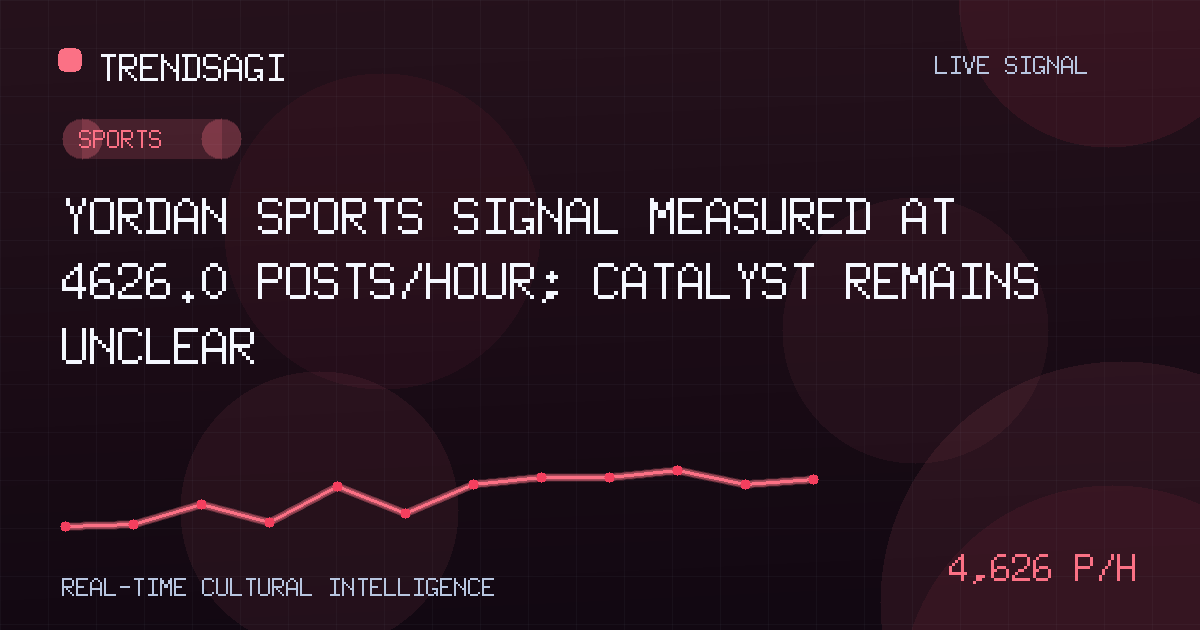
Yordan activity measured 4626.0 posts/hour in the latest sports-labeled snapshot; the identity behind the broad label and the cause remain unclear.
Automated briefing. Generated from stored signal measurements and source-backed research; it is not manually reviewed. Read the methodology and limitations.
Metrics in this briefing are a snapshot associated with its publication date and may not reflect current conditions.
What changed
The sports-labeled “Yordan” signal recorded 2666 posts in its latest snapshot, accompanied by a positive measured change during a short stored interval. Posting activity rose, but the available verified evidence does not identify the trigger or confirm which Yordan the broad label represents.
Measured at 2026-09-30T22:55:02Z, the snapshot change rate was 4626.0 posts/hour over the exact 1889-second window using 2 stored observations. This is a measured rate for that stored interval, not a live or current rate, forecast, reach, engagement, or unique-person count.
| Observation | Value |
|---|---|
| Observation time | 2026-09-30T22:55:02Z |
| Measurement window | 1889 seconds using 2 stored observations |
| Measured snapshot change | 4626.0 posts/hour |
| Latest snapshot volume | 2666 posts |
Snapshot volume and measured change rate answer different questions and should not be combined. The volume is the count captured in the latest snapshot; without collection-window and deduplication details, it cannot explain the rate or represent individual people.
Why this topic may be moving
The reason for the movement remains unclear. The verified public context available for this briefing does not identify a specific, timestamp-aligned catalyst. It would be unsupported to attribute the burst to a game, injury, transfer, award, controversy, or viral clip. The Sports category narrows the subject area only; it neither resolves the person nor connects the posts to one event.
The broad label itself creates plausible alternative explanations. “Yordan” could be appearing as a name fragment, shortened reference, account text, quoted phrase, or metadata match. A genuine update, reaction thread, reused clip, repeated posts, or automated amplification could each lift a count, but none can be selected from the aggregate alone.
Because the stored description is empty, there is no topic-level explanation to disambiguate the label. The evidence supports an investigation alert, not a causal headline.
A large increase in a broad-name feed is an alert to investigate, not confirmation that one person or event caused it.
Why it matters
Several groups should care, but for different reasons:
- News editors need to avoid attaching a fast-moving label to the wrong person or event.
- Team, athlete, and league communications teams need identity and catalyst confirmation before issuing a response.
- Trend and platform analysts need to separate raw label volume from coherent activity around one entity.
- Decision-makers should not treat the snapshot as evidence of public sentiment, reach, or importance.
A wrong identity match can create a misleading story, while premature certainty can obscure a genuine developing event. The alert is useful because it directs verification; it is not yet a verified event brief.
What to watch next
The next checks should resolve identity before attempting an explanation:
- Resolve the entity. Review a representative sample of matched posts for profile names, author biographies, quoted accounts, captions, and outbound destinations. Determine whether the same Yordan appears across the cluster or whether several unrelated meanings do.
- Find a timestamp-aligned catalyst. Compare the measured interval with updates from an official team, league, athlete, or other responsible publisher, then seek independent reporting. A catalyst is persuasive only if its published time and details fit the observed acceleration.
- Separate originals from repetition. Check whether the count is dominated by original posts or by quote posts, reposts, repeated captions, or the same media artifact. That distinction changes whether the signal looks like broad participation or concentrated amplification.
- Test unambiguous queries. Once the identity is known, compare the broad “Yordan” label with the relevant surname, team, league, and event terms. A narrow query that does not move would weaken the case for one shared catalyst.
- Check persistence. Examine subsequent comparable snapshots. Sustained activity, rapid decay, or a one-interval spike would support different editorial interpretations, and the current window alone cannot establish duration.
- Corroborate before interpreting sentiment. Only after identity and content are resolved should analysts code positive, negative, neutral, or mixed reaction. The current aggregate does not support that coding.
The strongest confirmation would combine a verified identity match, a public catalyst whose timestamp aligns with the measured interval, and continued activity under an unambiguous query. Repeated media, multiple unrelated identities, or immediate decay would instead point toward a narrower explanation.
Methodology and limitations
The supplied rate was measured from 2 stored observations across an exact 1889-second window ending at 2026-09-30T22:55:02Z. It describes change during that interval only. It is not a live or current rate, forecast, reach measure, engagement metric, or count of unique people.
The latest snapshot volume is 2666 posts. No lookback period, geographic coverage, language coverage, matching rule, or treatment of quote posts, reposts, and duplicates is supplied. The volume and rate are distinct measures and should not be used to infer one another.
The stored category is Sports, while the description is empty and the label is ambiguous. No external event fact is included because no sufficiently specific public catalyst could be verified. This briefing therefore identifies a measured change and a verification path, not a cause, sentiment reading, or broader trend trajectory.
Track This Topic for New Signals
Set alerts for future velocity or sentiment changes around this topic.
Explore Tracking PlansAbout TrendsAGI research
TrendsAGI's automated research pipeline publishes dated signal snapshots, methodology notes, and practical workflows for teams evaluating cultural momentum. Read how signals are scoped, scored, and limited in our research methodology.


