3610-second window · 3 observations · Measured Oct 8, 2026, 3:11 PM UTC · Provider: go_recent_snapshot_v2
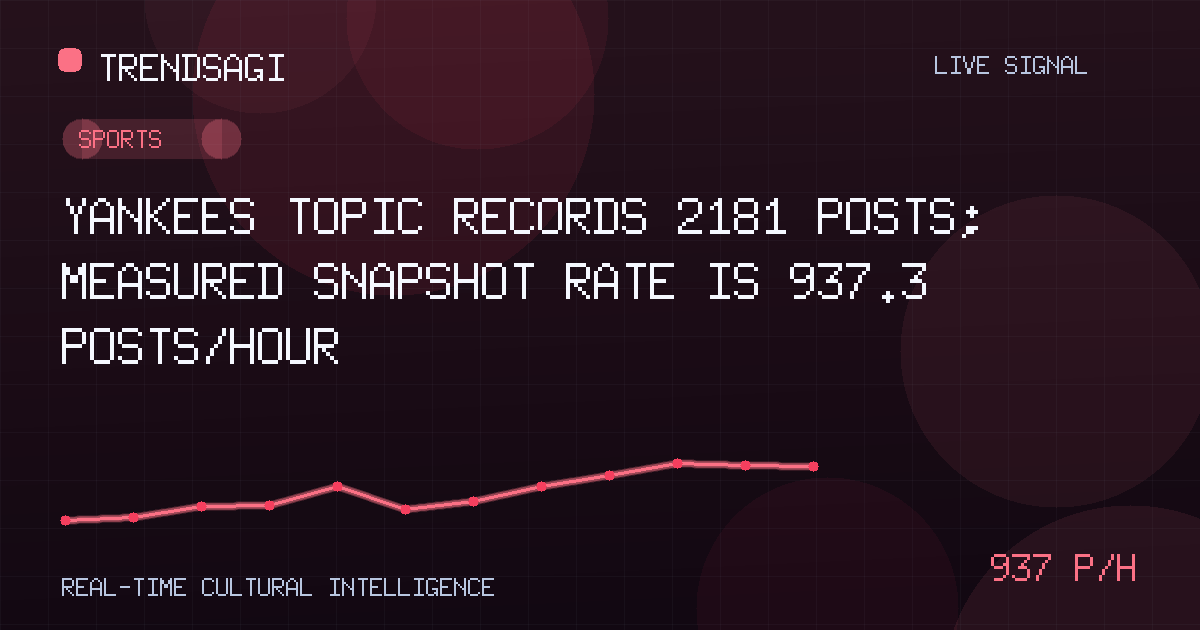
Yankees topic records 2181 posts; measured snapshot rate is 937.3 posts/hour
The Yankees signal shows 2181 posts and a measured snapshot rate of 937.3 posts/hour, while the catalyst and audience remain unverified.
Automated briefing. Generated from stored signal measurements and source-backed research; it is not manually reviewed. Read the methodology and limitations.
Metrics in this briefing are a snapshot associated with its publication date and may not reflect current conditions.
What changed
The stored Yankees signal contained 2181 posts in the latest snapshot, showing a concentrated cluster of activity associated with that observation. It does not identify a verified trigger. No specific game result, roster move, injury, announcement, or other public event can be tied to the increase from the available evidence, so the cause remains unclear.
Across an exact 3610-second window using 3 stored observations, the measured change rate was 937.3 posts/hour. This is a measured snapshot rate for that interval, not a live or current rate, forecast, reach, engagement count, or unique-person count.
| Observation time | Measured posts/hour | Snapshot volume |
|---|---|---|
| 2026-10-08T15:11:38Z | 937.3 posts/hour | 2181 posts |
Why this topic may be moving
The defensible conclusion is temporal: Yankees-related posting increased during the measured interval. The available classification is Sports, but the signal includes no item-level account of what was discussed. The label alone cannot show whether posts referred to a team, player, historical debate, criticism, or another use of the phrase.
Several mechanisms could create this pattern, but none is verified:
- A timed sports event, result, or announcement could produce a sharp response.
- A prominent post or repeated phrase could circulate without a formal news development.
- Quoted posts, reposts, duplicate text, or automated activity could raise the post count without a matching rise in independent participation.
- A difference in collection conditions or baseline could affect measured movement, although the available evidence does not show such a change.
These are hypotheses for verification, not explanations supported by the snapshot. Item text, timestamps, and source mix are needed to distinguish among them.
The signal is evidence of increased posting around the Yankees label, not evidence that a particular Yankees story occurred. That distinction should govern both headline language and downstream response.
What the signal establishes
The reliable findings are narrow but useful: the latest stored snapshot contained 2181 posts; the supplied series produced a measured snapshot rate of 937.3 posts/hour over the exact 3610-second interval; and the observation was classified as Sports.
It does not establish:
- the public event, if any, that triggered the discussion;
- how many distinct people participated;
- whether posts were original, reposted, quoted, duplicated, or automated;
- sentiment, geography, language, platform mix, or audience composition;
- whether the rate persisted after the observed window; or
- whether the movement was high relative to a normal Yankees or sports baseline.
Why it matters
For a sports editor, the increase is a verification lead, not a ready-made story. A responsible report would identify the item that generated attention and show when it appeared relative to the spike. Writing a causal explanation now would turn an unverified hypothesis into a factual premise.
For teams, community managers, and analysts, the signal may warrant a closer look at conversation volume and integrity. It should not be treated as evidence of public consensus, crisis severity, or market demand. A large number of posts can still come from a narrow set of accounts or repeated content.
For readers, the practical value is calibration: attention was concentrated in the measured interval, but neither importance nor cause follows from volume alone.
What to watch next
- Persistence: Compare the next stored snapshot and adjacent windows under the same method. A single-window cluster followed by lower activity would be consistent with a time-bound burst; continued elevation would support a sustained conversation. Neither outcome is established yet.
- Earliest traceable item: Inspect early posts and replies for the first repeated claim, link, quote, or phrase. Chronology can reveal whether conversation followed an item rather than preceded it.
- Catalyst verification: Check whether an official update, game report, or reputable news report aligns in both time and subject. Independent corroboration strengthens the link; a loose thematic match does not.
- Post composition: Separate original posts from reposts and quotes, deduplicate matching text, and inspect account concentration. This tests whether the snapshot reflects broad participation or repeated circulation.
- Baseline: Compare adjacent Yankees observations and similar Sports signals collected by the same process. Without that context, the absolute snapshot volume is not enough to label the movement exceptional.
Concrete signals to look for
- A verified catalyst that repeatedly appears in the earliest traceable posts.
- A sharp timing match between an external update and the start of the rise.
- Broad original-post participation rather than repeated circulation of a single item.
- Continued elevation in subsequent stored observations, if the conversation persists.
- A mismatch between high post volume and low distinct-account participation.
Methodology and limitations
The snapshot time is 2026-10-08T15:11:38Z. Its volume is 2181 posts. The rate is supplied as a measured change over an exact 3610-second window based on 3 stored observations; it is not calculated here from the snapshot count, and the two figures should not be substituted for each other.
With 3 observations, the series does not adequately show variance, persistence, or a normal baseline. No item sample, account-level data, collection coverage, geography, sentiment, or verified public catalyst is available in the signal used for this briefing. Accordingly, the trend conclusion is limited to increased posting during the measured interval. The next update should preserve the measurement method while adding source-mix, account, duplication, and external-catalyst checks.
Track This Topic for New Signals
Set alerts for future velocity or sentiment changes around this topic.
Explore Tracking PlansAbout TrendsAGI research
TrendsAGI's automated research pipeline publishes dated signal snapshots, methodology notes, and practical workflows for teams evaluating cultural momentum. Read how signals are scoped, scored, and limited in our research methodology.