901-second window · 2 observations · Measured Sep 25, 2026, 5:56 AM UTC · Provider: go_recent_snapshot_v2
Yahir snapshot measures 2694.4 posts/hour; underlying trigger remains unverified
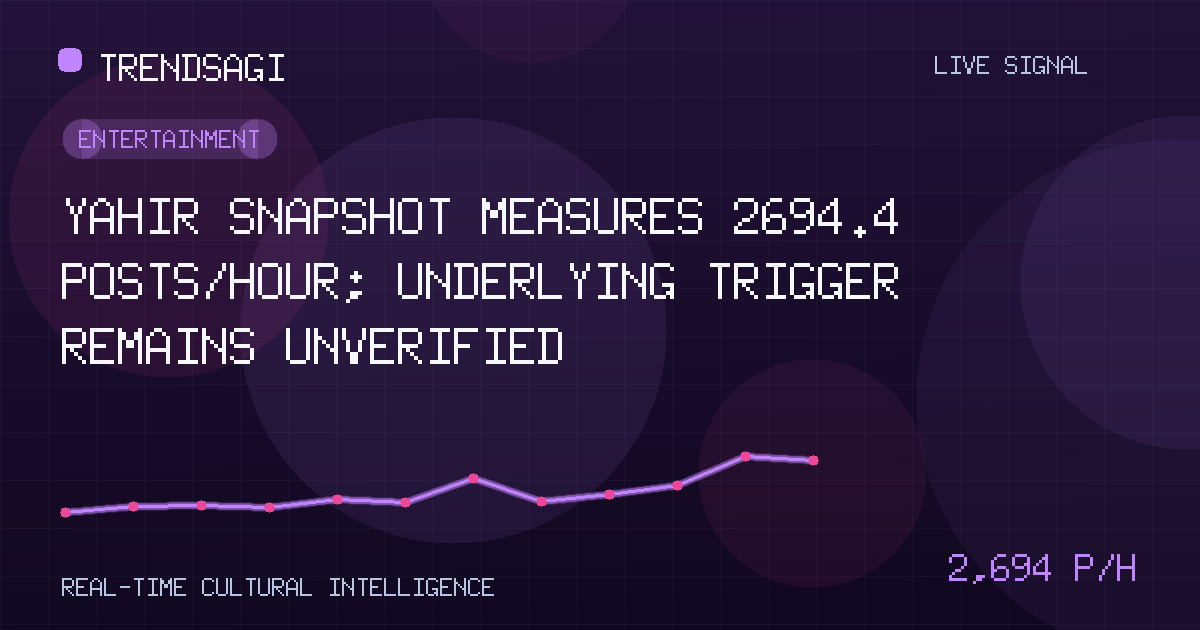
Yahir recorded 2694.4 posts/hour in a 901-second stored window, while the latest snapshot held 1531 posts; the public trigger is unverified.
Automated briefing. Generated from stored signal measurements and source-backed research; it is not manually reviewed. Read the methodology and limitations.
Metrics in this briefing are a snapshot associated with its publication date and may not reflect current conditions.
What changed
Yahir shows a sharp short-window rise in posting activity in the latest stored observation. The measured snapshot rate is 2694.4 posts/hour, but the available record does not establish what triggered the increase.
The measurement was taken at 2026-09-25T05:56:22Z from two stored observations across an exact 901-second window. The latest snapshot volume is 1531 posts. These are distinct measures: snapshot volume is a stored total, while the rate describes measured change within the observation window—not live/current activity, reach, engagement, or unique people.
| Observation time | Measured snapshot rate | Snapshot volume | Measurement basis |
|---|---|---|---|
| 2026-09-25T05:56:22Z | 2694.4 posts/hour | 1531 posts | Exact 901-second window; 2 stored observations |
The measured rate establishes the pace of the observed burst, not its cause. For Yahir, the key open questions are what the posts discuss, whether public context corroborates a trigger, and whether later observations show persistence.
What the signal establishes
The signal establishes a change in observed posting intensity for the tracked term. It does not establish the identity of the posters, the content of their posts, the sentiment behind them, or the geographical and language mix of the activity.
- Established: The topic was monitored in the Entertainment category, and the latest observation recorded 2694.4 posts/hour.
- Not established: A triggering event, an organic versus automated explanation, audience size, influence, or a continuing trajectory.
- Also unestablished: How activity compares with earlier days, the typical baseline for this query, and whether subsequent observations remain elevated.
Why this topic may be moving
No verified public context accompanies the stored signal, so the reason for the movement remains unclear. The snapshot does not identify a release, appearance, controversy, or other event that could explain the burst. Attributing the increase to any of these would go beyond the evidence.
A rapid change is still useful as a monitoring signal. It tells readers and editors that the observed stream of posts changed enough to merit investigation. It does not tell them what happened, whether the explanation is shared across public sources, or whether attention will last beyond the measured interval.
Why it matters
For editors and publishers, the immediate task is verification rather than narrative filling. A fast-moving topic creates pressure to explain its cause quickly, but an unverified explanation can give an uncertain signal more authority than it deserves.
For people following Yahir, the alert is useful only alongside context. Readers should be able to distinguish a documented event from speculation about why discussion increased, and should know that a high posting rate does not establish importance, accuracy, or public support.
For teams measuring conversation, the key distinction is between detection and diagnosis. This signal is strong enough to prompt a timely check of posts and public reports. It is not enough on its own to support claims about a news cycle, audience response, or sustained trend.
What to watch next
- Timing and corroboration: Check for a verifiable report or first-party announcement whose timestamp plausibly fits the 901-second window. Timing can support an explanation, but it does not by itself prove that the event caused the observed increase.
- Post content: Inspect a representative selection of posts for a repeated subject, quoted material, or direct references to an underlying occurrence. The aim is to identify what is being discussed, not to treat the topic name as a complete description.
- Source diversity: Determine whether the activity comes from many identifiable accounts or a small set repeatedly publishing related material. Snapshot volume does not distinguish these patterns, and neither pattern alone establishes legitimacy or organic interest.
- Persistence: Seek additional stored observations using the same query and collection method. A higher subsequent measured rate would support persistence within that continued method; a lower one would show that the latest burst was not sustained in the next check.
- Measurement consistency: Check that both stored observations used matching query wording, time-zone handling, volume definitions, and collection coverage. A change in any of those can affect comparability even when the underlying public conversation has not changed.
- Sentiment and reach: Separate the direction of discussion from its intensity, and intensity from audience impact. A burst may be positive, negative, mixed, or largely neutral; the supplied signal contains none of that evidence.
Methodology and limitations
The 2694.4 posts/hour figure is a measured snapshot rate from 2 stored observations over the exact 901-second window. It is not a live/current rate, a forecast, a total of unique people, or a measure of engagement. The separate 1531-post figure is the latest snapshot volume, not a rate or a unique-person count.
Two observations provide a narrow comparison, not a long-run baseline. They cannot show whether this rate is unusual for Yahir, whether a comparable burst happened previously, or how long activity will remain elevated. The empty stored description supplies no event context, and the category label alone cannot supply it.
There is also no supplied breakdown by geography, language, account type, source, sentiment, or originality. Those omissions limit any conclusion about who participated and why. Practical next steps are therefore to validate the collection method, inspect the actual posts, and seek a dated public explanation before assigning a cause.
The useful takeaway is narrow and clear: a measured burst was recorded for Yahir, but neither its cause nor its persistence has been established.
Track This Topic for New Signals
Set alerts for future velocity or sentiment changes around this topic.
Explore Tracking PlansAbout TrendsAGI research
TrendsAGI's automated research pipeline publishes dated signal snapshots, methodology notes, and practical workflows for teams evaluating cultural momentum. Read how signals are scoped, scored, and limited in our research methodology.