899-second window · 3 observations · Measured Oct 9, 2026, 7:22 AM UTC · Provider: go_recent_snapshot_v2
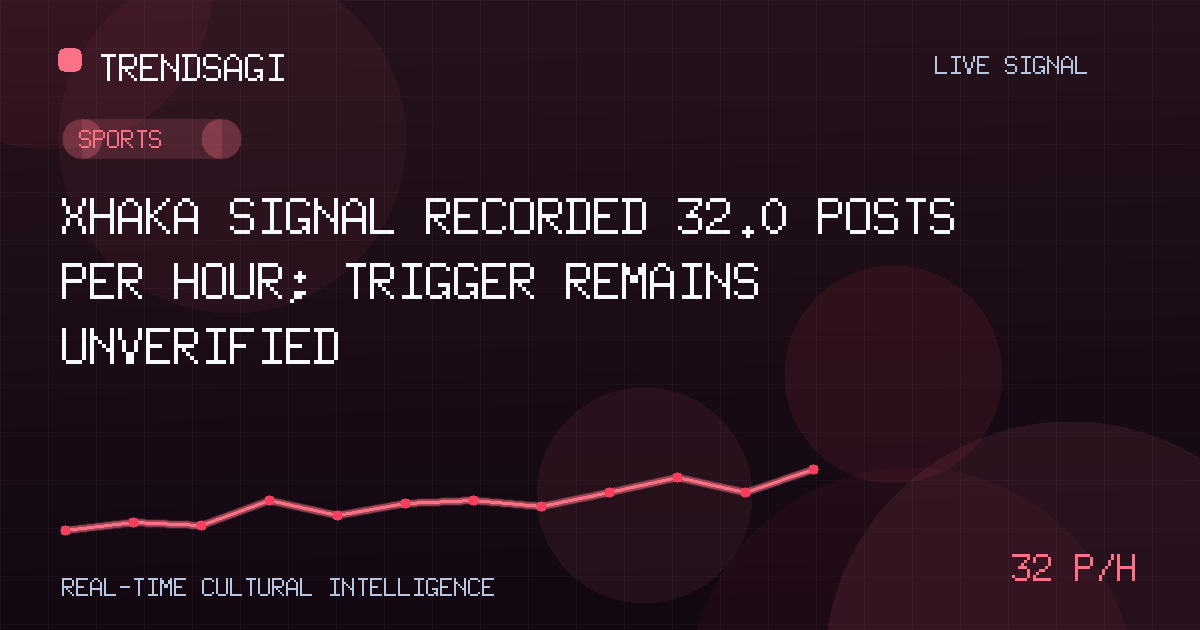
Xhaka signal recorded 32.0 posts per hour; trigger remains unverified
Xhaka registered a measured 32.0 posts per hour in the latest snapshot; the cause is unverified, with practical checks for readers and analysts.
Automated briefing. Generated from stored signal measurements and source-backed research; it is not manually reviewed. Read the methodology and limitations.
Metrics in this briefing are a snapshot associated with its publication date and may not reflect current conditions.
What changed
The “Xhaka” signal registered a measured snapshot rate of 32.0 posts per hour, indicating concentrated posting around the label during the stored window. The direct answer is bounded: the stored signal reports increased activity, but why it moved remains unclear because no verified public context connects the burst to a confirmed match, injury, transfer, announcement, or other event.
The latest snapshot, observed at 2026-10-09T07:22:09Z, contained 50 posts. The 32.0 posts-per-hour figure was measured over an exact 899-second window using 3 stored observations. It is a historical snapshot measure—not a live rate, forecast, reach estimate, engagement count, or unique-person count—and 50 is the sample volume, not another rate.
| Observation time | Measured posts/hour | Snapshot volume |
|---|---|---|
| 2026-10-09T07:22:09Z | 32.0 posts/hour | 50 posts |
Why this topic may be moving
The stored category is “Sports,” but neither it nor the bare label “Xhaka” identifies the person, team, club, competition, or event involved. An ambiguous label can combine several conversations, so entity resolution is the first verification task. A reader may assume a particular person from the name, but the stored record does not supply that identification.
Possible explanations must remain hypotheses until checked:
- A team, league, or other verified announcement could prompt immediate reactions.
- A match event, injury report, lineup decision, or result could reset discussion.
- A transfer, contract, milestone, or retrospective clip could resurface older posts.
- A viral secondary post could amplify conversation even without a new primary event.
None of these mechanisms is established by the stored record, and the blank signal description supplies no event-level explanation.
What the signal can and cannot establish
A measured posting rate locates attention around a label; it does not, by itself, explain the event or importance behind that attention.
The record establishes a time-bounded change signal: 3 observations across an exact 899-second window yielded a measured 32.0 posts/hour, with a latest snapshot volume of 50 at 2026-10-09T07:22:09Z. That is enough to prioritize “Xhaka” for checking and to compare with adjacent windows if available.
It does not establish identity, sentiment, organic participation, or causation. The sample may include replies, quotes, duplicates, automated posts, or unrelated meanings of the name; the available fields do not separate those possibilities. It also cannot show whether discussion was supportive, critical, neutral, or mixed.
Why it matters
For supporters and general readers, the key distinction is between noticing a conversation become more active and learning that something consequential happened. The posting rate can reflect a fresh development, repetition, a misleading label, or low-information chatter. The label alone should shape what to verify, not what to believe.
For sports editors, community managers, and analysts, this is a triage signal rather than a finding. Before making it part of a headline or report, check entity identity, primary-source timing, sample composition, and whether independent posts add information. The absence of a verified cause also means it should not be framed as breaking news.
What to watch next
- Entity match. Determine which person or organization “Xhaka” denotes in the sampled posts. If accounts refer to different subjects, split the signal rather than combining them.
- Primary event. Look for a dated announcement or event that precedes or exactly overlaps the observation window. The timing must be explicit; a later article cannot explain an earlier peak by itself.
- Post composition. Separate original posts from replies, reposts, quotes, media clips, and duplicates. This shows whether the rate reflects new reporting, coordinated amplification, or repeated reaction.
- Source quality. Identify the earliest credible posts and trace claims to relevant official or primary records. Label aggregation, fan accounts, and unattributed screenshots as unconfirmed unless corroborated.
- Persistence. Compare later stored snapshots using the same collection method. Check whether activity remains elevated, fades quickly, or shifts to a clearly identified event; do not extend the measured snapshot rate beyond its window.
- Conversation direction. Sample the posts for sentiment, geography, language, and concrete claims. Those dimensions are not present in the stored signal and should not be inferred from its rate.
A concrete confirmation would be a verified event page plus timestamped posts linking the label to that event. Without that link, the most accurate description remains “activity increased around Xhaka; cause unverified.”
Methodology and limitations
This briefing uses the supplied snapshot observed at 2026-10-09T07:22:09Z, latest volume of 50 posts, stored category of Sports, and measured rate of 32.0 posts/hour over an exact 899-second window based on 3 observations. Values are reported as stored and are not recalculated, annualized, or extrapolated.
The signal description is blank. No verified public publisher or official page was available to establish why the label was moving, so no external event is attributed. That is not proof that no event occurred; it means the cause is unsupported in the evidence used here.
Limitations include the 50-post sample, unknown collection and deduplication rules, unknown geography and language, and no account-level verification. Posts are not people, volume is not reach, and a measured rate is not a forecast. The result is useful for deciding what to investigate next, not for asserting why it happened.
Track This Topic for New Signals
Set alerts for future velocity or sentiment changes around this topic.
Explore Tracking PlansAbout TrendsAGI research
TrendsAGI's automated research pipeline publishes dated signal snapshots, methodology notes, and practical workflows for teams evaluating cultural momentum. Read how signals are scoped, scored, and limited in our research methodology.