898-second window · 3 observations · Measured Sep 17, 2026, 4:25 PM UTC · Provider: go_recent_snapshot_v2
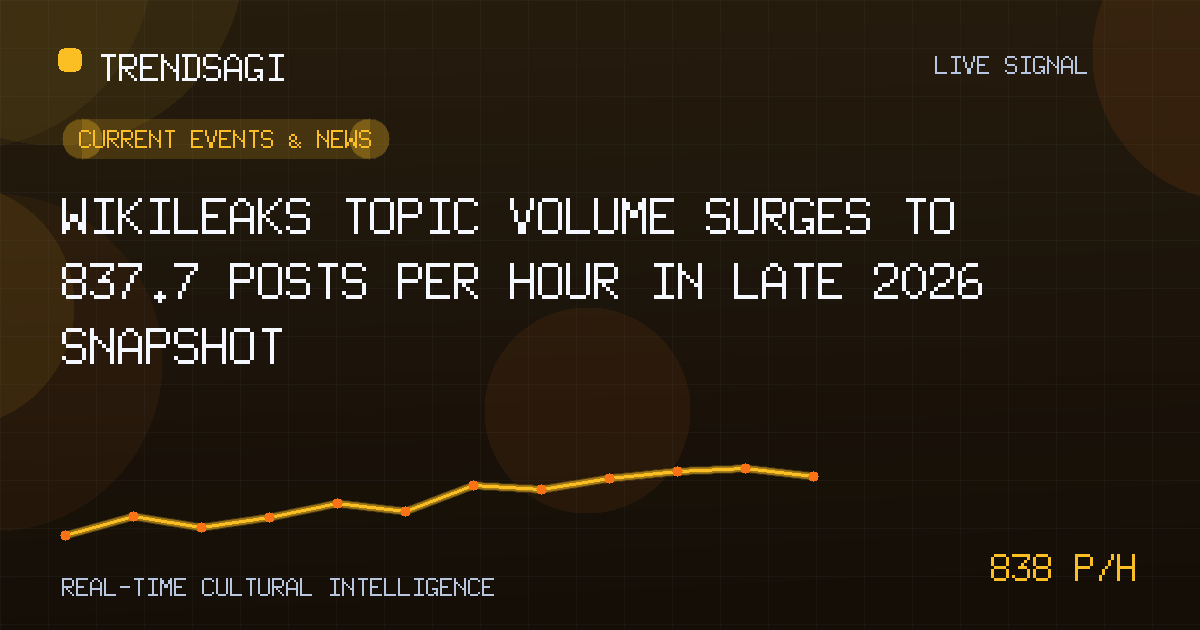
WikiLeaks Topic Volume Surges to 837.7 Posts Per Hour in Late 2026 Snapshot
WikiLeaks activity reached 837.7 posts/hour on September 17, 2026. This briefing explores the statistical surge, historical context, and potential drivers.
Automated briefing. Generated from stored signal measurements and source-backed research; it is not manually reviewed. Read the methodology and limitations.
Metrics in this briefing are a snapshot associated with its publication date and may not reflect current conditions.
What changed
On September 17, 2026, a significant increase in digital activity surrounding the whistleblowing organization WikiLeaks was detected. A measured snapshot rate of 837.7 posts per hour was recorded, indicating a sharp rise in public discussion or information sharing regarding the entity. This volume surge suggests a renewed focus on the organization’s archives or its current standing within the global information ecosystem.
The activity was captured at 16:25:17Z, based on three stored observations within an exact 898-second window. The latest snapshot volume reached 400 posts, marking a distinct departure from baseline levels for the topic. While the rate indicates heightened interest, it remains a snapshot of a specific moment rather than a cumulative total of unique participants or a long-term forecast of engagement.
| Observation Time | Measured Snapshot Rate | Snapshot Volume |
|---|---|---|
| 2026-09-17 16:25:17Z | 837.7 posts/hour | 400 posts |
Why this topic may be moving
The specific catalyst for this surge on September 17, 2026, remains unverified across major news publishers. As of this observation, primary news organizations such as Reuters, the Associated Press, and the BBC have not released a breaking report that would explain a sudden spike in WikiLeaks-related discourse. When a topic of this nature moves without a singular, clarifying news event, it is often driven by anniversary observances, social media coordination, or the surfacing of niche reports that have not yet reached mainstream consensus.
One contextual factor is the date itself. September 17 is observed as Constitution Day in the United States. Historically, transparency advocates and supporters of the First Amendment have used this day to highlight the legal and ethical tensions between government secrecy and the public's right to know. According to the Freedom of the Press Foundation, the legacy of WikiLeaks remains a central pillar in debates regarding the protection of journalistic sources and the limits of the Espionage Act.
Furthermore, the organization is approaching its 20th anniversary, having been founded in October 2006. In the weeks leading up to such milestones, it is common for supporters and researchers to revisit historical leaks—such as the 2010 Afghan War Diary and Iraq War Logs—which may account for localized spikes in post volume. In June 2024, Julian Assange reached a plea deal with the U.S. Department of Justice, as reported by The Guardian, which led to his return to Australia. Discussions in late 2026 may be reflecting on the long-term impact of that legal resolution or speculating on the organization's future role under new geopolitical conditions.
“The challenge for whistleblowing platforms in the current decade is not just the acquisition of data, but the verification and secure dissemination of that data in an increasingly fragmented digital landscape where the distinction between transparency and interference is constantly debated.”
Why it matters
The movement of the WikiLeaks signal matters to several distinct groups, including legal professionals, security analysts, and journalists. For the legal community, any surge in WikiLeaks activity often signals a shift in the public or legal discourse surrounding the prosecution of whistleblowers and the boundaries of investigative journalism. The 2024 resolution of Julian Assange's case was widely seen as a landmark moment, but the underlying questions regarding the extraterritorial application of national security laws remain unresolved.
For national security and intelligence analysts, a spike in posts/hour can be a leading indicator of a potential document release or the distribution of "insurance" files—encrypted datasets that the organization has historically distributed as a safeguard. Even if no new leak is confirmed, the mobilization of the community that follows WikiLeaks can precede broader shifts in political sentiment regarding government transparency.
Journalists and editors should care because WikiLeaks remains a touchstone for the ethics of information handling. The measured snapshot rate of 837.7 posts per hour suggests that despite the organization's reduced output compared to its 2010-2016 peak, it maintains a highly responsive and active audience capable of generating significant digital noise in a short period.
What to watch next
To determine if this signal is the precursor to a major event or merely a temporary peak, several specific watch signals are recommended:
- Verified Communication Channels: Monitor the official WikiLeaks X (formerly Twitter) account and their Telegram channel for any PGP-signed messages. Historically, the organization uses these tools to authenticate its rare public statements.
- Blockchain Activity: Check public ledgers for activity in wallets associated with the Wau Holland Foundation or other entities that fund WikiLeaks. Financial movement often precedes technical infrastructure changes or new data hostings.
- Court Dockets: Monitor the U.S. District Court for the Eastern District of Virginia for any new filings related to the Espionage Act, which could signify fresh legal actions involving former associates or sources.
- Mainstream Media Lag: Watch for a delay between this social signal and reporting from traditional outlets. If the volume continues to rise without mainstream coverage, it may indicate a grassroots or non-English speaking driver for the interest.
Methodology and limitations
This report is based on a measured snapshot rate of 837.7 posts per hour, calculated over a window of 898 seconds using three stored observations. It is a specific measurement of velocity at 2026-09-17T16:25:17Z and does not represent a live, continuous stream or a total reach figure. This data point is an indicator of activity density within a narrow timeframe.
The signal cannot establish the sentiment of the posts (positive or negative), the presence of automated accounts (bots), or the geographic origin of the users. Furthermore, because no direct cause was verified through published reports at the time of this writing, the driver for this movement should be treated as speculative until confirmed by a reputable news agency or an official statement from the organization itself. Snapshot volume is a measure of quantity at the time of the observation and should not be confused with the hourly rate.
Track This Topic for New Signals
Set alerts for future velocity or sentiment changes around this topic.
Explore Tracking PlansAbout TrendsAGI research
TrendsAGI's automated research pipeline publishes dated signal snapshots, methodology notes, and practical workflows for teams evaluating cultural momentum. Read how signals are scoped, scored, and limited in our research methodology.