2703-second window · 3 observations · Measured Oct 30, 2026, 10:00 AM UTC · Provider: go_recent_snapshot_v2
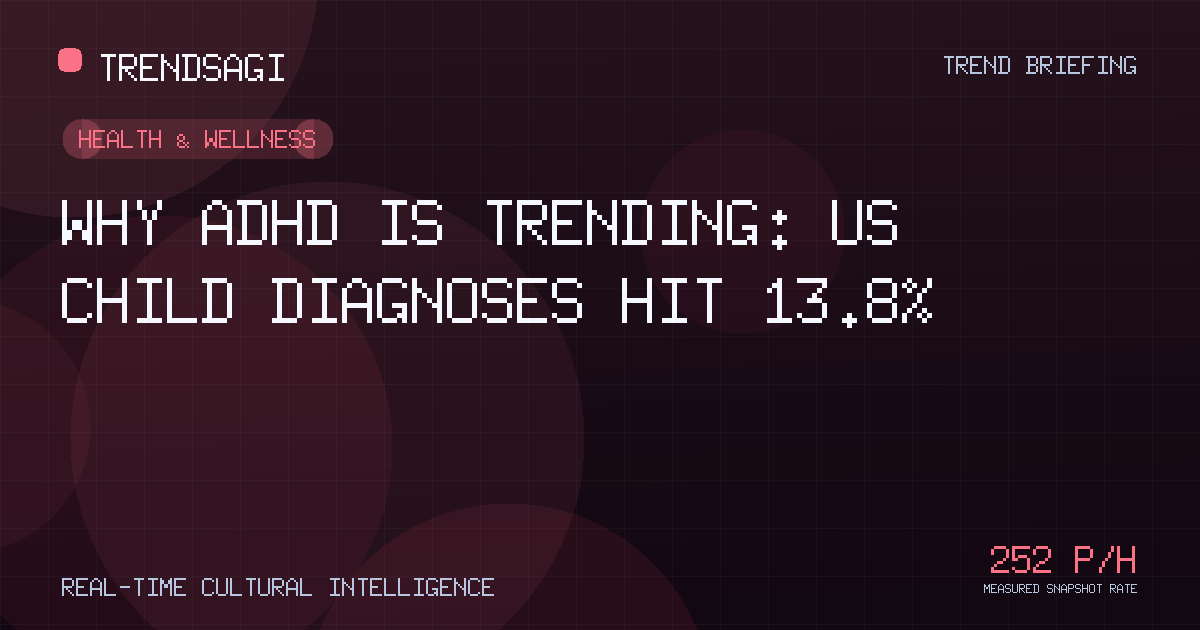
Why ADHD Is Trending: US Child Diagnoses Hit 13.8%
ADHD is trending as CDC data show US child diagnoses at 13.8%, up from 9.9% in 2019, plus mortality and treatment news. Here's what's verified.
Automated briefing. Generated from stored signal measurements and source-backed research; it is not manually reviewed. Read the methodology and limitations.
Metrics in this briefing are a snapshot associated with its publication date and may not reflect current conditions.
What changed
ADHD is trending because several verified news threads are converging at once: new CDC survey figures show US childhood ADHD diagnoses rose from 9.9% in 2019 to 13.8% in 2025 (Contemporary Pediatrics, citing CDC data), ADHD Awareness Month 2026 has brought a round of treatment developments (Xtalks), and a study linking ADHD to higher all-cause mortality risk is circulating (Nursing Times). Conversation about the topic is also measurably elevated: TrendsAGI recorded 251.7 posts per hour across a 2,703-second window ending 2026-10-30T10:00:12Z, with a latest snapshot volume of 455 posts. That rate is a measured snapshot at that moment, not a live count or a forecast.
What the evidence does not show is a single verified trigger for the surge. No source in the current coverage dates a specific event to 2026-10-30, and none establishes whether the diagnosis, mortality or awareness-month stories are driving the social conversation rather than merely coexisting with it. The honest answer to "why is ADHD trending" is: several real, checkable stories landed close together, and the online conversation around them is running hot.
Signal readings
| Observation time | Measured posts/hour | Snapshot volume |
|---|---|---|
| 2026-10-30T10:00:12Z | 251.7 | 455 posts |
The rate was calculated from three stored observations over an exact 2703-second window. It describes posting activity captured in that window only. It is not reach, engagement, unique people, or a prediction of where the conversation goes next.
Why this topic may be moving
The search-intent brief points to three clusters rather than one cause.
- Diagnosis-rate news. The CDC-sourced jump from 9.9% to 13.8% is the most concrete number in circulation, and it is the kind of figure that travels because it touches families directly. Contemporary Pediatrics is the publisher reporting it, drawing on CDC survey data on ADHD in children.
- Mortality-risk coverage. Nursing Times reports a link between ADHD and higher mortality risk from all causes. Headline-level claims like this tend to outrun the underlying detail, and the current results do not include effect sizes, confounders or methodology.
- Awareness-month treatment news. Xtalks rounds up five ADHD care developments tied to ADHD Awareness Month 2026. Roundups invite shares; they also tend to list options without helping a patient compare them.
The useful distinction in this cycle is between what is measured and what is merely loud: the diagnosis percentage and the conversation rate are both observed numbers, but only one of them tells you anything about how many people actually have ADHD.
Why it matters
Searchers are asking a question that splits in two: is ADHD genuinely more common, and is the internet creating or imitating it? The verified material supports a careful reading rather than a verdict. A rise in reported diagnoses can reflect real changes in prevalence, changes in how and when clinicians diagnose, broader awareness among parents and adults, or some mix of all three. The supplied brief does not quantify that split, and no ranking page it analyzed does either — which is precisely the gap worth naming.
The mortality story matters for a different reason: it changes the stakes of the conversation from identity and productivity to health outcomes. But a headline claim without an effect size is not something a reader should act on directly. What a reader can do is treat it as a prompt to ask a clinician about overall health monitoring, not as a personal risk estimate.
The treatment coverage matters most to people deciding what to raise in an appointment. A list of 2026 developments is only useful alongside questions: what is this for, who is it appropriate for, what is the evidence base, and what would change my clinician's recommendation?
What to watch next
- Whether the diagnosis figure gets a denominator. Watch for reporting that separates measurement changes from real prevalence shifts in the 9.9% to 13.8% move.
- Real detail on the mortality study. Effect sizes, confounder handling, and specifically what the medication signal showed. Until that appears, treat the claim as reported but unexplained.
- Adult-versus-child reconciliation. Child-focused prevalence data and adult-focused treatment panels rarely meet in the same article; a piece that ties them together would be genuinely new.
- Conversation composition. The one thing this measurement can add is proportion: whether posting activity clusters around the diagnosis news, the mortality study, the treatment roundup, or general ADHD discourse. That split is not yet established.
- Whether the rate holds. A single measured window says nothing about persistence. Repeated observations over coming days would show whether this is a spike or a plateau.
Frequently asked questions
How many US children have been diagnosed with ADHD now, and how fast is that rising?
CDC survey data reported by Contemporary Pediatrics puts US childhood ADHD diagnoses at 13.8% in 2025, up from 9.9% in 2019. That is a rise of roughly four percentage points in reported diagnoses over six years.
Is the rise in diagnoses real ADHD or better awareness and overdiagnosis?
The verified coverage does not settle this. A jump in reported diagnoses can reflect genuine changes in prevalence, shifts in diagnostic practice, greater awareness, or a combination, and the sources cited here do not quantify the split.
Can social media and constant multitasking cause ADHD, or only mimic the symptoms?
Nothing in the verified material establishes that social media causes ADHD. The question of whether online habits mimic ADHD symptoms or simply raise awareness and self-referral is discussed in coverage but not resolved with data.
Does ADHD raise mortality risk, and does medication reduce it?
Nursing Times reports that ADHD is linked to higher mortality risk from all causes. The specifics — effect size, confounders and what the medication analysis showed — are not described in the available results, so the claim should be read as a reported association, not a personal risk figure.
What new ADHD treatments became available in 2026?
Xtalks published a roundup of five developments in ADHD care tied to ADHD Awareness Month 2026. The verified brief does not detail each one, so it is best read as a signpost for questions to bring to a clinician rather than a comparison of options.
How is adult ADHD diagnosed and treated differently from childhood ADHD?
The available sources split along age lines — child prevalence data from CDC-based reporting and adult-focused treatment discussion — without reconciling the two. A careful answer to how adult diagnosis and treatment differ requires detail this brief does not verify.
Methodology and limitations
The activity figure comes from three stored observations spanning exactly 2,703 seconds and ending at 2026-10-30T10:00:12Z, yielding a measured snapshot rate of 251.7 posts per hour against a latest volume of 455 posts. It captures posting activity in that window only; it is not a live rate, a forecast, a reach estimate, or a count of unique people.
This briefing is limited in four ways. First, the cause of the activity is unconfirmed — no verified source dates a specific triggering event to the observation time. Second, the social volume cannot be attributed to any one of the news threads. Third, the mortality finding arrives without methodology or effect size. Fourth, no traffic or search-volume data for related queries is available, so search demand is inferred from the questions being asked rather than measured.
What the signal can establish is that conversation about ADHD was running at a measurable rate at a specific moment while several verifiable stories were in circulation. Who should care: clinicians and patients navigating diagnosis conversations, parents weighing the new prevalence figures, and anyone reading mortality headlines without context. The practical next check is simple — follow the diagnosis-percentage reporting for denominator detail, and hold mortality claims until effect sizes appear.
Sources
- CDC: ADHD diagnoses in US children rose to 13.8% from 2019 to 2025 (Contemporary Pediatrics) — contemporarypediatrics.com
- ADHD linked to higher mortality risk from all causes (Nursing Times) — nursingtimes.net
- ADHD in Children (CDC) — cdc.gov
- ADHD Awareness Month 2026: 5 Developments in ADHD Care Worth Knowing (Xtalks) — xtalks.com
Track This Topic for New Signals
Set alerts for future velocity or sentiment changes around this topic.
Explore Tracking PlansAbout TrendsAGI research
TrendsAGI's automated research pipeline publishes dated signal snapshots, methodology notes, and practical workflows for teams evaluating cultural momentum. Read how signals are scoped, scored, and limited in our research methodology.