2699-second window · 3 observations · Measured Oct 3, 2026, 10:06 PM UTC · Provider: go_recent_snapshot_v2
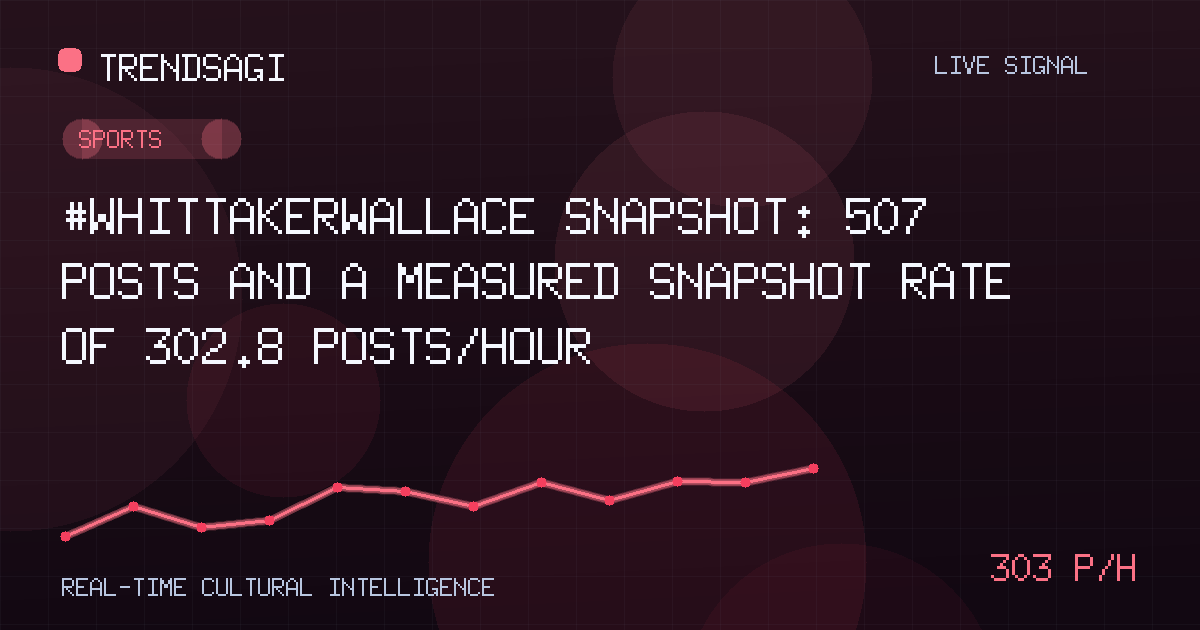
#WhittakerWallace snapshot: 507 posts and a measured snapshot rate of 302.8 posts/hour
The #WhittakerWallace snapshot contained 507 posts with a measured snapshot rate of 302.8 posts/hour; the cause is unverified.
Automated briefing. Generated from stored signal measurements and source-backed research; it is not manually reviewed. Read the methodology and limitations.
Metrics in this briefing are a snapshot associated with its publication date and may not reflect current conditions.
What changed
The latest stored #WhittakerWallace snapshot contained 507 posts, and the associated series measured 302.8 posts/hour. The direct conclusion is limited to a historical posting spike: the record establishes rapid accumulation within the sampled window, but not a verified public trigger. It should not yet be presented as a confirmed sports event.
The rate is a measured snapshot rate over an exact 2699-second window using 3 stored observations associated with 2026-10-03T22:06:25Z. It is not a live or current rate, a forecast, a reach estimate, or an engagement measure. The 507 figure is the latest snapshot volume, not another rate.
| Observation time | Measured snapshot rate | Snapshot volume |
|---|---|---|
| 2026-10-03T22:06-03-03T22:06:25Z | 302.8 posts/hour | 507 posts |
Why this topic may be moving
The measurement record contains no narrative explanation for the spike. Its broad Sports category supplies context, but it does not identify a player, team, competition, result, announcement, or controversy. The hashtag alone does not disambiguate the subject. Attributing the rise to a specific story without a timestamp and verified connection would therefore be speculation.
Possible explanations are hypotheses, not findings:
- Event response: A time-bound sports event would need a traceable timestamp before the surge and public reporting that explicitly connects participants to #WhittakerWallace.
- Viral content: A post, clip, quotation, or screenshot would need to be located and its circulation compared with the burst; the format alone is not evidence.
- Recirculation: Older material could be reposted under the hashtag, so new-looking volume might not represent a newly developing story.
- Amplification: Repeated wording, tightly clustered posts, or overlapping accounts could indicate organized distribution. Repetition alone would not establish coordination.
Bottom line: The observation establishes a rapid historical burst of tracked posts. It does not establish what happened, who drove the activity, or whether public interest persisted.
Why it matters
Trend velocity can be useful as a triage signal, especially for sports desks, but velocity does not validate a claim. Its practical value depends on finding a real trigger and determining who is participating.
- News editors and fact-checkers: Use the spike to prioritize verification, not as proof that a named event, claim, or person is responsible.
- Athletes, teams, sponsors, and reputation teams: If the identity is confirmed, monitor whether the discussion contains factual errors, privacy concerns, or harassment before responding.
- Trend analysts and platform teams: Compare persistence, account composition, and content types before calling the signal broad public interest or coordinated activity.
What to watch next
The priority is to replace the unresolved explanation with a verifiable event chain:
- Search for discovery: Run targeted Google searches for the exact hashtag, the phrase without the hashtag, and plausible spelling variants around the observation time. Treat snippets as discovery leads; confirm the subject and exact timing on the originating public page before using any external fact.
- Resolve the identity: Determine which Whittaker Wallace or sports context is actually associated with the posts. Check spelling, aliases, and the relevance of the stored category before attributing activity to a person or event.
- Build a timestamp chain: Locate the earliest substantive post and trace what it cited, replied to, or quoted. Compare that sequence with the observation time; later summaries do not prove what started the surge.
- Collect comparable snapshots: Use the same hashtag, collection method, counting rules, and measurement window. Record whether subsequent rates remain near, rise above, or fall below 302.8 posts/hour, while keeping 507 posts as a separate snapshot benchmark.
- Audit composition: Count unique accounts, original posts, replies, reposts, duplicates, and linked material where permitted. Determine whether volume comes from new participants or repeated circulation, and do not infer automated activity from the rate alone.
Concrete signals that would change the assessment
- Trigger validation: A verified public event or post timestamped before the burst would provide a plausible explanation, but not automatic causation.
- Persistence: Comparable subsequent snapshots near, above, or below 302.8 posts/hour would show whether the measured burst held, strengthened, or faded.
- Breadth: Growth in unique accounts and original substantive posts would support wider participation; repost-only growth would point more toward recirculation.
- Response: An official clarification, documented correction, or independent reporting could materially change the story, but none is established in the current record.
Methodology and limitations
The 302.8 posts/hour value is the measured snapshot rate for an exact 2699-second window using 3 stored observations associated with 2026-10-03T22:06:25Z. The 507 value is snapshot volume at the latest stored observation. Neither figure establishes reach, engagement, or unique-person counts.
Only 3 observations are available to characterize the shape and durability of the spike. The record also does not show whether posts were original, replies, reposts, duplicates, automated, or unique to identifiable accounts. The broad category and hashtag text cannot resolve those issues. Because no external cause could be verified, this briefing makes no claim about what happened beyond the measured posting activity.
Subsequent analysis should preserve the same collection and counting method before comparing periods. A higher or lower measured rate would be a relative signal, not proof of why activity changed or whether genuine public interest grew.
Track This Topic for New Signals
Set alerts for future velocity or sentiment changes around this topic.
Explore Tracking PlansAbout TrendsAGI research
TrendsAGI's automated research pipeline publishes dated signal snapshots, methodology notes, and practical workflows for teams evaluating cultural momentum. Read how signals are scoped, scored, and limited in our research methodology.


