906-second window · 2 observations · Measured Oct 2, 2026, 3:41 AM UTC · Provider: go_recent_snapshot_v2
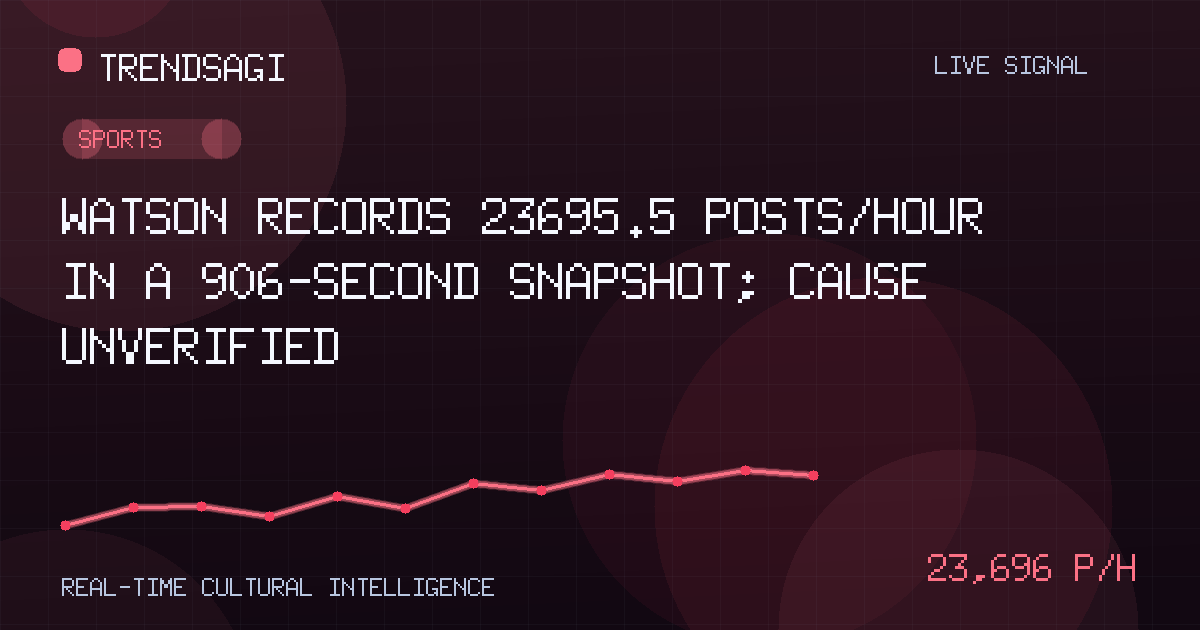
Watson records 23695.5 posts/hour in a 906-second snapshot; cause unverified
Watson shows 23695.5 posts/hour over a 906-second snapshot with 6545 posts; the cause and correct identity still need verification.
Automated briefing. Generated from stored signal measurements and source-backed research; it is not manually reviewed. Read the methodology and limitations.
Metrics in this briefing are a snapshot associated with its publication date and may not reflect current conditions.
What changed
The Watson signal records a short-term posting burst in the supplied Sports category. At 2026-10-02T03:41:09Z, the latest snapshot contained 6545 posts. Across an exact 906-second window, the measured change rate was 23695.5 posts/hour based on 2 stored observations. The actionable conclusion is limited: Watson merits immediate checking, but the available evidence does not establish the catalyst behind the activity.
The 23695.5 posts/hour figure is a measured snapshot rate, not a live count, forecast, reach figure, engagement total, or estimate of unique people. No verified public event can yet be tied confidently to the increase. In practical terms, this is a fast-moving monitoring alert with an unresolved identity and cause, not a confirmed story.
| Observation time | Measured snapshot rate | Latest snapshot volume |
|---|---|---|
| 2026-10-02T03:41:09Z | 23695.5 posts/hour | 6545 posts |
The rate was measured over the exact 906-second window from 2 stored observations.
Why this topic may be moving
A credible explanation must answer three separate questions: what Watson refers to, what changed around the observed time, and whether the posting activity is organic. The stored signal currently supports only the speed of the change.
- Identity remains unresolved. The label Watson does not by itself reveal whether posts concern a particular person, organization, team, event, or another subject sharing the same name. Without representative post text, account names, or matching terms, the posts cannot yet be assigned to one entity reliably.
- The category is not a cause. Sports indicates how the signal was classified, but it does not prove that a match, athlete, competition, announcement, or sporting controversy triggered the activity. A category label describes placement; it does not explain timing.
- Several mechanisms remain possible. Rapid activity could reflect genuine event reaction, breaking news, criticism, repeated references to an earlier post, quotation or repost behavior, spam, or a collection change. These are hypotheses rather than established findings.
- No external catalyst has been verified. No specific public report, official announcement, result, incident, or scheduled event has been confirmed as a close match for the spike. The responsible conclusion is therefore that the cause is unclear.
The measured velocity establishes urgency, not meaning: posts accumulated rapidly during the window, but the signal does not show why, whether the participants are distinct people, or whether the response is favorable.
Identity resolution is especially important because aggregation around an ambiguous label can combine unrelated conversations. A sample of recent posts should be checked for shared entities, consistent terminology, source links, and event-specific references before the activity is described as one coherent trend.
Why it matters
For a sports desk, the signal may indicate a developing story worth checking immediately. The high measured rate makes it suitable for rapid triage, but publication language should remain conditional until the referent and catalyst are confirmed. A volume spike alone cannot establish that a sporting event is responsible.
Audience and communications teams should also avoid treating volume as sentiment. Posts can express excitement, criticism, confusion, opposition, or neutral repetition. A large increase may create monitoring needs even if the underlying conversation is false, automated, or unrelated.
Analysts and platform teams have a different need: they should determine whether the signal reflects broad participation or repeated content from a limited source pool. Snapshot volume counts posts, while the measured rate describes change during a specific interval. Neither measure supplies unique-person counts, impressions, or evidence of influence.
Readers should not interpret the burst as proof that Watson has suddenly become important, popular, or controversial in a broader population. It establishes that the monitored signal changed quickly at the recorded time. Significance requires a verified subject, attributable cause, sustained follow-up, and evidence that people are discussing distinct matters rather than duplicating the same content.
What to watch next
The next checks should be concrete and ordered so that identity and cause are resolved before interpretation:
- Identify the referent. Review a representative sample of recent posts for the specific Watson being discussed. Look for surnames, account handles, teams, locations, event terms, quotations, and source links. Confirm whether the sample points to one subject or several unrelated ones.
- Check the onset against public events. Search for verified reporting or official information connected to the exact subject and relevant time. A useful catalyst should have a clear, independently verifiable connection to the activity rather than merely share the keyword.
- Separate original posts from repetition. Inspect whether the sample contains distinct reporting and reactions or mostly quotations, reposts, duplicated wording, and links. This distinction affects whether the signal looks like broad conversation or concentrated amplification.
- Test persistence. Take additional snapshots using the same collection scope and compare them across subsequent, consistently defined windows. Confidence should increase if the rate remains elevated and the same identified subject continues to dominate the sample.
- Track volume and rate separately. Snapshot volume shows how many posts are present at an observation time; the measured posts/hour figure describes accumulation during the stated window. Neither should be substituted for the other.
- Examine the character of the discussion. Classify sampled posts as original information, reaction, criticism, repetition, or suspected automation. Then assess whether prominent factual claims are supported. High activity can increase attention without increasing reliability.
Concrete confirmation would require several signals to align: one clearly identified Watson, a verified event or announcement near the onset, continued activity in later windows, and a sample dominated by substantively related posts. If those checks fail, the item should remain an unattributed monitoring signal rather than a sports-news conclusion.
Methodology and limitations
The latest stored observation was recorded at 2026-10-02T03:41:09Z and contained 6545 posts. The measured change rate was 23695.5 posts/hour over an exact 906-second window using 2 stored observations. It is a retrospective snapshot comparison, not a current or live rate and not a projection of future activity.
Only 2 observations are available, so the signal cannot establish a durable trend, percentage growth, acceleration relative to normal activity, or the likely duration of the burst. The record also provides no historical baseline, query wording, geographic scope, language scope, sentiment distribution, or unique-account count. Posts may include duplicates, automated behavior, and multiple meanings of Watson.
Finally, the Sports classification is a stored category rather than independent proof of a sporting cause. No external causal claim is included because no specific public catalyst could be verified. Readers should use the measurement to prioritize checking, not to infer reach, popularity, sentiment, or newsworthiness on its own.
Track This Topic for New Signals
Set alerts for future velocity or sentiment changes around this topic.
Explore Tracking PlansAbout TrendsAGI research
TrendsAGI's automated research pipeline publishes dated signal snapshots, methodology notes, and practical workflows for teams evaluating cultural momentum. Read how signals are scoped, scored, and limited in our research methodology.