901-second window · 3 observations · Measured Oct 9, 2026, 9:21 PM UTC · Provider: go_recent_snapshot_v2
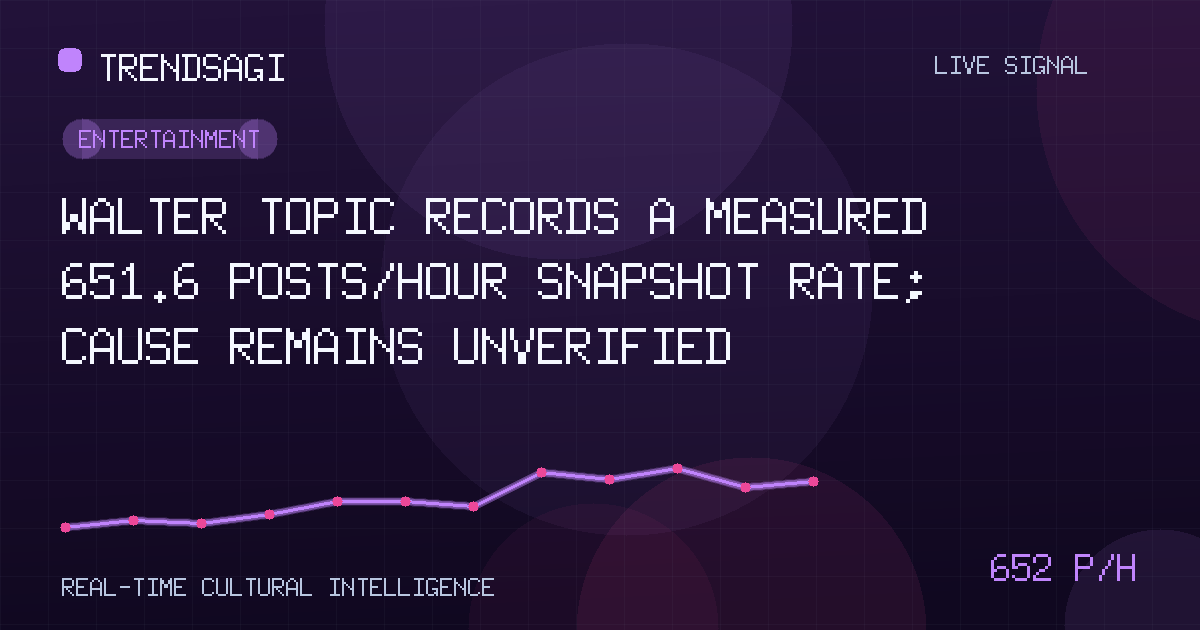
Walter topic records a measured 651.6 posts/hour snapshot rate; cause remains unverified
The Walter topic shows a measured 651.6 posts/hour snapshot rate; here is what is known, what is unclear, and what to verify next.
Automated briefing. Generated from stored signal measurements and source-backed research; it is not manually reviewed. Read the methodology and limitations.
Metrics in this briefing are a snapshot associated with its publication date and may not reflect current conditions.
What changed
An Entertainment topic labeled “Walter” shows a measured snapshot rate of 651.6 posts per hour, but the stored record does not establish a verified catalyst. The defensible conclusion is narrower than a conventional trend call: activity around an ambiguous label was moving quickly during the observation window, while the relevant person, work, event, and reason for interest remain unresolved.
The rate was measured at 2026-10-09T21:21:43Z across an exact 901-second window using three stored observations. The latest snapshot contained 325 posts. Posts per hour is a measured snapshot rate, not a live or current rate, a forecast, reach, engagement, or a count of unique people; snapshot volume is a separate count and should not be described as a rate.
| Metric | Stored observation |
|---|---|
| Observation time | 2026-10-09T21:21:43Z |
| Measured snapshot rate | 651.6 posts/hour |
| Latest snapshot volume | 325 posts |
| Measurement basis | Exact 901-second window; 3 stored observations |
Why this topic may be moving
The stored record classifies “Walter” as Entertainment, but it supplies no description, full name, work title, account, location, or initiating post. That makes entity resolution the first reporting problem: “Walter” could denote multiple people or fictional characters, and the label alone cannot connect the burst to any one of them.
Possible drivers include a release, appearance, episode, controversy, viral clip, or renewed attention to older material. A less substantive explanation is also possible: name collision, reposting, automated activity, or a monitoring artifact. These are hypotheses, not verified causes. The observed pace cannot distinguish among them.
No verified, publisher-attributed public context was available in the stored record to identify the trigger, so this briefing does not assign a cause.
The strongest established fact is the pace of observed posting; the most consequential missing fact is what “Walter” denotes.
Why it matters
The signal is best treated as an investigation alert rather than a ready-to-publish trend. Its immediate value is telling monitoring teams that a short observation window contained unusually fast activity. Before that alert becomes coverage, editors need to determine whether the posts concern the same subject and whether a real-world event explains their timing.
- News and entertainment editors can use it to prioritize verification.
- Social, audience, and communications teams can check whether the label is relevant to a person or property they monitor.
- Researchers and analysts can examine whether the activity reflects distinct discussion, repeated material, or patterned posting.
The signal does not establish sentiment, authenticity, organic reach, location, language, audience size, or the sequence of events. It also cannot show whether participants are praising, criticizing, questioning, or simply reposting the subject.
- Do not equate 325 posts with 325 people.
- Do not describe 651.6 posts/hour as current or expected activity.
- Do not attach the Entertainment classification to a specific title without post-level evidence.
- Do not infer a controversy from volume alone.
- Do not extrapolate the short measurement window into a longer trend.
What to watch next
Six checks would turn the raw alert into a reportable finding:
- Resolve the label. Inspect representative raw posts and record which “Walter” each side names. Note aliases, work titles, fictional characters, locations, and unrelated people sharing the name.
- Find the earliest verifiable item. Establish the first identifiable post, announcement, clip, episode, or interaction associated with the activity, then compare its timestamp with the measured window.
- Verify a catalyst. Check relevant first-party accounts and statements, followed by independent reporting. Keep the originating event separate from later reactions and reposts.
- Audit content quality. Look for duplicated wording, repeated clips, repost chains, near-identical messages, or unusual account patterns. Do not label activity automated or coordinated without evidence.
- Test persistence. Use the same collection method, definitions, and comparable observation window. A later measured rate and snapshot count would show whether activity endured or quickly subsided.
- Segment the discussion. If the underlying data permits, compare language, geography, platform, source type, and whether posts add original reactions or merely repeat existing material.
Concrete signals that would strengthen the briefing
- Posts consistently identify the same person, character, or work.
- A specific event is named across an inspectable share of the activity.
- A first-party announcement aligns with the start of the measured rise.
- Independent publishers describe the same development rather than merely copying one post.
- Original reactions displace duplicate or near-duplicate content.
- A subsequent comparable observation confirms that elevated activity persisted.
Methodology and limitations
The measured change rate was supplied as 651.6 posts/hour over an exact 901-second window based on three stored observations ending at 2026-10-09T21:21:43Z. This briefing preserves those values and does not recalculate or extrapolate them. The latest snapshot volume of 325 posts describes only that observation.
No raw-post sample, historical baseline, sentiment distribution, geographic breakdown, or verified causal source is included in the stored signal. Posts are therefore not assumed to be unique or independent. Because the topic label is underspecified and the cause remains unverified, the signal supports monitoring and further checking, not a definitive claim about why “Walter” is moving.
Track This Topic for New Signals
Set alerts for future velocity or sentiment changes around this topic.
Explore Tracking PlansAbout TrendsAGI research
TrendsAGI's automated research pipeline publishes dated signal snapshots, methodology notes, and practical workflows for teams evaluating cultural momentum. Read how signals are scoped, scored, and limited in our research methodology.


