899-second window · 3 observations · Measured Oct 5, 2026, 1:21 AM UTC · Provider: go_recent_snapshot_v2
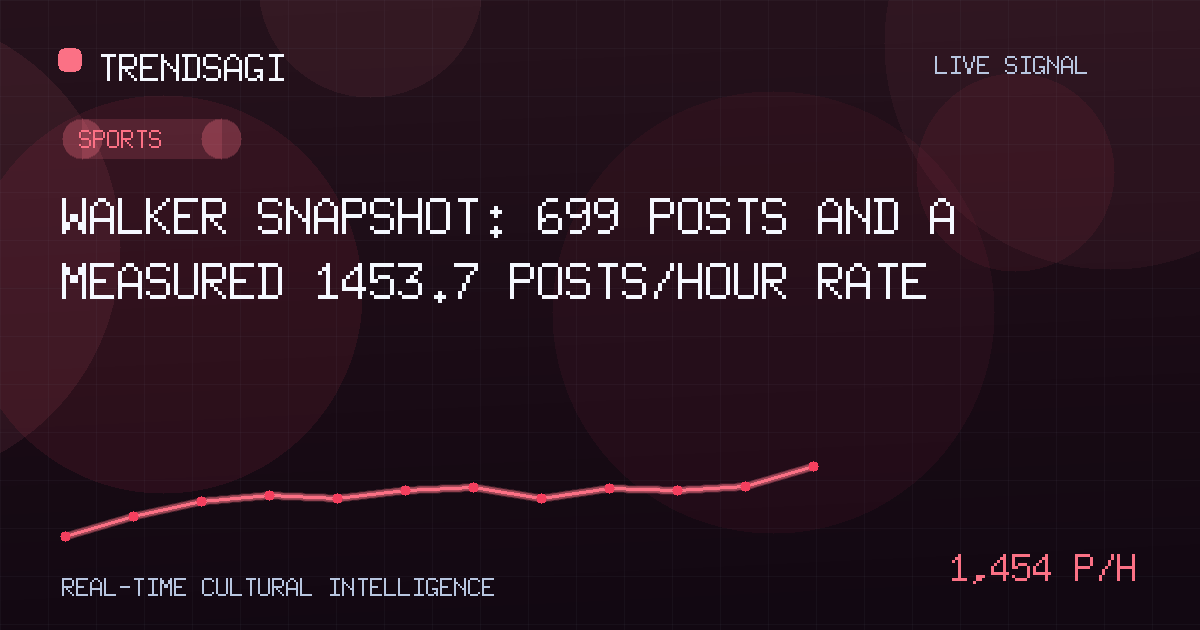
Walker snapshot: 699 posts and a measured 1453.7 posts/hour rate
The Walker signal shows 699 posts and a measured 1453.7 posts/hour rate; its unknown trigger and snapshot limits guide cautious interpretation.
Automated briefing. Generated from stored signal measurements and source-backed research; it is not manually reviewed. Read the methodology and limitations.
Metrics in this briefing are a snapshot associated with its publication date and may not reflect current conditions.
What changed
The stored “Walker” signal recorded 699 posts in the latest snapshot at 2026-10-05T01:21:50Z, while its measured snapshot rate was 1453.7 posts/hour. The direct answer is that Walker was receiving posts in the monitored stream, but the available record does not establish what triggered the activity. It also does not show that the rate was rising, falling, or unusually high compared with a longer baseline; the cause remains unverified.
| Measure | Stored value |
|---|---|
| Observation time | 2026-10-05T01:21:50Z |
| Measured snapshot rate | 1453.7 posts/hour |
| Latest snapshot volume | 699 posts |
The 1453.7 posts/hour figure is a measured snapshot rate over an exact 899-second window using 3 stored observations. It is not a live or current rate, forecast, reach estimate, engagement count, or unique-person count. The separate 699 figure is the latest snapshot volume. Together, they establish observed volume and pace at the stated time; they do not identify the people posting, whether posts were duplicated, or what event prompted them.
Why this topic may be moving
Only the label and the Sports category are clear in the available record. The category suggests a sports context, but it does not establish which Walker is intended. Without representative post text, entity names, hashtags, or publisher attribution, several explanations remain open:
- Event-driven attention: A game result, roster decision, injury update, or other sports development could concentrate discussion. None of those events is identified in the available record.
- Entity collision: “Walker” could combine multiple athletes or other people who share a surname. That would make one label appear more urgent than any individual underlying story.
- Repost amplification: Repeated copies of one item could lift the post count without proportionately increasing distinct conversation. The snapshot cannot test that possibility.
- Classification or distribution artifact: A broad label, automated feed behavior, or keyword mismatch could create activity not tied to one news event.
These are testable hypotheses, not findings. Because none can yet be tied to a verified event or dominant entity, choosing one as the cause would overstate the evidence.
The signal establishes posting volume and an observed rate; it does not establish who drove the activity, why it occurred, or how many distinct people were involved.
Why it matters
Sports editors need entity resolution before writing a headline. “Walker” is too broad to treat as a single person, and combining unrelated identities could turn several routine conversations into a misleading apparent trend.
Trend analysts and media teams should use the measurement as a prompt to investigate, not as proof of a news event. A high observed post count can justify checking the source stream, but publishing an unsupported explanation would give the signal false authority.
Fans, community managers, and communications staff also need the distinction between volume and conversation. Repeated items can make a topic look broader than it is. Clear entity labels and duplicate checks help those groups avoid amplifying an ambiguous spike.
What to watch next
The next useful step is an audit that can separate a real event from a naming or measurement problem:
- Resolve the label. Sample representative posts from the exact 899-second window and capture full names, teams, and hashtags. Separate each entity before aggregating.
- Test count quality. Look for exact duplicates, copied text, repost chains, and repeated source URLs. Keep raw post volume separate from distinct items or authors when those checks are available.
- Establish a baseline. Compare matched windows before and after the observation using the same label and collection method. Without that comparison, “high” remains relative and undefined.
- Trace chronology. Identify the earliest substantive posts, then examine what followed. This can show whether discussion developed around an item or merely accumulated in one burst.
- Verify the apparent trigger. Check official team or league notices, direct statements, and reputable reporting before assigning a cause. External facts should enter the briefing only when their publisher and relevance can be verified.
- Recheck the signal. Preserve the same query, category, and counting method at the next observation so persistence or cooling can be assessed without changing the measurement.
Concrete signals to monitor
- Sustained event attention: a later matched window remains high against its own baseline, and posts converge on one verified entity and event.
- Transient spike: the rate returns toward baseline and no corroborated event emerges.
- Label collision: high volume separates into clusters about different people or contexts.
- Repost or automation concern: volume is dominated by near-identical items or synchronized repetition; that pattern would require validation, not an immediate assumption of automated activity.
Methodology and limitations
The 1453.7 posts/hour figure comes from 3 stored observations over an exact 899-second window and was measured at 2026-10-05T01:21:50Z. It is sufficient to report the supplied snapshot pace, but not to reconstruct a full trajectory, determine seasonality, or establish a recurring baseline. The 699 figure is latest snapshot volume, not a denominator for the rate.
The record does not supply post text, author counts, engagement, geography, source platform, a prior-window comparison, or verified public context. “Sports” is category metadata, not proof that all posts concern one athlete or one event. No external cause is attributed here because the available evidence does not identify one.
A useful next update should preserve the exact timestamp, label, collection method, entity clusters, duplicate checks, matched baseline, and any verified event attribution. Until those checks exist, this is an investigation signal rather than a causal account or forecast.
Track This Topic for New Signals
Set alerts for future velocity or sentiment changes around this topic.
Explore Tracking PlansAbout TrendsAGI research
TrendsAGI's automated research pipeline publishes dated signal snapshots, methodology notes, and practical workflows for teams evaluating cultural momentum. Read how signals are scoped, scored, and limited in our research methodology.