2690-second window · 2 observations · Measured Oct 3, 2026, 2:56 AM UTC · Provider: go_recent_snapshot_v2
Valkyries records a measured 3515.1 posts/hour snapshot rate
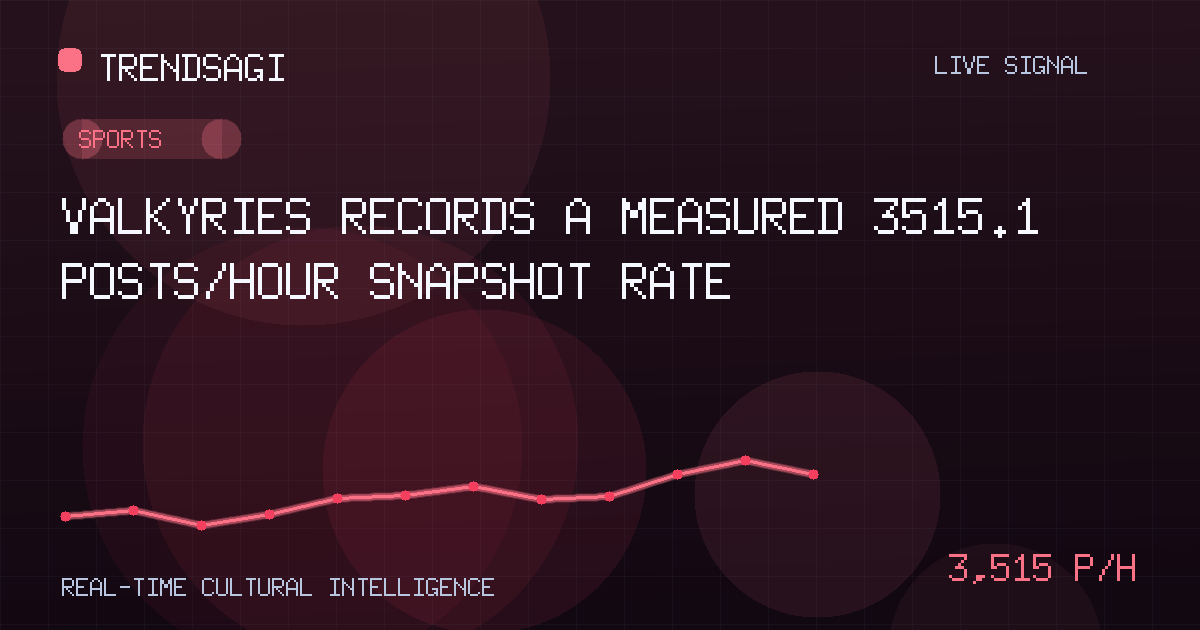
Valkyries recorded a measured 3515.1 posts/hour snapshot rate; review what the 2-observation signal shows and what to verify next.
Automated briefing. Generated from stored signal measurements and source-backed research; it is not manually reviewed. Read the methodology and limitations.
Metrics in this briefing are a snapshot associated with its publication date and may not reflect current conditions.
What changed
Direct answer: The stored signal shows Valkyries registering a measured snapshot rate of 3515.1 posts/hour at the observed point. That makes the topic a priority for rapid verification, but it does not establish why people were posting. The record is categorized as Sports and provides no signal description identifying the relevant organization, match, person, or event.
The measured change is 3515.1 posts/hour over an exact 2690-second window using 2 stored observations, with the latest snapshot observed at 2026-10-03T02:56:43Z. The latest snapshot volume was 3000 posts. The posts/hour figure is a measured snapshot rate—not a live or current rate, forecast, reach, engagement total, or count of unique people.
| Snapshot observed at, UTC | Measured snapshot rate | Snapshot volume |
|---|---|---|
| 2026-10-03T02:56:43Z | 3515.1 posts/hour | 3000 posts |
Why this topic may be moving
No verified public context accompanies the stored signal, so the cause remains unclear. The label “Valkyries” is also broad enough to create an entity-matching problem: posts using the same term may not all refer to the same subject. Assignment to the Sports category narrows the context, but it does not prove that every collected post concerns the same team, nickname, competition, or sporting development.
Possible explanations should be treated as verification targets rather than findings:
- A match result, roster decision, coaching change, schedule update, or other announcement involving an entity using the name Valkyries could have prompted discussion.
- A controversial moment, viral clip, or player-related incident could have accelerated sharing without creating a broader substantive conversation.
- Posts may combine several subjects that share the label, making the apparent spike partly a classification effect rather than an event-driven surge.
- Duplicate copying, coordinated posting, or automated activity could contribute to the measured rate without representing an equivalent amount of independent interest.
Without verified reporting or post-level evidence tied to a specific event, none of these explanations can be selected responsibly.
The strongest defensible conclusion is that monitored Valkyries activity changed at a measured snapshot rate of 3515.1 posts/hour during the stored interval; its trigger and persistence remain unverified.
Why it matters
For sports editors, the immediate issue is verification speed. A fast-moving label can shape coverage decisions, but publishing before resolving which Valkyries is meant risks amplifying an entity collision or attaching a story to the wrong event. The first editorial task is therefore to inspect representative and highly distributed posts, identify the entities named, and compare their timing with the measured interval.
For community managers and audience teams, the signal indicates where investigation may be useful, not how many people were reached or how strongly they felt. The 3000-post snapshot describes collected volume; it does not establish the size of the active community. Repetition, reposting, and multiple accounts can produce substantial post volume without creating equivalent independent participation.
Trend analysts should also distinguish conversation speed from durable attention. The record supports a change-rate finding for the exact measured interval, but it does not reveal whether activity continued afterward, spread across platforms and locations, or developed a coherent topic. A brief reaction burst and a sustained event-driven trend require different editorial responses.
What to watch next
- Entity consistency: Review a representative sample of the 3000 posts and record which Valkyries organization, person, team, or context is named. Convergence on the same subject would strengthen the trend interpretation.
- Persistence: Obtain observations immediately before and after the stored interval, using the same collection method. Continued elevation in later windows would support a sustained pattern rather than an isolated burst.
- Original activity: Separate original posts from copies, reactions, and repeated phrases. Track account concentration and the share of posts that add distinct information rather than merely repeat existing content.
- Geographic and platform spread: Check whether discussion is concentrated in an existing fan community or is appearing across multiple platforms and regions. Breadth can help distinguish a local event from wider attention.
- Event alignment: Compare post timestamps with verified public reporting. A cause should be attached only when the timing and described subject align with the collected conversation.
- Conversation quality: Examine whether posts are providing news, first-hand accounts, criticism, celebration, questions, or unsupported speculation. Each pattern has different implications for reporting and community response.
- Collection integrity: Confirm that the rate was not affected by a change in sources, query rules, deduplication, or collection volume. A measurement change can resemble a real-world spike.
Concrete confirmation would look like several of these signals occurring together: stable elevated activity in subsequent windows, a rising share of original posts, consistent identification of the same subject, and verified event reporting whose timing matches the conversation. If the rate quickly normalizes or posts divide among unrelated subjects, the event should instead be treated as a short-lived or ambiguous burst.
Methodology and limitations
The reported 3515.1 posts/hour is the supplied measured change rate over an exact 2690-second window using 2 stored observations. The latest snapshot, observed at 2026-10-03T02:56:43Z, contains 3000 posts. Those values are reported without recalculation, rounding, or conversion. Snapshot volume and measured snapshot rate describe different aspects of the record and should not be substituted for one another.
The evidence does not include an independent historical baseline, post text, source links, platform distribution, geographic data, account counts, sentiment, or verified event context. With only 2 stored observations, the signal cannot establish normal or abnormal performance, statistical uncertainty, cause, or what happened after the snapshot. It also cannot distinguish unique people, independent contributions, and automated activity.
The practical conclusion is therefore narrow but actionable: monitor Valkyries closely, resolve the underlying entity, test whether the activity persists, and seek verified timing before assigning a cause or describing the signal as a broader public trend.
Track This Topic for New Signals
Set alerts for future velocity or sentiment changes around this topic.
Explore Tracking PlansAbout TrendsAGI research
TrendsAGI's automated research pipeline publishes dated signal snapshots, methodology notes, and practical workflows for teams evaluating cultural momentum. Read how signals are scoped, scored, and limited in our research methodology.


