896-second window · 3 observations · Measured Oct 5, 2026, 8:56 AM UTC · Provider: go_recent_snapshot_v2
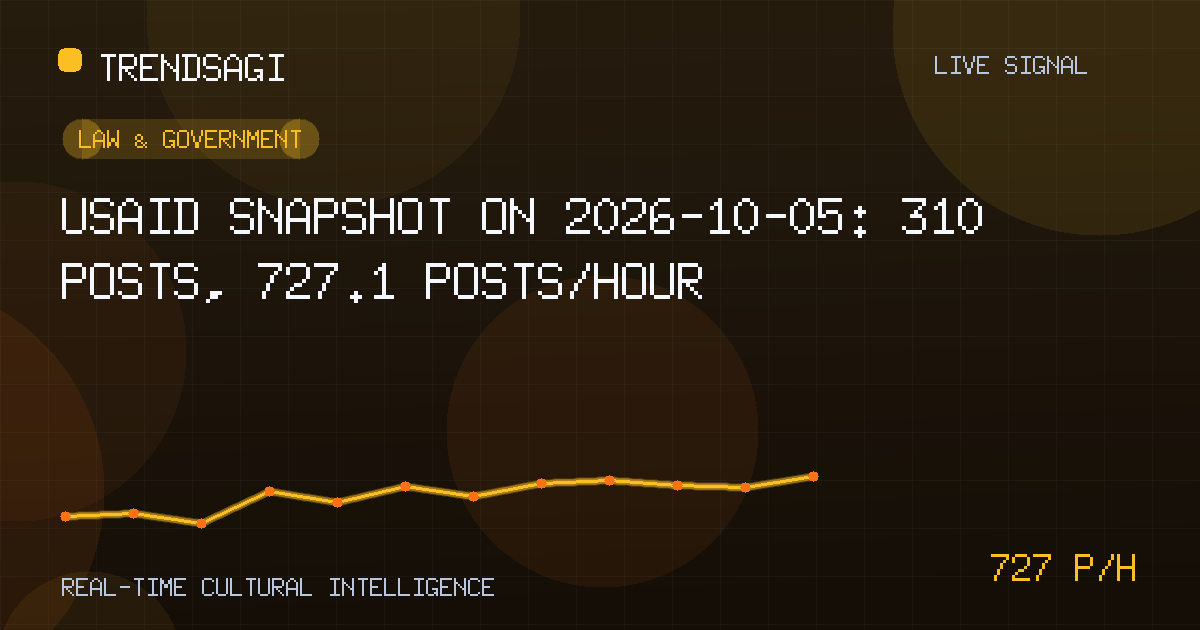
USAID snapshot on 2026-10-05: 310 posts, 727.1 posts/hour
USAID’s 2026-10-05 snapshot shows 310 posts and a measured 727.1 posts/hour rate; the catalyst and persistence remain unverified.
Automated briefing. Generated from stored signal measurements and source-backed research; it is not manually reviewed. Read the methodology and limitations.
Metrics in this briefing are a snapshot associated with its publication date and may not reflect current conditions.
What changed
The latest stored snapshot records 310 USAID-related posts at 2026-10-05T08:56:41Z. The supplied change measure is 727.1 posts per hour, showing the recorded posting pace during the captured interval; it does not identify a confirmed catalyst or show that the activity continued.
Here, 727.1 posts/hour is a measured snapshot rate—not a live or current rate, forecast, reach figure, engagement metric, or count of unique people. It was measured over an exact 896-second window using 3 stored observations. With no prior baseline, it cannot establish a percentage increase, acceleration, or persistence.
| Observation time | 2026-10-05T08:56:41Z |
|---|---|
| Measured snapshot rate | 727.1 posts/hour |
| Measurement window | 896 seconds |
| Stored observations | 3 |
| Snapshot volume | 310 posts |
Why this topic may be moving
The stored category is Law & Government, which makes policy action a reasonable place to begin checking, but the category is not evidence that a policy event occurred. The signal description is empty, and no source-level public context accompanies the record to verify why activity changed. The cause remains unclear.
Several different mechanisms could produce the same posting pattern. These are hypotheses to test, not findings:
- A newly published agency action, funding decision, legal filing, hearing, or oversight communication.
- Reaction to a report, investigation, speech, partner statement, or media story not yet tied to the observation time.
- Operational consequences involving grants, contracts, staffing, or program delivery.
- A larger story crossing into USAID and prompting issue migration rather than a new agency-specific event.
- Automation, reposting, or coordinated amplification that raises post counts without equivalent independent attention.
Timing and source diversity must be checked before naming a cause. A rapid rate can result from one event, many independent reactions, or mechanical duplication, and the stored figures do not distinguish among them.
A measured posting rate can establish the pace captured during one interval, but not the event behind the posts, the identity or number of participants, or the policy consequence.
Why it matters
For people working in or overseeing USAID-related activity, the distinction between concentrated activity and a verified event is operationally important. Posting can trigger immediate questions about programs, funding, staffing, and partners before the underlying facts are clear.
- USAID program teams: Check whether an official direction or partner-facing change corresponds to the observation window.
- Grant recipients and contractors: Separate actionable operating changes from general commentary or recycled claims.
- Congressional staff, journalists, and watchdogs: Require a dated primary record before attributing the movement to policy news.
- Researchers and communications teams: Measure persistence and source composition rather than treating raw volume as public reach.
The immediate value of the signal is therefore triage: it says verify quickly, not what to conclude.
What the signal can and cannot establish
The stored figures establish only a narrow set of facts:
- The record places the topic under Law and Government at the stated time.
- The latest snapshot contains 310 posts.
- The supplied measurement is 727.1 posts/hour over 896 seconds using 3 observations.
They do not provide the context needed for a substantive trend conclusion:
- No normal USAID baseline is supplied for comparison.
- There is no account count or information showing whether posts are original, unique, organic, or coordinated.
- The record does not identify who posted, geographic distribution, language, or media source.
- It does not establish sentiment, factual accuracy, or evidentiary quality.
- It does not measure reach, engagement, unique participants, or policy impact.
- It cannot determine whether government action, news coverage, or platform behavior caused the movement.
What to watch next
Useful next checks are ordered by how quickly they can resolve the ambiguity:
- Find a primary event. Look for a dated USAID notice, congressional record, court filing, funding decision, procurement action, hearing, or oversight communication close to the observation window.
- Test the timing. Compare the event's publication time with the full observation window, not merely the final snapshot time. A later event cannot explain earlier posts.
- Check source diversity. Determine whether outlets and accounts cite independent evidence or recycle one unsourced assertion.
- Compare like with like. Collect subsequent non-overlapping windows using the same query and collection settings, then look for persistence, decay, or another burst.
- Audit volume quality. Inspect exact duplicates, near-duplicate wording, repost chains, and sudden account activity; these can inflate apparent conversation without adding independent information.
- Seek operational confirmation. Look for follow-through in official implementation materials, partner notices, award records, or program communications before inferring a real-world effect.
Concrete confirmation would be a named, time-aligned event supported by a primary document and independent pickup. Continued posting alone is not causal confirmation, and even a verified event would not by itself establish public sentiment or impact.
Methodology and limitations
All figures are reproduced from the stored observation: 2026-10-05T08:56:41Z, 310 posts, 727.1 posts/hour, an 896-second window, and 3 observations. The rate was supplied as a measured snapshot rate rather than independently recalculated here.
The record does not disclose the collection method, query, observation overlap, deduplication rules, baseline, geography, language, or account metadata. Snapshot volume and measured rate are separate fields; their relationship is not defined and should not be arithmetically combined.
No causal claim is made because no source-level evidence verifies a catalyst. This signal is best used as a trigger for document checking and follow-up measurement, not as a standalone measure of public opinion, institutional activity, or policy consequences.
Track This Topic for New Signals
Set alerts for future velocity or sentiment changes around this topic.
Explore Tracking PlansAbout TrendsAGI research
TrendsAGI's automated research pipeline publishes dated signal snapshots, methodology notes, and practical workflows for teams evaluating cultural momentum. Read how signals are scoped, scored, and limited in our research methodology.