1817-second window · 3 observations · Measured Sep 24, 2026, 6:11 PM UTC · Provider: go_recent_snapshot_v2
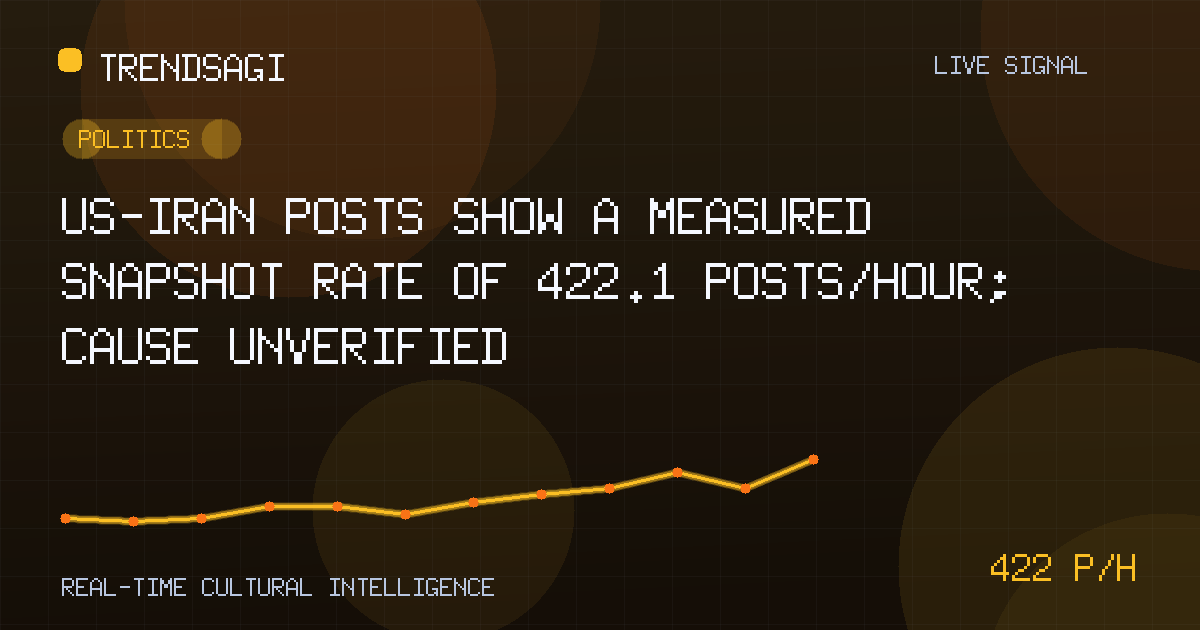
US–Iran posts show a measured snapshot rate of 422.1 posts/hour; cause unverified
US–Iran posts show a measured 422.1 posts/hour snapshot rate; the cause is unverified, the evidence is limited, and next checks are provided.
Automated briefing. Generated from stored signal measurements and source-backed research; it is not manually reviewed. Read the methodology and limitations.
Metrics in this briefing are a snapshot associated with its publication date and may not reflect current conditions.
What changed
The stored Politics-category signal shows a measured rise in posts labeled US–Iran during the latest observation window, but it does not establish what triggered the rise. The result supports a statement about posting activity, not a claim about a particular event, public opinion, or real-world consequences.
The measured snapshot rate was 422.1 posts/hour over the exact 1817-second window, using 3 stored observations ending at 2026-09-24T18:11:54Z. The latest snapshot contained 727 posts. The rate describes observed change, not a live or current rate, and the volume is a separate count.
| Metric | Value |
|---|---|
| Observation time | 2026-09-24T18:11:54Z |
| Measured snapshot rate | 422.1 posts/hour |
| Snapshot volume | 727 posts |
Neither figure establishes reach, engagement, or the number of unique people. The rate is not an estimate of how many people saw or acted on the posts, and the snapshot volume is not a measure of audience size or agreement.
Why this topic may be moving
The stored material provides no descriptive account of the discussion, and no external catalyst is verified in this briefing. Several explanations remain possible:
- Event-driven discussion: a verified public statement or development could prompt new posts; that possibility has not been established for this snapshot.
- Renewed circulation: an older item could be reposted, making the stream look newly active without a new underlying event.
- Measurement changes: a change in contributing accounts, query coverage, or collection could alter the observed post count.
These are hypotheses, not findings about what happened. A candidate explanation should be independently verified and fit the timing and subject of the posts. Even a genuine event is not automatically the cause without a visible connection to the stream.
What the signal can—and cannot—establish
The signal establishes a positive measured change in the stored post count and identifies the topic and category. It does not supply the underlying posts needed to inspect their claims. In particular, it cannot establish:
- which specific statement, incident, or policy the posts discuss;
- whether posts are original, replies, quotations, or repeated copies;
- who is posting, their locations, or whether they represent public opinion;
- whether the activity reflects a new event, renewed circulation, or a collection change; or
- whether the claims are accurate, coordinated, or consequential.
The defensible conclusion is that posting in this stored stream increased during the measured window—not that a new event, a shift in public opinion, or real-world impact has been established.
Until those questions are answered, the strongest editorial takeaway is simple: report the measured rise, keep the cause explicitly unresolved, and avoid turning platform activity into a factual narrative about the world.
Why it matters
Editors, policy analysts, communications teams, and general readers should care because a posting burst can influence what gets noticed next. That makes the signal useful for triage, but not for declaring a crisis, proving a policy effect, or claiming consensus.
- Journalists: find a specific, checkable claim and verify it before using the burst as the headline explanation.
- Policy teams: compare discussion with confirmed policy developments rather than equating attention with importance or effects.
- Public-information teams: examine whether prominent claims are supported, disputed, or unresolved; do not presume misinformation is present.
- Readers: treat the rate as a prompt to check evidence, not as a measure of truth, popularity, or agreement.
What to watch next
The useful follow-up is to test explanations, not extrapolate the measured rate. Watch for:
- Event alignment: a named, verifiable statement, action, or incident repeatedly cited in the posts, with its publication time and exact claim checked against the relevant record or reporting.
- Source diversity: independent credible accounts describing the same development, rather than posts that all trace back to one unconfirmed claim.
- Content convergence: a recurring concrete subject across the stream, which would be more actionable than the broad topic label alone.
- Evidence quality: quotations or links that resolve to primary material, rather than screenshots, reactions, or unsupported summaries.
- Correction and clarification: verified denials, corrections, or updates that materially change the leading account.
- Measurement continuity: a later stored observation using the same topic definition and collection method, compared through posts/hour rather than snapshot volume alone. Note changes in wording, translations, or account composition.
- Consequences: confirmed policy, legal, economic, or security effects reported by credible sources, kept separate from commentary about them.
If reporting later establishes a catalyst, the update should name it, attribute the relevant fact to its publisher, and explain how its timing and content connect to the posts. Without that connection, the reason for the rise should remain unresolved.
Methodology and limitations
The supplied 422.1 posts/hour figure is a measured snapshot rate over the exact 1817-second window using 3 stored observations. It is historical, not live or current, and is not a forecast. The 727-post figure is latest snapshot volume, not a rate, reach, engagement count, or unique-person count.
No post-level text, account identities, historical counts, query definition, sampling frame, or collection procedure accompanies the signal. The 3 observations therefore do not establish representativeness, continuity of measurement, sentiment, or coordination.
The topic label and Politics category organize the record; they do not verify the content of individual posts. No descriptive signal summary is supplied, and no external catalyst is verified here. The defensible conclusion is that the observed stream changed during the measured window. Its trigger and significance remain unresolved; establishing them would require post-level inspection, verified public context, and consistent measurement.
Track This Topic for New Signals
Set alerts for future velocity or sentiment changes around this topic.
Explore Tracking PlansAbout TrendsAGI research
TrendsAGI's automated research pipeline publishes dated signal snapshots, methodology notes, and practical workflows for teams evaluating cultural momentum. Read how signals are scoped, scored, and limited in our research methodology.