905-second window · 3 observations · Measured Oct 1, 2026, 8:56 AM UTC · Provider: go_recent_snapshot_v2
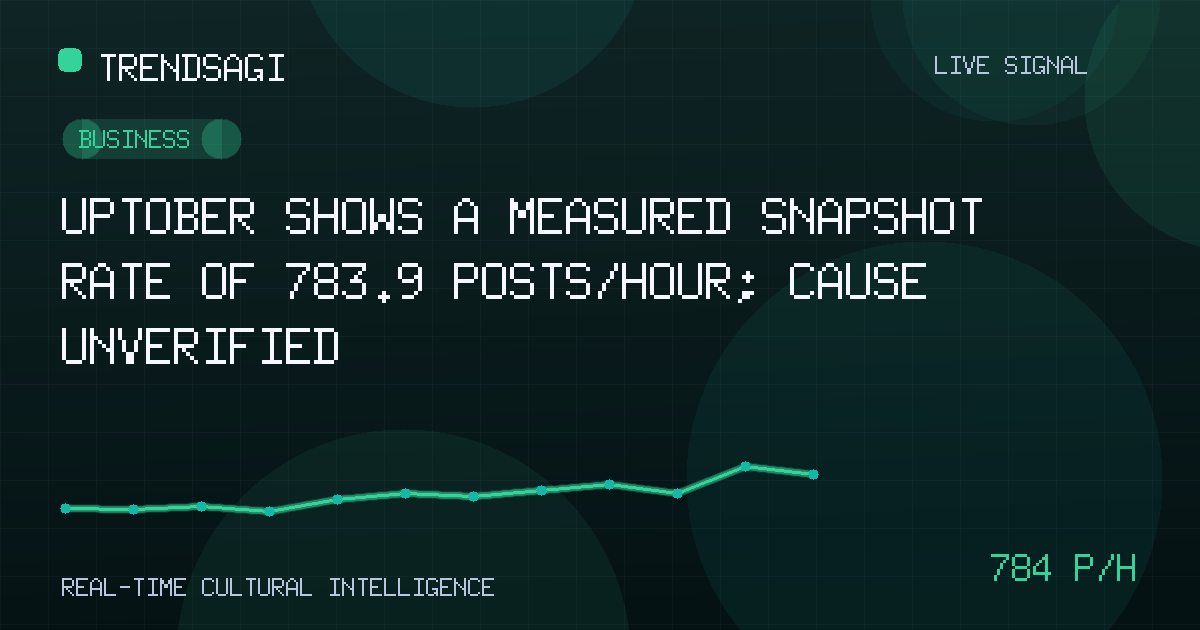
Uptober shows a measured snapshot rate of 783.9 posts/hour; cause unverified
Uptober showed a measured snapshot rate of 783.9 posts/hour over a 905-second window; the cause is unverified, with practical checks.
Automated briefing. Generated from stored signal measurements and source-backed research; it is not manually reviewed. Read the methodology and limitations.
Metrics in this briefing are a snapshot associated with its publication date and may not reflect current conditions.
What changed
Uptober was an active topic in the captured window, but why it was moving has not been verified. At 2026-10-01T08:56:50Z, the latest snapshot contained 1358 posts. That is a timestamped observation, not evidence of a sustained trend, a particular news trigger, or broader public demand.
The stored series registered a measured snapshot rate of 783.9 posts/hour over an exact 905-second window using 3 stored observations. It is not a live or current rate, forecast, reach figure, engagement count, or count of unique people.
| Observation time | Measured snapshot rate | Snapshot volume |
|---|---|---|
| 2026-10-01T08:56:50Z | 783.9 posts/hour | 1358 posts |
The rate covers the stated 905-second window and is derived from 3 stored observations.
Why this topic may be moving
No verified public context was available for this briefing, so the increase cannot responsibly be attributed to a specific announcement, event, campaign, or market development. The cause remains unclear.
Several explanations are possible, but each remains a hypothesis rather than a reported fact:
- Seasonal or scheduled use: A recurring phrase associated with a calendar period could generate repeated posting without a new event. That possibility has not been verified for this signal.
- An external event: A report, launch, policy announcement, market development, or promotional campaign could have prompted discussion. No specific event has been tied to this activity with verified timing and provenance.
- Community amplification: Repeated wording, reposting, coordinated scheduling, or automated activity could raise post counts without equivalent growth in distinct authors.
- Semantic overlap: Unrelated audiences may use the same label for different subjects, making the combined post volume a poor proxy for one coherent conversation.
Until the topic’s audience, timing, and public context are resolved, none of these possibilities should be presented as the established reason.
A high posting rate can identify where to investigate, but it cannot identify the reason. Until timing and provenance align, the defensible conclusion is: active signal, cause unverified.
What the signal can establish
The signal is useful as a monitoring trigger. It establishes that the collection system detected the topic at meaningful volume during a narrowly defined observation window. It gives editors a reason to examine the conversation more closely.
It does not establish:
- how posting activity compares with a normal baseline for this topic;
- whether the pattern continued beyond the captured window;
- how many distinct people created the posts;
- whether the posts were original, reposted, or automated;
- whether the conversation was positive, negative, or neutral;
- whether the volume reflected organic interest, coordinated activity, or several unrelated uses of the label;
- any connection to revenue, customer demand, asset performance, or another business outcome.
Without a historical baseline, the activity also cannot be described as a record, an acceleration relative to prior Uptober periods, or proof of seasonality.
Why it matters
The immediate value is situational awareness: a concentrated burst of posts can warrant checking for a developing story, campaign, community movement, or manipulation risk.
- Editors and communications teams should verify the trigger before connecting the topic to a news event or broader narrative.
- Marketing and business teams can use the signal as a prompt to investigate audience interest, but post volume alone is not evidence of market demand.
- Investors and analysts should not infer a price direction, trading activity, or economic consequence from this label or its posting rate.
- Platform and risk teams may want to inspect whether repetition, automation, or unrelated meanings are inflating the aggregate count.
The key distinction is between a reason to look and a reason to conclude. This record supports the former, but not the latter.
What to watch next
- Collect comparable snapshots. Reapply the same query, collection method, and observation length. Determine whether later measured snapshot rates and snapshot volumes remain elevated, decline, or reverse.
- Inspect a representative sample. Separate original posts from reposts, identify repeated wording, and flag possible automation. This would show whether volume reflects broad participation or concentrated amplification.
- Resolve what Uptober denotes. Examine the languages, communities, regions, and subject matter using the label. Unrelated meanings should not be merged into one trend.
- Verify a public trigger through Google Search. Look for credible reporting and primary announcements near the documented observation window, then check publication times, provenance, and independent corroboration.
- Distinguish original evidence from commentary. A primary announcement or first-party publication would be more useful than posts that merely react to an unverified claim.
- Track impact separately from volume. Check whether credible references, substantive original contributions, and relevant audience responses follow the posting activity.
Concrete signs of a durable trend would include comparable activity in later windows, coherent use by the same identifiable audience, independent public references, and verified alignment with a primary event. None is established by the current snapshot alone.
Methodology and limitations
This briefing uses the supplied snapshot timestamp, volume, stored category, observation window, and measurement summary. No supporting description accompanied the stored topic record. The Business category is classification metadata, not proof that the activity represents a business event or commercial demand.
The reported 783.9 posts/hour figure is a measured snapshot rate over the exact 905-second window from 3 stored observations. It must not be read as a live rate, projection, audience size, or engagement measure. Because no verified external fact was available to explain the activity—and no historical baseline was supplied—the briefing identifies the observed change while leaving its cause and persistence unresolved.
Track This Topic for New Signals
Set alerts for future velocity or sentiment changes around this topic.
Explore Tracking PlansAbout TrendsAGI research
TrendsAGI's automated research pipeline publishes dated signal snapshots, methodology notes, and practical workflows for teams evaluating cultural momentum. Read how signals are scoped, scored, and limited in our research methodology.