907-second window · 3 observations · Measured Sep 26, 2026, 12:10 AM UTC · Provider: go_recent_snapshot_v2
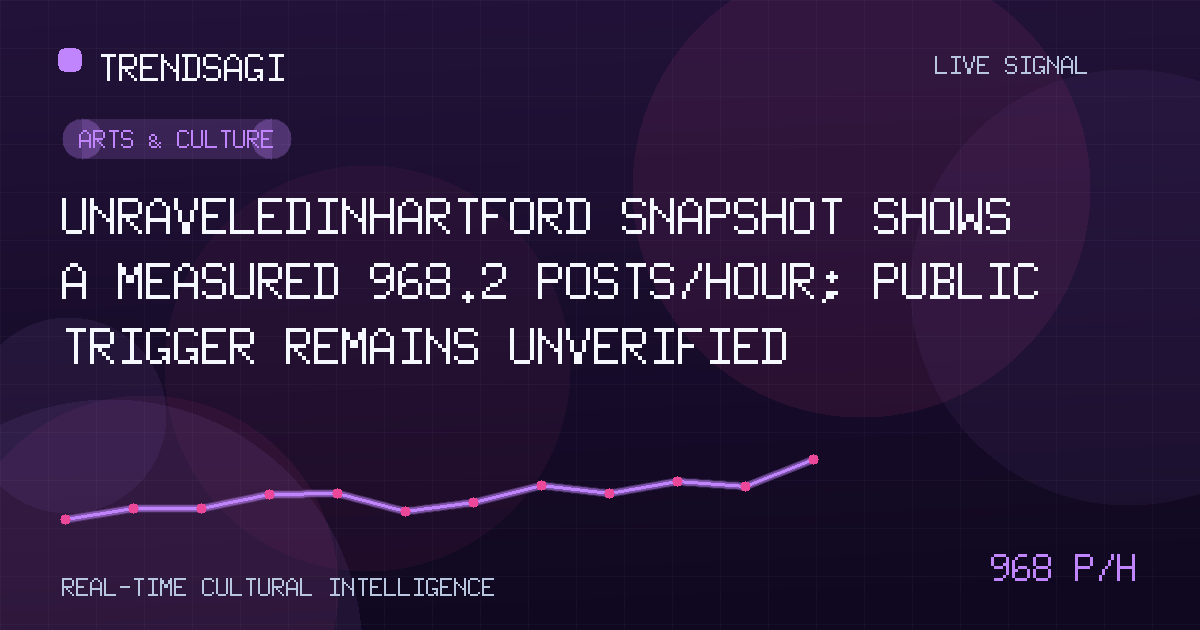
UnraveledInHartford snapshot shows a measured 968.2 posts/hour; public trigger remains unverified
The latest UnraveledInHartford snapshot contained 356 posts and a measured 968.2 posts/hour rate; the reason for the surge remains unverified.
Automated briefing. Generated from stored signal measurements and source-backed research; it is not manually reviewed. Read the methodology and limitations.
Metrics in this briefing are a snapshot associated with its publication date and may not reflect current conditions.
What changed
#UnraveledInHartford registered a sharp, measurable rise in posting activity in the latest stored record. The direct answer is that the record shows a concentrated posting burst, while its cause remains unverified. No reliable public context establishes which event, announcement, controversy, or cultural program prompted the increase.
The measured snapshot rate was 968.2 posts/hour across an exact 907-second window using 3 stored observations. The latest snapshot, observed at 2026-09-26T00:10:50Z, contained 356 posts. This is a retrospective snapshot measurement, not a live or current rate, forecast, reach estimate, engagement figure, or count of unique people.
| Observation time | Measured posts/hour | Snapshot volume |
|---|---|---|
| 2026-09-26T00:10:50Z | 968.2 | 356 posts |
Why this topic may be moving
No attributable public explanation is available in the verified context used for this briefing, so assigning a trigger would go beyond the evidence. The stored category, Arts & Culture, provides context but does not prove that a performance, exhibition, venue, or arts campaign caused the surge. The hashtag's function also remains unestablished: it could relate to programming, promotion, audience discussion, or another use of the name.
Possible mechanisms include a timed announcement, the start of discussion around a cultural activity, amplification by participants or organizers, local reporting, or reaction to an update. These are hypotheses, not findings. A responsible account should wait for an official statement or reliable reporting with relevant timing before identifying any of them as the reason for the movement.
A high post count can justify attention without proving a large audience, a specific event, or a settled public reaction. Here, the defensible finding is rapid measured movement with low causal confidence.
What the signal can and cannot establish
Within the monitored collection, the signal establishes that posting activity for the phrase changed at the stated measured snapshot rate during the stated window. It also records a latest snapshot volume of 356 posts. Those facts make the signal useful for editorial triage: the phrase merits further checking because it showed concentrated momentum, not because its wider importance has been demonstrated.
The signal does not establish how many people participated, whether accounts were unique, or whether the activity was organic. It provides no basis by itself for conclusions about sentiment, attendance, demand, geographic concentration, media coverage, or economic impact. Reposts, quotations, promotional copies, reactions, and automated or coordinated behavior could all contribute to a short burst. None can be presumed from volume alone.
Who should care
Organizations that may have used the label should check whether it refers to their programming and whether the conversation creates a need for schedule, ticketing, access, venue, or clarification information. The category makes that possibility worth checking, but it does not establish a connection.
- Hartford-area cultural organizations, venues, artists, and community groups should determine whether the phrase belongs to an active initiative or event.
- Local editors and reporters should seek attributable confirmation rather than treating repeated posts as independent corroboration.
- Arts and culture teams should inspect whether the discussion contains questions, firsthand accounts, criticism, or practical information.
- Audience-facing teams should respond only after identifying the underlying subject and should avoid repeating an unverified explanation.
- Trend and communications teams should monitor persistence without presenting the snapshot rate as a live audience measure.
What to watch next
Several checks could turn this ambiguous burst into a usable story:
- Collect a fresh observation. Use the same collection definition to see whether the rise persists, reverses, or fades. A later snapshot can establish persistence, but it cannot turn the reported rate into a live trend.
- Review the earliest available substantive posts around the observed window. Identify who introduced the phrase, what the posts added, and whether momentum appeared to come from original material, replies, reposts, or repeated wording.
- Verify a public trigger through Google Search. Look for an attributable page from an organizer, venue, municipal cultural body, or established local publisher. A usable explanation needs both a matching subject and credible timing; unrelated results should not be attached to the signal.
- Separate official information from reaction. A primary announcement could explain why the phrase appeared, while replies might reveal audience questions or operational concerns. Those forms of evidence should not be merged without support.
- Inspect related language and geography within the corpus. Adjacent tags, place references, recurring names, and changes in posting behavior may clarify whether the label concerns Hartford activity or participates in a broader conversation.
- Watch for concrete follow-up signals. Verified scheduling, venue, ticketing, access, program, review, cancellation, correction, or organizer-clarification information would matter only if it directly concerned this phrase.
What would change the assessment
A verified, attributable explanation with relevant timing would raise confidence in the cause. A fresh comparable snapshot would show whether the movement persisted or reversed. Evidence of distinct, firsthand contributions would strengthen the signal's significance, while repeated wording from a limited set of accounts would suggest amplification without proving manipulation. Claims about audience size, attendance, or economic effect would require separate evidence.
Until those checks are completed, the appropriate classification is a high-velocity signal with an unverified cause—not a confirmed Hartford cultural event. That distinction preserves the importance of the measured change without overstating what the posts establish.
Methodology and limitations
The reported 968.2 posts/hour is a measured snapshot rate based on 3 stored observations across the exact 907-second window ending at 2026-09-26T00:10:50Z. It describes observed posting velocity only. The 356-post figure is the latest snapshot volume; it should not be treated as a cumulative campaign total, audience estimate, or unique-account count without supporting collection documentation.
No verified public source established why the topic was moving, so the briefing asserts no external cause. The record supplies a category but no verified explanatory description, historical baseline, sentiment distribution, account-level provenance, engagement data, or detailed collection coverage. Results may also be affected by collection scope, duplicate inclusion, and coordinated behavior. The finding is therefore limited to the reported change and the need for further verification.
Track This Topic for New Signals
Set alerts for future velocity or sentiment changes around this topic.
Explore Tracking PlansAbout TrendsAGI research
TrendsAGI's automated research pipeline publishes dated signal snapshots, methodology notes, and practical workflows for teams evaluating cultural momentum. Read how signals are scoped, scored, and limited in our research methodology.