15-minute window · 3 observations · Measured Sep 24, 2026, 9:22 AM UTC · Provider: go_recent_snapshot_v2
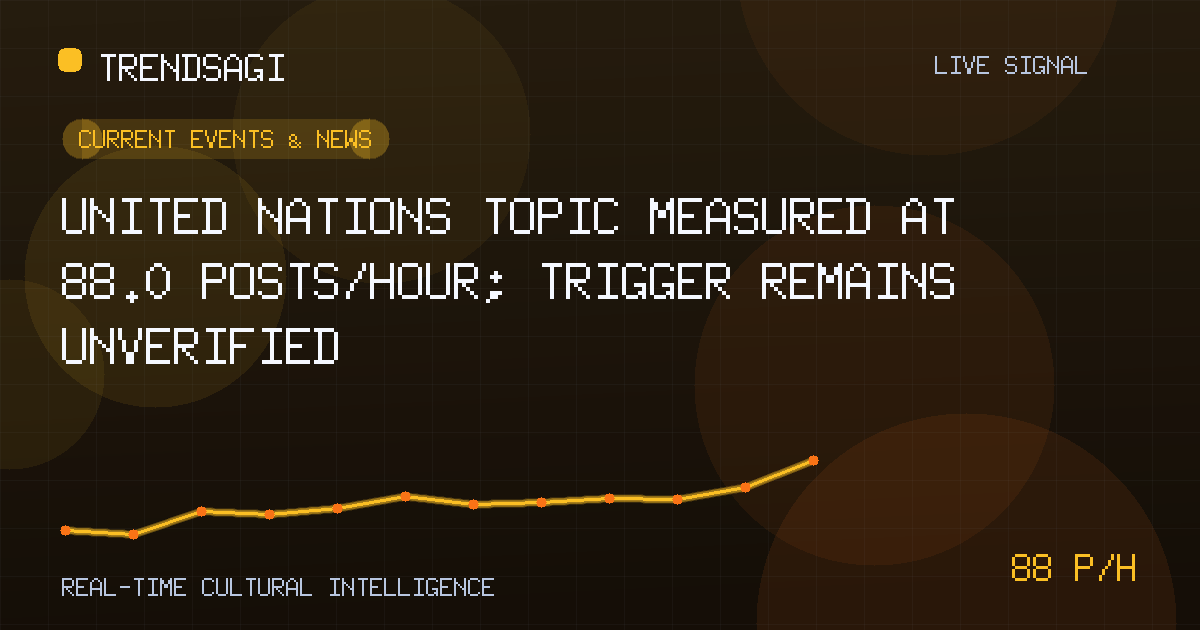
United Nations topic measured at 88.0 posts/hour; trigger remains unverified
The United Nations snapshot records 450 posts and a measured 88.0 posts/hour rate; the trigger and significance remain unconfirmed.
Automated briefing. Generated from stored signal measurements and source-backed research; it is not manually reviewed. Read the methodology and limitations.
Metrics in this briefing are a snapshot associated with its publication date and may not reflect current conditions.
What changed
The available record shows an increase in posting activity about the United Nations, but the reason for the change remains unconfirmed. At 2026-09-24T09:22:15Z, the latest snapshot contained 450 posts. Across an exact 900-second window using 3 stored observations, the measured snapshot rate was 88.0 posts/hour. This is a recorded observation, not a live count, reach estimate, or forecast.
The measured change in the record is a snapshot rate of 88.0 posts/hour, based on 3 observations over exactly 900 seconds. The associated snapshot volume is 450 posts. These are different measures: the rate describes posting activity during the measurement window, while the snapshot is a separate count at the recorded time. Neither establishes who posted, what they believed, or how many people saw the discussion.
| Observation time | 2026-09-24T09:22:15Z |
|---|---|
| Latest snapshot volume | 450 posts |
| Measured snapshot rate | 88.0 posts/hour |
| Measurement window | Exactly 900 seconds |
| Observations used | 3 stored observations |
Why this topic may be moving
The measurement alone cannot identify the trigger, and no verified public context underpins this briefing. Several mechanisms could produce the pattern; none is established by the record.
- Event-driven discussion: A newly published institutional item or a wider news development could prompt reaction. This is a hypothesis to test, not a claim that any particular event occurred.
- Recirculation and repetition: A widely shared item may generate many posts about the same report. Volume can rise without an equivalent number of independent stories or viewpoints.
- Measurement effects: Platform coverage, topic-labeling practices, or a change in which conversations are observed could affect the count. The record does not identify the platform or sampling boundary, so these possibilities cannot be evaluated.
A broad topic label also creates an aggregation problem. Different institutional issues can be grouped together even when they carry different significance. Without a story, speaker, or subtopic breakdown, the snapshot cannot show which issue accounts for the activity.
Treat a measured post rate as a prompt to investigate, not as proof of its cause. It becomes decision-useful when paired with identifiable stories, reliable timestamps, and a comparable collection method.
How to interpret the signal
The record establishes a timestamp, a snapshot volume, and a measured rate under a specified observation method. Those facts justify further checking; they do not establish why discussion intensified or what the United Nations itself was doing.
- Can show: The pace of recorded posting activity during the measured window and the size of the associated snapshot.
- Cannot show: The identity or agenda of posters, their sentiment, agreement, reach, or number of unique participants.
- Cannot establish: That an official statement, policy development, or external event caused the activity.
- Cannot support: A live trend claim, a forecast, or a comparison with another period without aligned collection methods.
Why it matters
For editors, the first task is to identify what is being discussed. Summarizing a broad United Nations spike risks conflating unrelated events or mistaking repeated reporting for independent confirmation.
For diplomatic, humanitarian, and policy teams, the rate is an investigation lead—not evidence of public support, institutional urgency, or an imminent decision. Communications and monitoring teams should examine the source mix and expressed views before deciding whether a response is warranted.
Researchers should also preserve the measurement design. Changes in platform coverage, topic definitions, duplicate handling, or observation boundaries could alter the count without a comparable change in underlying attention. The practical value here is triage: decide where to investigate next, not what to announce or conclude.
What to watch next
- Topic composition: Review the posts associated with the measured window and group them by event, source, and subtopic. One dominant story would support a different explanation from several unrelated conversations.
- Primary confirmation: Once a specific event is identified, check dated United Nations publications, meeting records, and official statements. These can confirm the event, but not the scale or meaning of the online reaction.
- A comparable measurement: Seek a later window using the same platform coverage, topic definition, duplicate handling, and window length. A rate matching or exceeding 88.0 posts/hour would strengthen the case for persistence, not explain the cause.
- Concentration and sentiment: Distinguish original reactions from quotations, reposts, coordinated amplification, spam, and questions or criticism. Posting activity alone does not resolve these categories.
- A timing explanation: Compare the observation with independently published reporting and primary records. If no specific development aligns with the window, leave the trigger unresolved rather than forcing a connection to a prominent United Nations event.
Methodology and limitations
The reported 88.0 posts/hour figure comes from the supplied 3 observations across exactly 900 seconds. The 450 posts are the latest snapshot volume, not a rate. No earlier matching rate is provided, so the figure should be read as an absolute measured pace, not by itself as evidence of acceleration or a percentage increase.
The record supplies no platform definition, sampling rule, duplicate-removal method, geographic distribution, account-level breakdown, or sentiment analysis. Those omissions limit causal and comparative conclusions. The timestamp identifies when the snapshot was observed; it does not make the measurement live. Any future explanation should require both matching evidence and a comparable measurement method.
Track This Topic for New Signals
Set alerts for future velocity or sentiment changes around this topic.
Explore Tracking PlansAbout TrendsAGI research
TrendsAGI's automated research pipeline publishes dated signal snapshots, methodology notes, and practical workflows for teams evaluating cultural momentum. Read how signals are scoped, scored, and limited in our research methodology.