15-minute window · 3 observations · Measured Sep 24, 2026, 11:52 AM UTC · Provider: go_recent_snapshot_v2
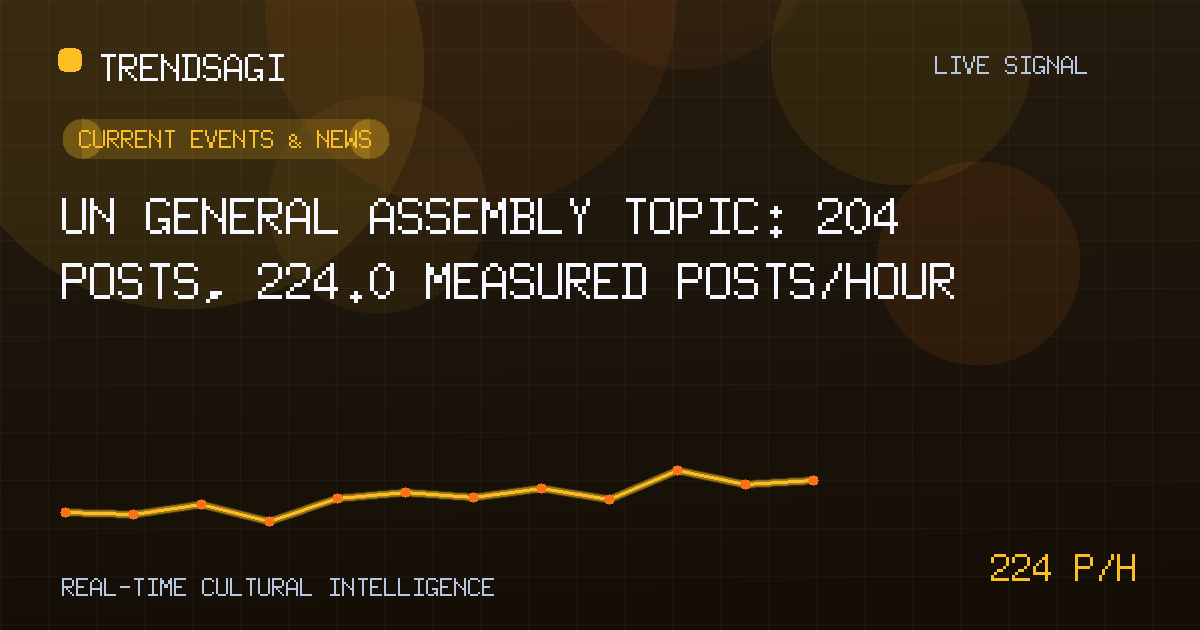
UN General Assembly topic: 204 posts, 224.0 measured posts/hour
A stored UN General Assembly snapshot has 204 posts and a measured 224.0 posts/hour; see what it means and what to verify next.
Automated briefing. Generated from stored signal measurements and source-backed research; it is not manually reviewed. Read the methodology and limitations.
Metrics in this briefing are a snapshot associated with its publication date and may not reflect current conditions.
What changed
The UN General Assembly topic is moving quickly within the stored sample: the latest snapshot contains 204 posts, and the measured snapshot rate is 224.0 posts/hour. The defensible conclusion is limited to rapid posting activity in that window—not a confirmed news trigger, a live/current rate, or evidence of a sustained wider trend.
The observation was taken at 2026-09-24T11:52:10Z. The 224.0 posts/hour figure was measured over an exact 900-second window using 3 stored observations. The 204 figure is the latest snapshot volume, not the rate; it is not reach, engagement, a forecast, or a count of unique people.
| Observation time | Measured snapshot rate | Latest snapshot volume |
|---|---|---|
| 2026-09-24T11:52:10Z | 224.0 posts/hour | 204 posts |
What the signal establishes
The measurement establishes that the sampled topic accumulated posts quickly around the observation time. It does not establish what the posts said, whether they concerned new Assembly business, or whether the topic label classified every sampled item accurately. No signal description is supplied, so an event, location, or actor cannot be inferred from the label alone.
No earlier comparable reading is provided. That means the 224.0 posts/hour figure cannot show how this window compares with a normal day, a previous Assembly event, or another topic. It also cannot establish that activity was rising from a previous level or would continue. “Surge” and “sustained trend” would both imply evidence not present here.
Volume is also not the same as participation. Several posts can come from one account, and quoted or repeated material can resemble independent discussion. The record gives no platform mix, geographic coverage, account overlap, or engagement distribution. It therefore cannot support a reliable estimate of the audience or the number of people behind the posts.
Why this topic may be moving
No verified public catalyst is established in the available record, so the cause remains unclear. The broad label could capture discussion of a meeting, vote, statement, diplomatic negotiation, or reactions to member states’ positions. These are possibilities to investigate, not findings about the stored posts.
A useful verification would connect a reputable publisher’s report of a specific development near 2026-09-24T11:52:10Z to the underlying post text. Without that link, a relevant headline cannot establish why this window shows 224.0 posts/hour, and no particular international event should be named as the trigger.
Possible explanations include a time-bounded news response, a cluster of posts around a scheduled event, or renewed circulation of earlier material. Those are hypotheses to test, not findings. The stored observations do not distinguish among them.
Why it matters
A fast measured posting rate is a reason to investigate, not evidence of what happened, why it happened, or who took part.
Diplomatic and policy readers should care because a concentrated conversation can identify an issue worth checking, not because it has already demonstrated political significance. Before changing a briefing or position, teams should verify the underlying event and distinguish official action from commentary.
Journalists and editors need the same caution. A high post count can prioritize reporting, but it cannot validate the claims being repeated or show that the conversation reflects public consensus. Researchers should preserve the topic definition and measurement window when comparing results; changing the collection rule could create an apparent change that is methodological rather than real.
For general readers, the practical value is knowing where to look for reliable updates. If a verified event is behind the posts, timely context may matter. If the activity is recycled commentary or a misclassified topic, it may not. The current record cannot resolve that distinction.
What to watch next
Start with event linkage rather than interpretation. Search public reporting around 2026-09-24T11:52:10Z for a specific Assembly-related development, then compare the publisher’s account with the sampled post text. Confirm the date, institution, and action before connecting the story to the measured activity.
- A named catalyst: A confirmed meeting, vote, statement, negotiation, or controversy connected to the sample. General Assembly coverage without that connection is insufficient.
- Post composition: Original comments, quotations, reposts, and off-topic matches, if the record permits. This helps separate new discussion from duplication without turning posts into people.
- A comparable baseline: A new posts/hour reading using the same query, collection rules, and observation method. A change in topic definition must not be mistaken for a change in activity.
- Persistence: Later stored readings under the same method. The current 900-second window cannot show whether activity continues, fades, or returns.
- Claim and evidence quality: Recurring actors, locations, and assertions, plus their support. Repetition should be documented as repetition, not upgraded into consensus or factual confirmation.
Methodology and limitations
This briefing separates the stored observation from interpretation. At 2026-09-24T11:52:10Z, the snapshot volume was 204 posts. The measured snapshot rate was 224.0 posts/hour over an exact 900-second window using 3 stored observations. Neither figure is a live/current rate, forecast, reach estimate, engagement measure, or unique-person count.
No historical baseline, collection method, platform coverage, geographic breakdown, sentiment result, or verified causal event is supplied. Those omissions constrain claims about direction, representativeness, audience, and cause. The topic’s current-events classification is not evidence of a particular event. The defensible takeaway is to investigate the cause, not to assert one.
Track This Topic for New Signals
Set alerts for future velocity or sentiment changes around this topic.
Explore Tracking PlansAbout TrendsAGI research
TrendsAGI's automated research pipeline publishes dated signal snapshots, methodology notes, and practical workflows for teams evaluating cultural momentum. Read how signals are scoped, scored, and limited in our research methodology.