901-second window · 3 observations · Measured Sep 30, 2026, 6:21 PM UTC · Provider: go_recent_snapshot_v2
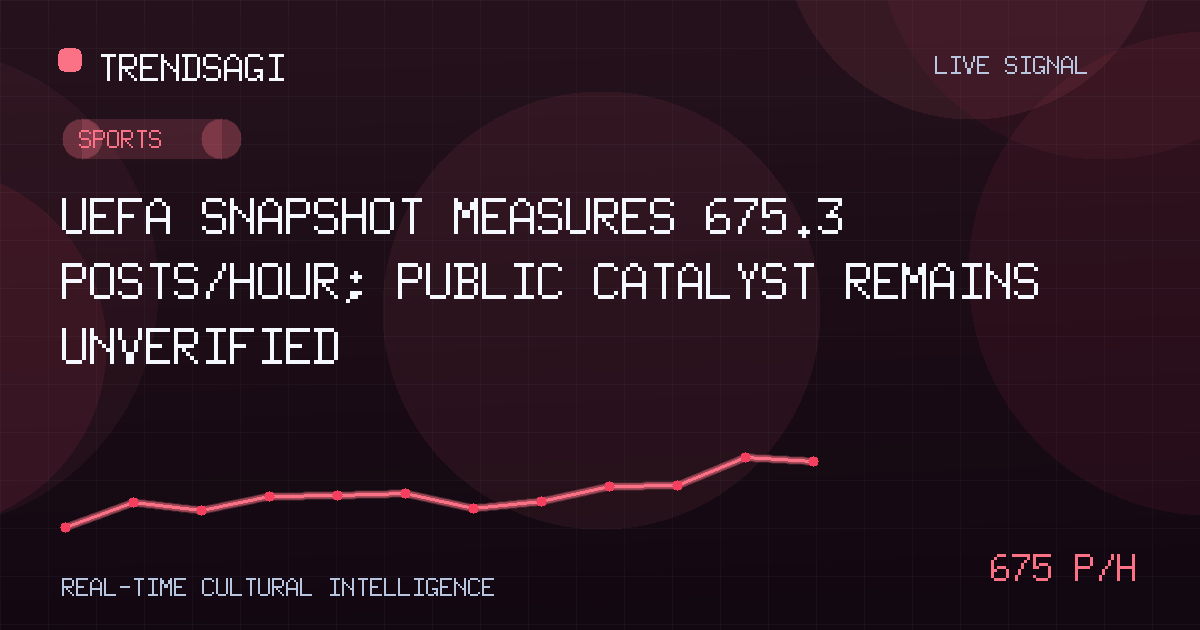
UEFA snapshot measures 675.3 posts/hour; public catalyst remains unverified
The UEFA signal measured 675.3 posts/hour over an exact 901-second window; the separate 642-post snapshot does not establish a catalyst.
Automated briefing. Generated from stored signal measurements and source-backed research; it is not manually reviewed. Read the methodology and limitations.
Metrics in this briefing are a snapshot associated with its publication date and may not reflect current conditions.
What changed
The posts associated with the UEFA label registered a measured snapshot rate of 675.3 posts/hour, while the latest snapshot contained 642 posts. This establishes that the label was active at the observation point, but it does not identify the event driving the activity or prove that the activity was sustained.
The 675.3 figure was measured over an exact 901-second window using 3 observations, with the result recorded at 2026-09-30T18:21:58Z. It is a measured historical snapshot rate, not a live or current rate, forecast, reach estimate, engagement measure, or count of unique people. No verified public catalyst is available, so naming a particular story would be speculation.
| Observation time | Measured posts/hour | Latest snapshot volume |
|---|---|---|
| 2026-09-30T18:21:58Z | 675.3 | 642 posts |
Why this topic may be moving
There is no evidence-backed single explanation yet. A UEFA-labeled burst can be tied to a timed announcement, match, result, competition draw, transfer, disciplinary decision, or club or national-team item. Those are candidate event types, not confirmed reasons. The signal also lacks the post-level evidence needed to determine whether a single story, multiple stories, or repeated reaction content drove the total.
The breadth of the label matters. Posts may use UEFA as shorthand for a governing-body decision, a club's European participation, a national-team item, or discussion adjacent to football rather than a single event. A high posting rate can therefore reflect meaningful news interest, a synchronized reaction, duplicated claims, or a mixture. Volume alone cannot separate them.
A measured rate establishes intensity inside its window; attribution requires a dated event, matching post content, and a plausible causal link.
A defensible causal match would need the public event to occur before the surge, sampled posts to refer to it explicitly, and independent parts of the discussion to converge on the same subject. If those conditions are absent, the safer conclusion is simply that UEFA-labeled posting was active during the measured window and its cause remains unresolved.
Why it matters
Attention is not the same as impact, and this signal supports operational decisions rather than a broader narrative about UEFA.
- Media and editors: Treat the spike as a verification prompt, not an automatic story assignment. A fast-moving label can create pressure to explain the activity quickly, while an incorrect causal frame could amplify the original discussion.
- Clubs, players, and sponsors: A conversation spike may become relevant to reputation or public messaging, but the measurement does not show sentiment, audience scale, or effects on people.
- Analysts: Preserve 642 and 675.3 as separate measures. Combining them or treating posts as unique participants would create a misleading account of attention.
- Trust and safety teams: A sudden rise can justify checking duplication, synchronized reposting, spam, or misleading claims, although none of those behaviors is established here.
What the signal can and cannot establish
The useful distinction is between observing activity and explaining it.
- It establishes: the observation time, a 642-post snapshot, a 675.3 posts/hour measured snapshot rate over 901 seconds, and a rate based on 3 observations.
- It cannot establish: how the activity compares with a prior period, because no baseline is supplied.
- It cannot establish: whether the rate persisted after the snapshot or whether it represents continuing attention rather than a temporary reaction.
- It cannot establish: unique participants, organic reach, engagement, sentiment, geography, language distribution, or account concentration.
- It cannot establish: whether posts were original, duplicated, automated, coordinated, or connected to a specific public event.
What to watch next
The next checks should distinguish sustained interest from a short, mechanically amplified burst and should test plausible explanations against the timestamps and text of the posts.
- Comparable windows: Apply the same posts/hour method to subsequent windows of similar length. Continued activity would support sustained attention; a quick reversal would be more consistent with a short reaction spike.
- Event alignment: Inspect posts nearest the observation timestamp, record the events they explicitly name, and compare those references with the timing of verified public developments.
- Source mix: Separate original reporting, commentary, reaction posts, and institutional communications. A surge dominated by unsourced repetition would require a different explanation from one led by reporting.
- Conversation breadth: Check whether activity spans independent accounts, languages, and regions. Concentration in a narrow cluster may indicate amplification rather than broad audience interest.
- Amplification pattern: Look for repeated wording, quote-post chains, synchronized timing, or multiple copies of the same claim. These patterns can inflate post volume without adding unique perspectives.
- Event resolution: Monitor for a confirmed announcement, result, correction, or official response. A relevant update that attracts follow-up discussion would provide stronger evidence of a lasting event-driven trend.
Methodology and limitations
The timestamp and measurements are preserved as provided. The 675.3 posts/hour value is reported as a measured snapshot rate from an exact 901-second window based on 3 observations. The 642 figure is the latest snapshot volume; it is not treated as a rate or as the number of posts created inside the measurement window.
The limited observation basis and absence of a prior baseline constrain comparisons. A normalized posts/hour rate can be sensitive to where observations fall within a burst, and a broad topic label may collect ambiguous or off-topic wording. The measurement also does not reveal sentiment, authenticity, reach, or unique participation.
No external event is named because a causal catalyst has not been verified. The supportable conclusion is therefore narrow: UEFA-labeled posting was active at the observed moment, while the reason for the movement remains unclear.
Track This Topic for New Signals
Set alerts for future velocity or sentiment changes around this topic.
Explore Tracking PlansAbout TrendsAGI research
TrendsAGI's automated research pipeline publishes dated signal snapshots, methodology notes, and practical workflows for teams evaluating cultural momentum. Read how signals are scoped, scored, and limited in our research methodology.