15-minute window · 3 observations · Measured Oct 2, 2026, 5:36 PM UTC · Provider: go_recent_snapshot_v2
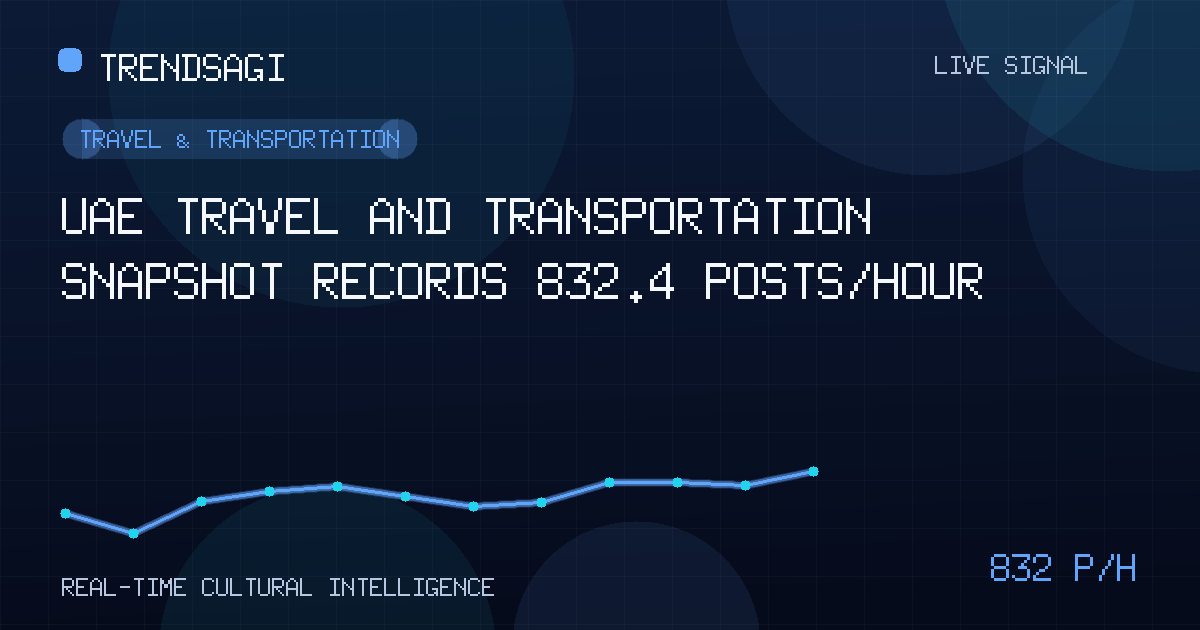
UAE travel and transportation snapshot records 832.4 posts/hour
The UAE topic logged 672 posts and a measured 832.4 posts/hour snapshot rate; here is what the signal can—and cannot—show.
Automated briefing. Generated from stored signal measurements and source-backed research; it is not manually reviewed. Read the methodology and limitations.
Metrics in this briefing are a snapshot associated with its publication date and may not reflect current conditions.
What changed
The UAE topic registered 672 posts in the latest stored snapshot at 2026-10-02 17:36:43 UTC. Across an exact 900-second window built from 3 stored observations, its measured snapshot rate was 832.4 posts/hour. The defensible takeaway is fast posting activity in that measured window, not a claim that the same pace continued afterward.
| Observation time | Measured snapshot rate | Latest snapshot volume |
|---|---|---|
| 2026-10-02 17:36:43 UTC | 832.4 posts/hour over 900 seconds; 3 observations | 672 posts |
The two figures answer different questions. Snapshot volume is the number of posts in the latest stored observation; posts/hour summarizes activity over the separate 900-second measurement window. The record does not supply enough underlying detail to reconcile them as if they shared the same denominator. It also does not convert discussion volume into traveler demand, resident behavior, unique participants, or operational impact.
Why this topic may be moving
The reason for the movement is unclear. No verified public context in the stored observation ties the pace to a particular announcement, incident, travel season, or campaign. Because the topic label is the entire UAE and the stored category is travel and transportation, the signal does not identify a city, airport, route, operator, or transport mode. Naming a trigger under those conditions would be speculation.
Several explanations remain testable. A service or policy announcement should leave traces in named places or accounts. Travel-planning interest may center on routes, fares, stays, or airport transfers. Promotional or coordinated amplification may show repeated wording and source concentration. A seasonal pattern would need comparison with other periods. These are checks to run, not conclusions supported by the current snapshot.
Why it matters
The immediate value is triage. Airlines, airports, rail and bus operators, hotels, transfer services, destination marketers, and travel editors can use the signal to decide what deserves closer inspection. It may point to a customer question, service disruption, information gap, or broader destination conversation. It may equally reflect repetition, promotion, or an event outside the travel category.
- Operations and customer-service teams can check whether posts identify a route, airport, vehicle, booking, or recurring service problem.
- Commercial teams can treat the conversation as a lead, then test it against searches, traffic, bookings, and actual customer behavior.
- Editors and policy teams should verify the location, source, and timing before turning the broad label into a public alert or response.
Geographic precision is crucial. A country-wide label can be dominated by discussion of one hub, corridor, or attraction. Acting on it as national demand could misdirect support, communications, or inventory decisions.
The strongest defensible conclusion is not that the UAE has a travel boom. It is that the UAE travel and transportation topic was moving at 832.4 posts/hour in this measured snapshot, while the driver, participants, and real-world consequences remain unverified.
What to check next
A fast triage sequence would be:
- Resolve the geography. Assign sampled posts to an emirate, city, airport, station, route, or attraction, and separate nationwide conversation from local concentration.
- Identify the subject. Code sampled items as announcements, questions, complaints, reactions, promotions, or duplicated material. This reveals whether a real information need exists.
- Test source concentration. Count distinct accounts, inspect repetition and timing, and check whether a small cluster accounts for the apparent momentum.
- Verify any claimed trigger. Match specific claims and timestamps with relevant official airport, airline, government, tourism, road, or rail publications; separate direct confirmation from unrelated coverage.
- Check downstream indicators. Compare the conversation with search interest, direct traffic, booking behavior, support contacts, or fare and availability changes. These indicators can corroborate relevance but do not prove causality.
What to watch next
The next useful signals are directional:
- Persistence: comparable later observations show whether the pace continues or was a short burst.
- Specificity: references concentrate on a named place, route, company, or transport mode.
- Independent confirmation: separate credible sources report the same event rather than repeating one post.
- Source diversity: activity broadens across accounts and regions instead of staying inside one cluster.
- Behavioral follow-through: searches, bookings, support questions, or operational measures move consistently with the discussion.
A persistent, geographically specific pattern with verified context would justify a confident briefing. Without those conditions, the correct status remains unexplained fast posting activity.
Methodology and limitations
The observation timestamp marks when the snapshot was recorded, not when any underlying event occurred. The 832.4 posts/hour value is a measured snapshot rate derived from 3 stored observations over an exact 900-second window. It is not a live or current rate, forecast, reach, engagement figure, or count of unique people.
The 672 posts are latest snapshot volume, not a rate. The topic-level measure does not reveal how posts were distributed across locations, languages, accounts, or subthemes, and the supplied data does not include a comparison baseline. Duplicate content, multiple posts from one account, or conversation not tied to travel could affect interpretation. None of those possibilities can be quantified from the supplied signal.
Use this observation as a queue for verification. It is enough to prompt focused monitoring and source checks, but not enough to identify the cause or quantify effects on UAE travel and transportation.
Track This Topic for New Signals
Set alerts for future velocity or sentiment changes around this topic.
Explore Tracking PlansAbout TrendsAGI research
TrendsAGI's automated research pipeline publishes dated signal snapshots, methodology notes, and practical workflows for teams evaluating cultural momentum. Read how signals are scoped, scored, and limited in our research methodology.