846-second window · 3 observations · Measured Sep 30, 2026, 9:25 PM UTC · Provider: go_recent_snapshot_v2
Tyler Mahle topic shows a measured 485.1 posts/hour snapshot rate
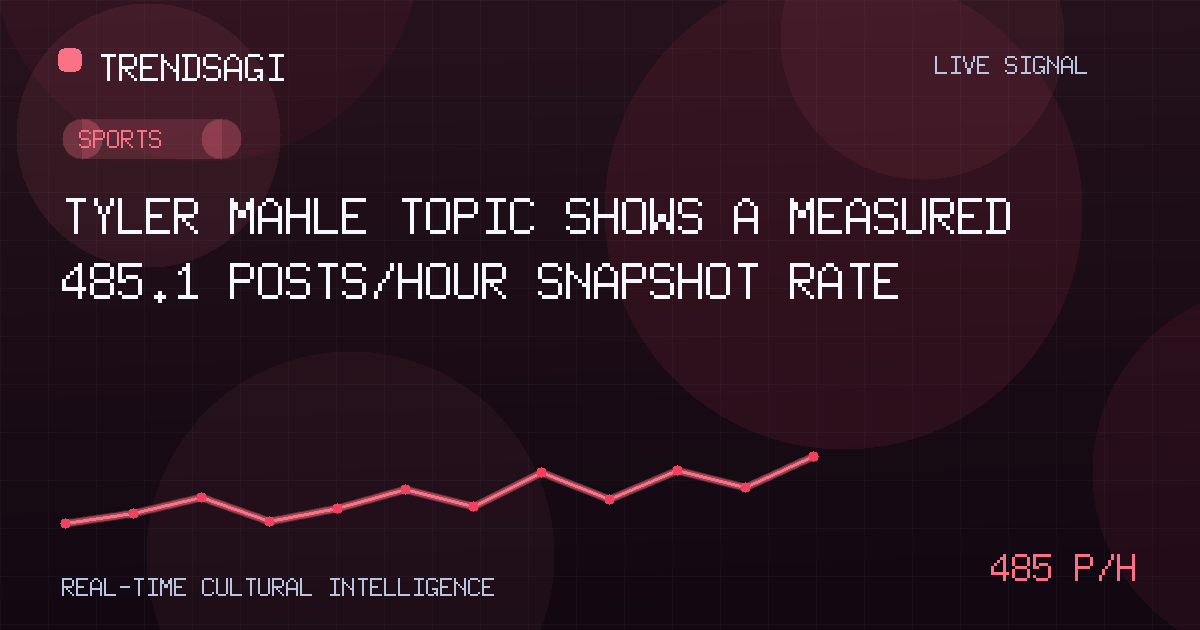
The Tyler Mahle signal shows 485.1 posts/hour in the measured window; this briefing explains what is known, what is not, and what to check next.
Automated briefing. Generated from stored signal measurements and source-backed research; it is not manually reviewed. Read the methodology and limitations.
Metrics in this briefing are a snapshot associated with its publication date and may not reflect current conditions.
What changed
The stored Tyler Mahle signal shows a measured snapshot rate of 485.1 posts/hour over an exact 846-second window using 3 stored observations, measured at 2026-09-30T21:25:22Z. Its latest snapshot contains 149 posts.
That establishes how quickly topic-attributed posts accumulated within the sampled interval. It does not establish a live or current rate, forecast, reach, engagement, or unique-person count. Because no earlier baseline is supplied, it also cannot show whether 485.1 is exceptional for Mahle, for the stored Sports category, or for comparable activity.
| Observation time | Measured snapshot rate | Snapshot volume |
|---|---|---|
| 2026-09-30T21:25:22Z | 485.1 posts/hour | 149 posts |
The two figures answer different questions. The rate describes pace; snapshot volume describes the amount in the latest stored observation. The record does not define whether the 149 posts belong to the same population used for the 485.1 posts/hour calculation, so the values should not be combined. Hourly normalization helps surface a short-window burst, but it is not evidence that the same pace lasted a full hour.
Why this topic may be moving
No verified public context establishes why the topic moved, and the stored signal contains no event description. The cause is therefore unresolved. The following are investigation paths, not factual explanations of this burst.
- Time-sensitive event: A game, announcement, availability update, or other sports development could produce immediate reporting and reaction.
- Narrative amplification: An outcome, clip, criticism, defense, or retrospective could prompt reaction and reposting.
- Distribution concentration: Quote posts, reposts, or duplicates could lift the post count without comparable growth in original discussion.
- Measurement change: A revised query, altered platform mix, or collection boundary could affect what is counted.
A game event, a media item, and a social clip may each create a different conversation pattern, but none can be tied to this observation from the information supplied. The key distinction is whether new facts drove new posts, existing material was recirculated, or the measurement itself changed.
The supported finding is about accumulation, not meaning: 485.1 posts/hour describes the sampled pace, while the reason for that pace remains unverified.
Why it matters
For an editor, this is a verification trigger rather than a conclusion about Mahle. A short, elevated rate can be worth checking quickly, but it carries no information by itself about sentiment, importance, credibility, or audience size. The 149-post snapshot gives the only absolute stored volume, not reach, while 485.1 gives normalized pace, not persistence.
- Sports editors: Use the signal to prompt timestamp checks, then verify any narrative against public reporting before publishing it as the cause.
- Social and community teams: Separate sustained discussion from a replay or repost burst before deciding whether a fact-based response is needed.
- Trend and research teams: Add a historical baseline, deduplication, source mix, and post-text classification before comparing topics.
- Readers and decision-makers: Do not treat 149 posts or 485.1 posts/hour as evidence of audience size, consensus, or influence.
A movement can be strategically relevant without being broadly consequential. Conversely, a modest post total can matter to a specialist audience. Without a benchmark, neither number should be labeled small, large, organic, or breakthrough.
What to watch next
The next useful work is verification rather than amplification.
- Establish timing and cause. A Google Search review centered on 2026-09-30T21:25:22Z should look for public items already published by the observation. Record the publisher and publication time for any credible match. A later summary does not establish what caused the earlier activity; if no timely item aligns, keep the cause unresolved.
- Test persistence. Compare the next stored observations with matched 846-second windows immediately before and after the observed interval. A single high snapshot may reflect clustering; sustained elevation across later observations would carry more weight.
- Audit sample composition. Review a representative post sample and classify original reporting, reaction, quote or repost, duplicate, and unrelated or ambiguous references. This can show whether apparent momentum is original discussion or repeated circulation.
- Separate breadth from recirculation. Check whether new original sources and accounts continue participating or whether the activity remains concentrated around the same item. Broadening would support a larger conversation; repetition would support a narrower explanation.
- Look for corroboration or correction. See whether multiple credible publishers report the same development, or whether clarification, denial, or retraction follows. Those are stronger signals of a durable event than unsupported repetition.
- Track the second wave. After any trigger is verified, watch whether discussion broadens into distinct substantive subtopics or fades as the initial item is copied. That distinction matters for whether the movement has lasting editorial relevance.
A practical escalation is straightforward: call it event-driven only when a timestamped public development aligns with fresh original posts. Treat it as short-lived recirculation if activity clusters around repeated material and the next comparable snapshots recede. Until both trigger and sample composition are verified, the accurate label is a measured post-volume spike with an unresolved cause.
Methodology and limitations
The rate reported here is the supplied measured snapshot rate for an exact 846-second window using 3 stored observations at 2026-09-30T21:25:22Z. The 149 posts are the latest snapshot volume. These are different measures, and neither is extrapolated into a live count or future projection. The hourly-normalized form is useful for alerting because it makes short observations comparable, but it can also magnify the visual effect of a brief cluster.
Important context is missing: there is no historical baseline, raw post text, source list, platform mix, account-level distribution, engagement data, sentiment, geography, query definition, or collection-change log. With 3 observations, the shape and persistence of activity inside and beyond the window cannot be assessed. The signal also cannot show whether participants are distinct, whether activity is organic or coordinated, or whether the topic is important relative to other sports conversations. The relationship between the rate population and the 149-post snapshot is unspecified. No external event is asserted because the public cause could not be verified.
The defensible conclusion is narrow but useful: the stored series recorded 485.1 posts/hour at the stated observation, alongside a 149-post latest snapshot. The next reporting decision should depend on persistence, original-post breadth, and a timestamped verified trigger—not on the rate alone.
Track This Topic for New Signals
Set alerts for future velocity or sentiment changes around this topic.
Explore Tracking PlansAbout TrendsAGI research
TrendsAGI's automated research pipeline publishes dated signal snapshots, methodology notes, and practical workflows for teams evaluating cultural momentum. Read how signals are scoped, scored, and limited in our research methodology.


