894-second window · 3 observations · Measured Oct 10, 2026, 7:21 AM UTC · Provider: go_recent_snapshot_v2
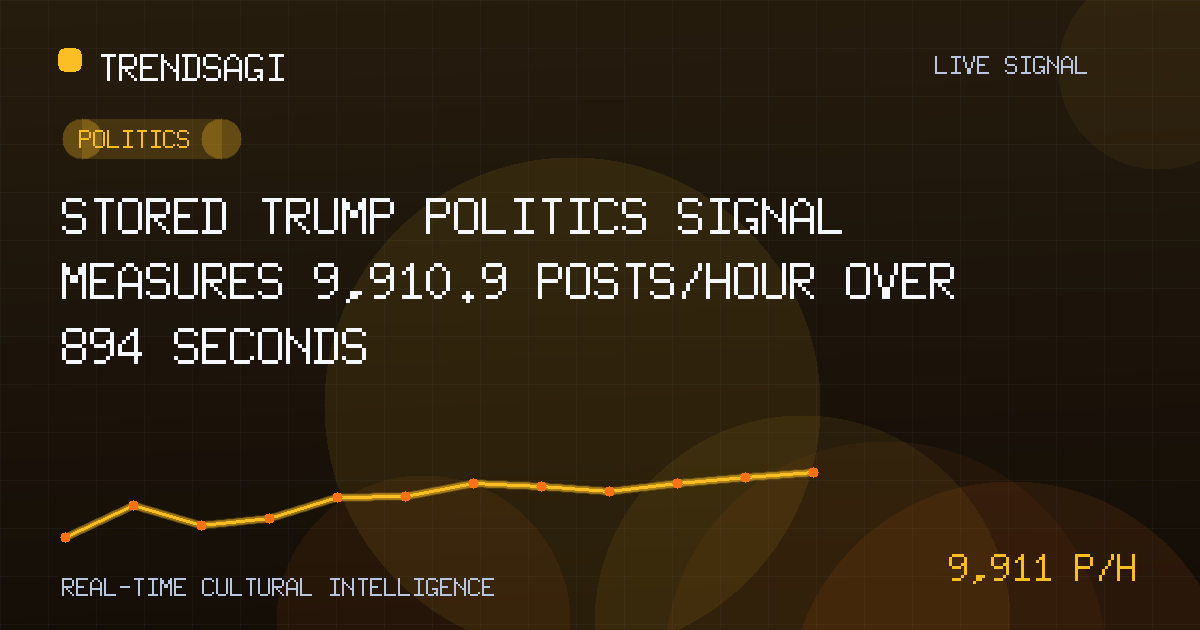
Stored Trump Politics signal measures 9,910.9 posts/hour over 894 seconds
A stored Trump Politics signal measured 9,910.9 posts/hour over 894 seconds; here is what the short-window spike can and cannot establish.
Automated briefing. Generated from stored signal measurements and source-backed research; it is not manually reviewed. Read the methodology and limitations.
Metrics in this briefing are a snapshot associated with its publication date and may not reflect current conditions.
What changed
The latest stored observation for the Politics topic labeled Trump shows a measured snapshot rate of 9,910.9 posts/hour. The figure comes from an exact 894-second window using three stored observations and is timestamped 2026-10-10T07:21:32Z; the record also reports a latest snapshot volume of 8,000 posts. The practical takeaway is a pronounced short-window burst in collected posting activity, not proof of a new event or a lasting shift in public opinion.
What can be said with confidence is limited to activity captured by the monitoring system. No verified, time-matched public context accompanies the signal, and the stored event description is empty. The cause therefore remains unclear. Editors and analysts should treat the result as a cue to check for breaking news, recycled claims, coordinated behavior, or a measurement effect—not as an explanation of why people posted.
| Observation time | Measured snapshot rate | Latest snapshot volume |
|---|---|---|
| 2026-10-10T07:21:32Z | 9,910.9 posts/hour | 8,000 posts |
Why this topic may be moving
No verified public trigger accompanies this snapshot, so any explanation must remain provisional. Several mechanisms could produce the pattern:
- Breaking-news response: A newly available statement, recording, court decision, campaign development, or other event could prompt rapid posting.
- Amplification from one source: A viral post, video, screenshot, or disputed quotation could generate many near-identical reactions.
- Scheduled attention: An address, interview, debate, anniversary, or campaign deadline could concentrate activity around a known moment.
- Nonorganic volume: Coordinated accounts, automated posting, or repost farms could raise the count faster than distinct human participation.
- Collection or labeling effects: Changes in sampling, duplicate handling, or broad keyword matching could alter the signal without an equivalent change in the underlying conversation.
These are testable hypotheses, not findings. A defensible cause would need timestamp alignment with the 894-second window, independent public corroboration, and evidence that the posts were substantively about the same development rather than merely mentioning the topic label.
What the signal can—and cannot—establish
The measured rate and snapshot volume answer different questions. The 9,910.9 posts/hour figure characterizes posting speed in the stored sample during the exact 894-second window. The 8,000-post figure is the size of the latest snapshot, not a rate. Neither measure establishes unique authors, reach, impressions, engagement, sentiment, factual accuracy, or policy impact. One account can publish repeatedly, while duplicate, automated, or near-identical content can inflate apparent breadth.
A measured post rate is evidence of activity inside a collection system, not proof of what happened, why it happened, or whether the underlying claims are true.
The largest interpretive gap is the missing baseline. Comparable earlier observations are not supplied, so the signal cannot establish how unusual 9,910.9 posts/hour is for this topic, whether the burst outlasts the measured window, or whether it exceeds prior news cycles. The broad “Trump” label and stored “Politics” category also do not show that every post expressed a political view or focused on the person named in the label.
Why it matters
Volume is useful mainly because it directs attention quickly. The people who should inspect the next layer of evidence are:
- Political editors and reporters: use the burst to decide which breaking claims merit immediate verification, while avoiding the assumption that volume confirms importance.
- Campaign, government, and advocacy teams: monitor whether the conversation is broad or concentrated, and prepare to answer the specific claim being repeated rather than the trend label alone.
- Platform trust and safety teams: test for coordinated posting, duplicate content, manipulation, or harmful misinformation that a raw count cannot reveal.
- Researchers and civic analysts: compare the observation with a stable baseline and account for geography, language, sampling, and collection artifacts before drawing conclusions.
- General readers: treat the number as a prompt to inspect sources and evidence, not as a poll, popularity score, or measure of consensus.
That makes the signal operationally useful even without a confirmed catalyst: it identifies where a rapid verification pass may save time.
What to watch next
The next checks should be concrete enough to change the interpretation:
- Catalyst: Look for a public report or primary record whose timing precedes or overlaps the 894-second window. A development published afterward cannot explain the initial burst.
- Content convergence: Determine whether a large share of posts cites the same statement, clip, quotation, accusation, or event. Shared substance is stronger evidence than a shared keyword.
- Persistence: Collect subsequent comparable snapshots. A rate sustained across several windows is more consequential than one confined to the measured interval.
- Concentration: Measure how much activity comes from the largest accounts, domains, or repost networks, and inspect repeated text and posting timing.
- Participation breadth: Check unique-account activity, communities, geography, and language. More distinct participants would support broader attention than many posts from a narrow group.
- Substantive sample: Review leading posts and classify them as original reporting, quotations, reactions, accusations, corrections, advertising, spam, or automated content.
- Attention quality: Compare production volume with views, saves, citations, and other engagement measures where available. Raw posting speed alone does not show whether people found the content useful or credible.
Persistence, independent verification, and broader unique participation would strengthen the case for genuine news-driven attention. An immediate decline or heavy concentration in near-duplicate posts would instead point toward a transient, coordinated, or nonorganic pattern. Neither outcome is established by the current signal.
Methodology and limitations
The figures are reported directly from the stored record: an observation timestamp of 2026-10-10T07:21:32Z, a latest snapshot volume of 8,000 posts, and a measured rate of 9,910.9 posts/hour calculated across an exact 894-second window using three observations. “Measured” describes how the rate was produced from those stored points; it does not mean the system counted every post everywhere or that the sample is representative.
The rate is a measured historical snapshot, not a live or current rate, forecast, reach measure, engagement metric, or unique-person count. The 8,000-post value is snapshot volume, not posts per hour. No platform coverage, geographic scope, account-deduplication method, historical baseline, sentiment breakdown, or verified event context is supplied.
Short windows can be sensitive to bursts, duplicates, and collection timing. The result is therefore best treated as a monitoring alert: it establishes that the stored sample registered 9,910.9 posts/hour at the stated observation time, while leaving the trigger, durability, audience, and substantive meaning unresolved.
Track This Topic for New Signals
Set alerts for future velocity or sentiment changes around this topic.
Explore Tracking PlansAbout TrendsAGI research
TrendsAGI's automated research pipeline publishes dated signal snapshots, methodology notes, and practical workflows for teams evaluating cultural momentum. Read how signals are scoped, scored, and limited in our research methodology.


