914-second window · 3 observations · Measured Oct 2, 2026, 3:11 AM UTC · Provider: go_recent_snapshot_v2
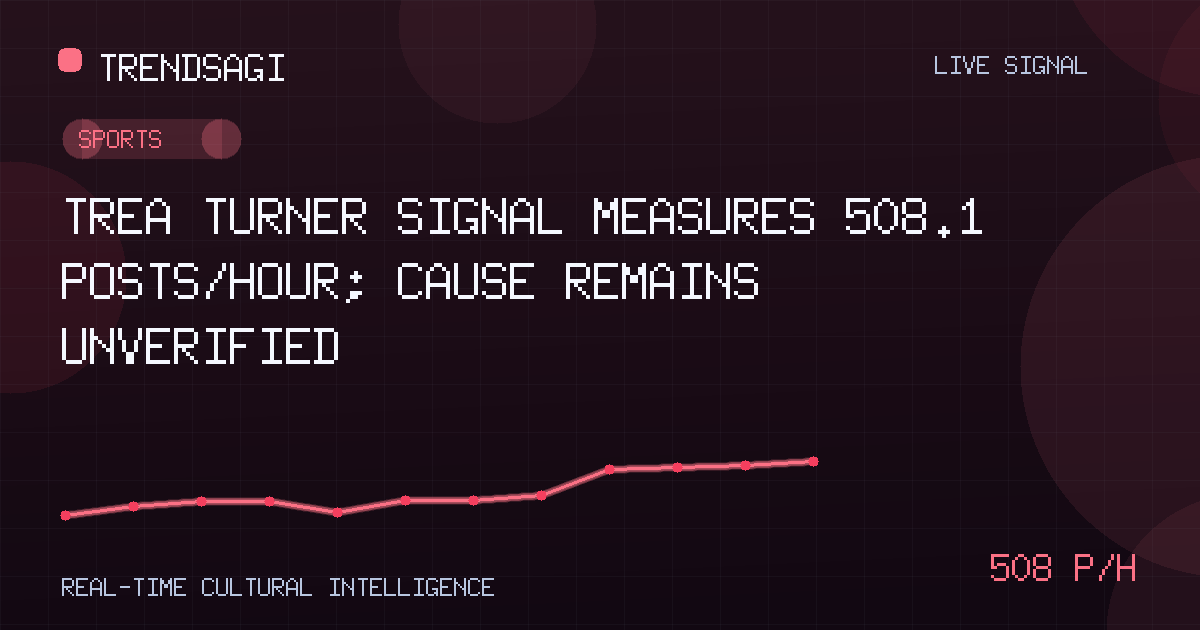
Trea Turner signal measures 508.1 posts/hour; cause remains unverified
Trea Turner's stored signal shows 508.1 posts/hour and 264 snapshot posts; here is what editors should verify next.
Automated briefing. Generated from stored signal measurements and source-backed research; it is not manually reviewed. Read the methodology and limitations.
Metrics in this briefing are a snapshot associated with its publication date and may not reflect current conditions.
What changed
The direct read is that Trea Turner is associated with a concentrated burst of social posting activity: the stored Sports signal measures 508.1 posts/hour. The cause is not established by the available record, so the movement should not be attributed to a match, injury, roster decision, controversy, or social post without verification.
The 508.1 figure is a measured snapshot rate based on three stored observations across an exact 914-second window ending at 2026-10-02T03:11:29Z. The latest snapshot volume was 264 posts. Snapshot volume is a separate stored measure, not a rate, reach estimate, engagement total, or unique-person count.
| Metric | Stored value | Interpretation |
|---|---|---|
| Observation time | 2026-10-02T03:11:29Z | UTC endpoint of the measured window |
| Measurement basis | 3 observations across 914 seconds | Exact basis for the measured change rate |
| Measured snapshot rate | 508.1 posts/hour | Historical measurement, not a live rate or forecast |
| Latest snapshot volume | 264 posts | Separate volume measure, not a unique-person count |
Why this topic may be moving
No verified public context establishes why the topic is moving. A name-centered burst can have several triggers, and the signal by itself cannot distinguish among them. The following are hypotheses to test, not findings:
- A live sporting event produced a result, announcement, or disputed moment.
- A broadcast clip, exchange, or public social post began circulating beyond its original context.
- Several unrelated conversations happened to include the name, creating the appearance of one story.
- Reposting, duplication, or automated behavior amplified the number of matching posts.
None should be presented as the explanation without a public source and a timeline that supports the connection. Until then, “cause unclear” is more accurate than a confident sports-news attribution.
A measured rate shows how quickly posts appear in the sampled record. It does not show who is posting, whether the posts are original, what they say, or why the activity began.
Who should care
The signal is useful as an alert, but its value depends on who is asking the question:
- Sports editors and reporters should verify the triggering event before writing a causal headline or treating the burst as a developing story.
- Athlete, team, brand, and reputation teams should inspect the underlying conversation before responding. High posting activity can indicate attention, criticism, confusion, or ordinary repetition.
- Trend and platform analysts should test whether activity is broad or concentrated among a small set of accounts, source types, or duplicated content.
- Readers should not equate a high posts/hour figure with popularity, accuracy, sentiment, or the number of people involved.
For all of these groups, the immediate need is context—not a larger adjective attached to the number.
What to watch next
These checks would turn the alert into a more reliable briefing:
- Establish chronology. Use Google Search to find public pages published close to the observation that connect Trea Turner to one specific new event. An event that occurred after the measured window cannot explain it; an older event needs evidence that discussion was newly accelerating.
- Collect comparable measurements. Compare later windows produced under the same collection rules with the 508.1 posts/hour measured snapshot rate. A sustained comparable rate would be consistent with persistence, while a lower follow-up rate would be consistent with cooling. Neither outcome is a forecast.
- Track the volume measures separately. Record each new observation time, measured posts/hour, and snapshot volume. Do not combine the current 264 posts with the rate or assume that one is derived directly from the other.
- Audit composition. Check whether matching posts are original reporting, personal reactions, quotations, reposts, or duplicates, and whether a few accounts dominate. A duplicate-heavy cluster suggests amplification rather than a broad new audience.
- Identify a coherent narrative. Look for a shared claim or event across independent publishers and public posts. Only then should a publisher-backed explanation replace “cause unclear.”
The strongest positive confirmation would be a verified event timeline followed by a coherent discussion cluster and comparable activity in later windows. A rapid decline, heavy duplication, or no shared narrative would weaken the case for a durable new event, but would not explain the original cause by itself.
Methodology and limitations
This briefing uses the canonical stored observation ending at 2026-10-02T03:11:29Z: three observations across an exact 914-second window, a measured snapshot rate of 508.1 posts/hour, and latest snapshot volume of 264 posts. The rate is a historical measurement, not a live value, projection, reach estimate, engagement measure, or unique-person count.
The record supplies no comparison baseline, collection geography, account-level deduplication, sentiment, content distribution, or unique-account count. It therefore cannot show whether 508.1 is unusually high for Trea Turner, whether the posts represent broad public interest, or whether the same people posted repeatedly. The stored metadata also does not explain how the 264-post snapshot relates arithmetically to the measured rate, so the two figures should remain distinct.
No verified public context establishes a catalyst. The signal therefore supports a claim about the observed posting burst and its measurement, not a claim about why it happened. The defensible editorial conclusion is that a 508.1 posts/hour measured snapshot burst is present, its cause remains unclear, and the next decision depends on event verification and comparable follow-up observations.
Track This Topic for New Signals
Set alerts for future velocity or sentiment changes around this topic.
Explore Tracking PlansAbout TrendsAGI research
TrendsAGI's automated research pipeline publishes dated signal snapshots, methodology notes, and practical workflows for teams evaluating cultural momentum. Read how signals are scoped, scored, and limited in our research methodology.