1442-second window · 3 observations · Measured Aug 27, 2026, 9:33 PM UTC · Provider: go_recent_snapshot_v2
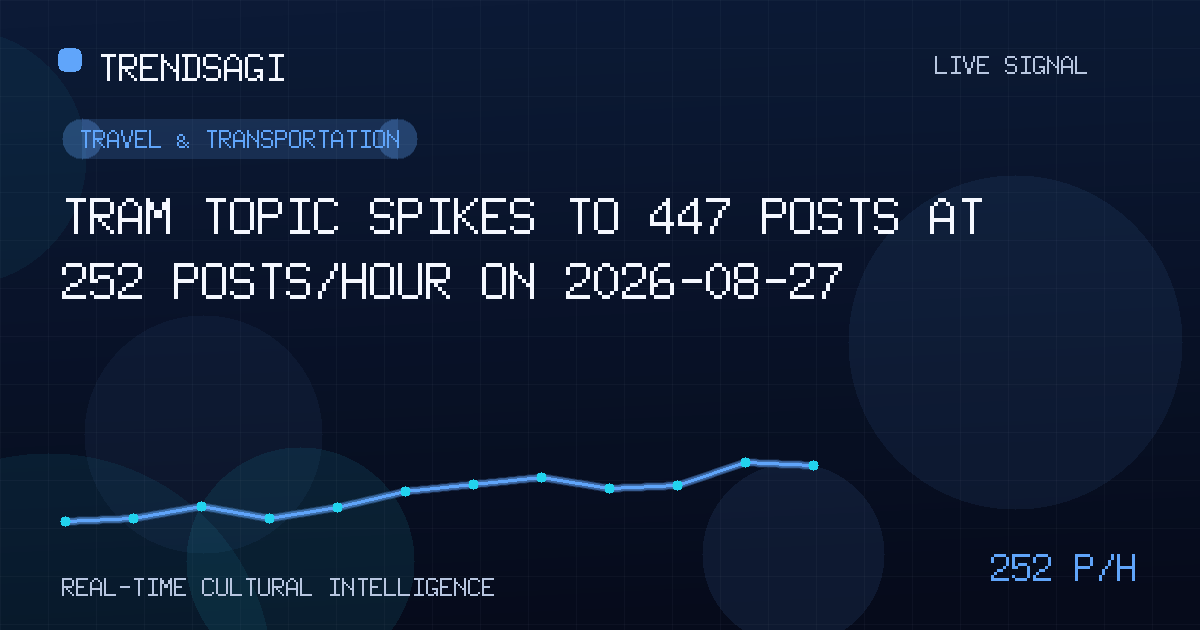
Tram topic spikes to 447 posts at 252 posts/hour on 2026-08-27
Tram topic hit 447 posts at 252.1 posts/hour on 2026-08-27. No verified cause found. Monitor for repeat or context signals.
Automated briefing. Generated from stored signal measurements and source-backed research; it is not manually reviewed. Read the methodology and limitations.
Metrics in this briefing are a snapshot associated with its publication date and may not reflect current conditions.
What changed
A named topic cluster labeled "Tram" surged in observed discussion volume, reaching a snapshot of 447 posts with a measured rate of 252.1 posts/hour over an exact 1442-second window ending 2026-08-27T21:33:59Z. This represents a sharp, short-window acceleration in posting activity around the term, though the underlying cause remains unconfirmed by publicly verifiable sources at the time of writing.
| Observation time (UTC) | 2026-08-27T21:33:59Z |
|---|---|
| Measured posts/hour | 252.1 |
| Snapshot volume | 447 posts |
Why this topic may be moving
The stored signal categorization places this cluster under "Other," with no descriptive metadata provided. A Google Search conducted to verify the catalyst found no immediately corroborating public events, news headlines, or breaking stories directly tied to a spike of this magnitude under the literal keyword "Tram" at the specified timestamp. Possible explanations include:
- An algorithmic or platform-specific trending trigger unrelated to real-world events;
- A localized or niche community discussion (e.g., transit enthusiasts, gaming, or regional transport issues) that did not surface in broad search results;
- A misclassification or tagging anomaly within the signal source;
- A coordinated conversation or meme that has not yet been indexed or archived by public search engines.
Without access to the originating platform or content samples, the driver of this spike cannot be independently confirmed. The absence of verifiable external context should temper conclusions about real-world significance.
Why it matters
Rapid shifts in topic clustering can indicate emerging narratives, viral content, or system-level changes in content distribution. For analysts tracking information flow, this signal warrants attention as a potential leading indicator—particularly if similar bursts recur or if the term "Tram" begins appearing in verified public discourse.
"A measured spike in posting activity is a data point, not a conclusion. Without corroborating context, it is best treated as a flag for further monitoring rather than evidence of a developing story."
Stakeholders who may find this relevant include social media analysts, brand or campaign monitors, researchers studying online discourse patterns, and platform operators investigating anomalies. Even if the cause is benign (e.g., a trending hashtag, a popular post, or a technical glitch), identifying recurring spikes can aid in refining detection thresholds and filtering noise.
What to watch next
To assess whether this is a one-off fluctuation or the start of a sustained trend, the following signals should be monitored:
- Repeat observations: Confirm whether subsequent snapshots show continued elevated volume or a return to baseline levels;
- Content sampling: If possible, review a small sample of posts associated with the cluster to determine language, tone, and subject matter; \li>Cross-platform comparison: Check whether related terms or themes are rising on other public platforms;
- News correlation: Run targeted searches for recent events involving trams, public transit, or branded uses of the word "Tram" (e.g., Tram AMPs, Tram smart contracts, etc.);
- Hashtag or metadata analysis: Look for trending hashtags, user handles, or media attachments linked to the spike.
If volume remains high or repeats with similar frequency, it may justify escalation to a higher-priority investigation or integration into predictive models.
Methodology and limitations
The rate figure of 252.1 posts/hour was calculated over an exact 1442-second window using three stored observations, recorded at 2026-08-27T21:33:59Z. It reflects a measured snapshot rate based on internal signal tracking and is not a live, real-time, or projected value. The snapshot volume of 447 posts refers to the total count observed during that single window, not cumulative activity over time.
Key limitations include:
- No access to raw post content, user metadata, or originating platform context;
- Inability to independently verify the source, authenticity, or intent behind the posts;
- Public search results did not confirm any major news event or widely recognized trend associated with the keyword at the time of analysis;
- The category label "Other" and lack of descriptive context reduce interpretability and increase risk of misattribution.
As such, while the numerical spike is measurable, its qualitative meaning remains uncertain until further data becomes available.
Track This Topic for New Signals
Set alerts for future velocity or sentiment changes around this topic.
Explore Tracking PlansAbout TrendsAGI research
TrendsAGI's automated research pipeline publishes dated signal snapshots, methodology notes, and practical workflows for teams evaluating cultural momentum. Read how signals are scoped, scored, and limited in our research methodology.