901-second window · 3 observations · Measured Sep 25, 2026, 7:52 AM UTC · Provider: go_recent_snapshot_v2
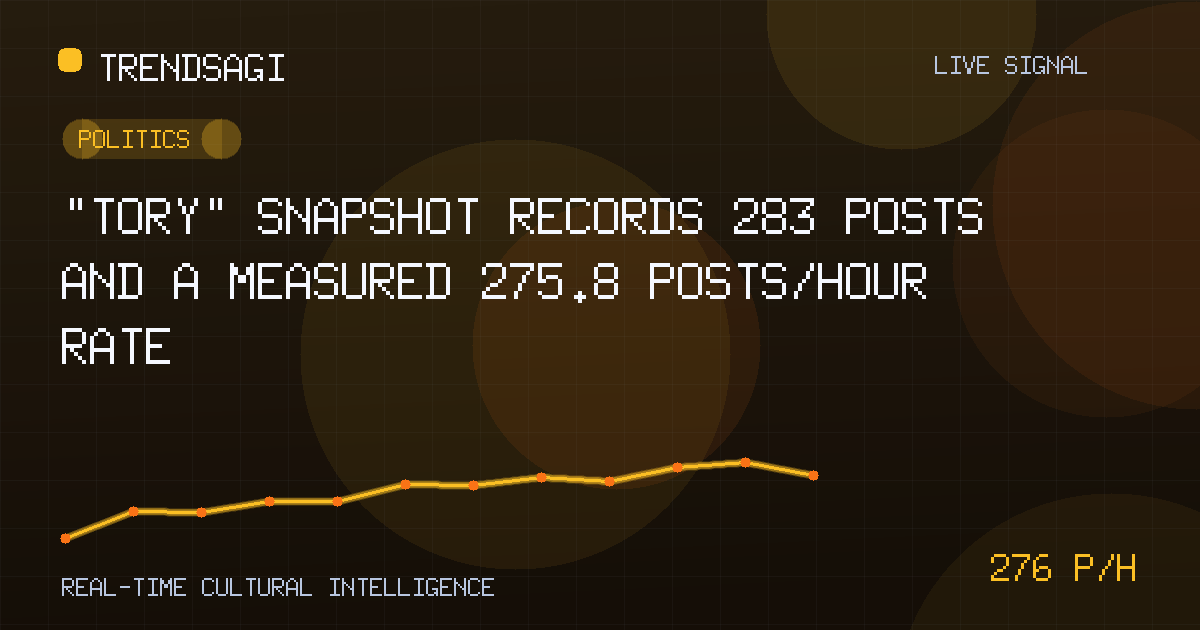
“Tory” snapshot records 283 posts and a measured 275.8 posts/hour rate
A stored “Tory” snapshot recorded 283 posts and a measured 275.8 posts/hour rate over 901 seconds; the briefing separates observation from unverified
Automated briefing. Generated from stored signal measurements and source-backed research; it is not manually reviewed. Read the methodology and limitations.
Metrics in this briefing are a snapshot associated with its publication date and may not reflect current conditions.
What changed
The stored “Tory” signal recorded 283 posts in the latest snapshot at 2026-09-25T07:52:03Z. Across an exact 901-second window using 3 stored observations, its measured snapshot rate was 275.8 posts/hour.
Direct answer: activity assigned to “Tory” warrants closer inspection, but its cause is unverified. The rate is not a live/current rate, forecast, reach estimate, engagement measure, or count of unique people, and the stored record does not establish a change in public opinion or political support.
| Observation time | Measured posts/hour | Latest snapshot volume |
|---|---|---|
| 2026-09-25T07:52:03Z | 275.8 posts/hour | 283 posts |
Keep these measures separate: the snapshot count and the window-based rate describe different quantities.
Why this topic may be moving
The cause is not established in the available record. The stored category is Politics, but the signal description is empty, and this briefing has no independently verified public context linking the timing to a particular development. These are checks to run, not explanations supported by the record.
- Event-linked discussion: Check whether posts repeatedly refer to a newly published statement, debate, campaign event, or policy announcement. A timestamped public item that precedes the cluster may explain attention, but a later article alone does not establish causation.
- Label ambiguity: Determine whether “Tory” is being used for party politics, a particular political reference, criticism, or another meaning. Do not treat differently framed posts as one narrative without examining their text and context.
- Repetition and distribution: Look for identical wording, quoted messages, copied articles, or repeated links. These can produce substantial topic volume without representing independent reactions, so deduplication and account-level review come before interpretation.
- Collection effects: Confirm that the query, matching rules, and capture process were consistent. A difference in what was collected could affect the result; nothing in the record establishes that such a change occurred.
Until that work is done, plausible-sounding links to a speech, policy dispute, or campaign update should remain hypotheses. The empty signal description provides no basis for choosing among them.
Why it matters
Journalists, campaign researchers, fact-checkers, and monitoring teams can use the measurement to decide which posts and timestamps deserve review. The important distinction is between attention to a label and evidence about the political issue behind it.
A measured post rate is a prompt to investigate, not a verdict on policy support, party influence, or the credibility of claims appearing in the posts.
For readers tracking UK Conservative politics, a concentrated window may warrant checking official statements and reporting. But without geography, platform coverage, or sampling information, the signal cannot be treated as a representative picture of voters or national conversation.
A useful editorial distinction is also between attention and impact. Increased discussion may increase the visibility of a claim without establishing that the claim is true, widely held, or likely to change behavior. Those questions require separate evidence and clearly described analysis.
The practical value is triage rather than a conclusion. Preserve the source posts, verify any claimed trigger, and avoid using the snapshot count as a proxy for popularity.
What to watch next
- Establish the chronology. Inspect the earliest distinctive posts associated with the recorded window, identify the first substantiated public reference, and check whether it predates the cluster. Separately record original publication times and later reposts.
- Compare like with like. Use the same 901-second window length, collection method, and topic-matching rules for adjacent intervals. Compare snapshot counts with snapshot counts and measured rates with measured rates; do not interchange them.
- Seek a verifiable driver. Check relevant official party communications, verified statements by political figures, and reporting from established publishers for a new event or intervention that aligns with the timing. Alignment supports an explanation, not automatic proof of causation.
- Watch for persistence and diffusion. Determine whether similarly measured activity continues in adjacent windows, whether one source is being widely repeated, and whether discussion moves from a specific claim to broader commentary. Continued activity would support a sustained-attention hypothesis; a single concentrated interval would not.
- Code a transparent sample. Separate event-specific references from generic uses, and record positive, negative, neutral, or unclear framing under an explicit rubric. Report the sample size and selection method, and do not generalize coded findings to all 283 posts.
Methodology and limitations
The reported 275.8 posts/hour is the supplied measured snapshot rate, based on 3 stored observations over an exact 901-second window and measured at 2026-09-25T07:52:03Z. The latest stored snapshot volume is 283 posts. Neither value is a live platform-wide total.
The rate is retained as supplied. An independent reproduction is not possible from this record because the individual observation values, matching criteria, and collection coverage are not provided. No confidence interval or platform-wide sampling frame is available.
No earlier series values or post-level sample are provided. The briefing therefore cannot establish whether the activity was unusual against a longer baseline, whether it accelerated or decelerated, or whether repeated posts came from the same accounts. It also cannot establish sentiment, authenticity, or representativeness.
The topic label is reproduced as recorded, not treated as proof that every post concerns the same subject. No verified public cause is connected to the timing for this briefing. Its defensible use is to focus scrutiny on the recorded window, inspect the underlying posts, and withhold broader conclusions until the missing context is supplied.
Track This Topic for New Signals
Set alerts for future velocity or sentiment changes around this topic.
Explore Tracking PlansAbout TrendsAGI research
TrendsAGI's automated research pipeline publishes dated signal snapshots, methodology notes, and practical workflows for teams evaluating cultural momentum. Read how signals are scoped, scored, and limited in our research methodology.


