875-second window · 3 observations · Measured Oct 10, 2026, 8:56 AM UTC · Provider: go_recent_snapshot_v2
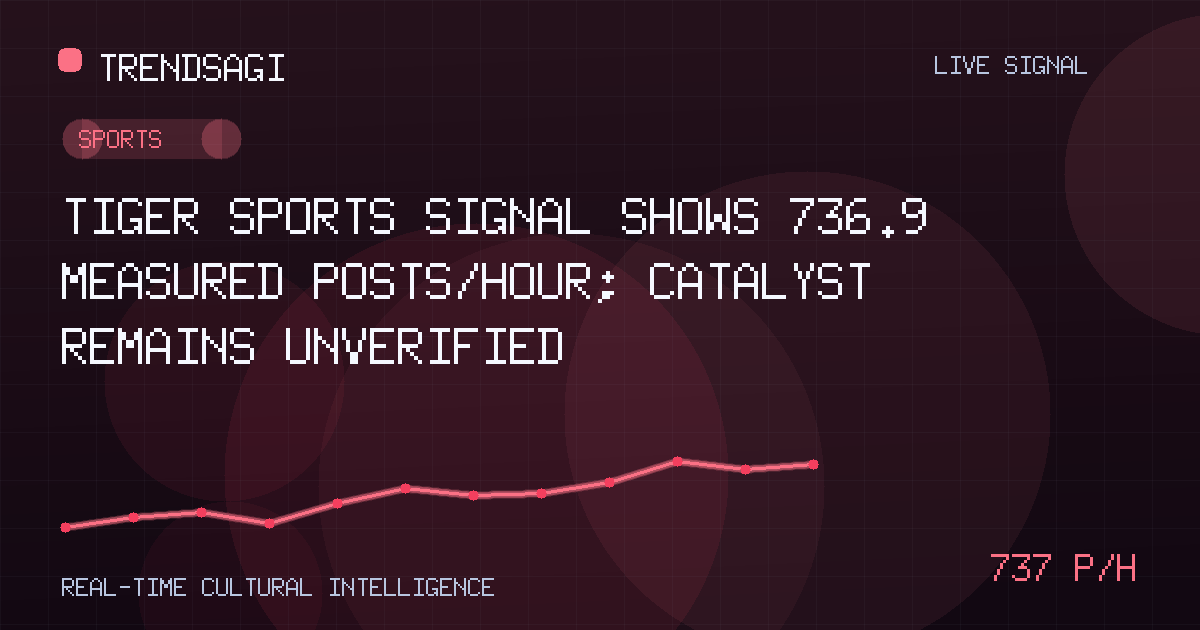
Tiger sports signal shows 736.9 measured posts/hour; catalyst remains unverified
Tiger sports posts show a measured 736.9 posts/hour snapshot rate; a separate 301-post snapshot has no verified catalyst or resolved subject.
Automated briefing. Generated from stored signal measurements and source-backed research; it is not manually reviewed. Read the methodology and limitations.
Metrics in this briefing are a snapshot associated with its publication date and may not reflect current conditions.
What changed
Answer: The “Tiger” sports signal shows increased activity, but the available record does not identify which person, team, competition, or news event the label represents. No public catalyst has been verified, so the increase should be treated as a monitoring alert rather than evidence for a specific sports story.
The measured snapshot rate is 736.9 posts/hour over an exact 875-second window using 3 stored observations. The latest snapshot was observed at 2026-10-10T08:56:20Z and contains 301 posts. The rate summarizes the observed change during that window; it is not a live/current rate, forecast, reach, engagement total, or count of unique people.
| Observation time | 2026-10-10T08:56:20Z |
|---|---|
| Measured snapshot rate | 736.9 posts/hour |
| Latest snapshot volume | 301 posts |
Why this topic may be moving
The stored category, “Sports,” narrows the field but does not resolve the subject. “Tiger” can be a surname, nickname, team name, event label, or a term used in unrelated sporting contexts. Several clusters can therefore contribute to one aggregate signal without representing one conversation.
- Entity mix: Posts may refer to different athletes, clubs, college programs, or competitions whose shared label is only “Tiger.” Entity resolution is the first unresolved issue.
- Event timing: A match, tournament, result, roster move, award, or announcement could create a concentrated burst, but no particular event has been verified as the trigger.
- Reaction cascade: An initial report, if one exists, could be followed by quotes, reactions, summaries, and reposts. That would increase captured volume without adding new underlying facts.
- Query effect: A broad keyword may capture incidental uses of “Tiger.” If collection or keyword matching changed, apparent momentum could also differ from normal conversation.
The defensible conclusion is narrow: more posts were captured during the measured window; who they concerned and why remain unresolved.
Why it matters
For a sports desk, this is a time-sensitive triage signal, not a ready-made headline. The first editorial question is not “What happened?” but “What does Tiger refer to here?” A reporter or editor should be able to name the entity, inspect representative posts, and find a verified event before assigning a narrative.
The rate also matters operationally. A measured 736.9 posts/hour indicates that the sampled feed changed quickly enough to merit timely review. It does not show how many people saw, authored, or responded to those posts. The 301 posts in the latest snapshot may include different authors, repeated material, or incidental mentions; the supplied figures cannot separate them.
- Editors and reporters need entity-level verification before treating the signal as a developing story.
- Audience and social teams need to distinguish a genuine single-subject spike from blended keyword traffic.
- Community and risk teams should check whether rapid repetition is introducing unsupported claims or confusion about which subject is involved.
What the signal can—and cannot—establish
The available evidence supports a descriptive finding, not a causal one.
- It establishes: a measured increase in captured posts of 736.9 posts/hour during the specified 875-second window, based on 3 observations; the latest snapshot time; and 301 posts at that time.
- It does not establish: the identity of the relevant person or team, the event behind the movement, sentiment, originality, organic versus automated posting, geography, or the number of unique participants.
- It cannot show persistence: a short measurement window does not prove that the increase continued beyond the sampled period or establish a longer-term baseline.
- It does not measure impact: posts/hour is not impressions, engagement, audience size, or public preference.
What to watch next
- Resolve the label. Review a representative sample of matching posts and cluster them by full names, hashtags, team references, competition terms, and location. Remove clusters that merely use “Tiger” incidentally.
- Establish sequence. Compare the first substantiated post, the verified news event, and the observation window. A catalyst published after the movement may be reporting the conversation rather than causing it.
- Check the next snapshots. Keep the query, collection method, window, and deduplication rules consistent. Compare both the measured snapshot rate with 736.9 posts/hour and snapshot volume with 301 posts; neither measure should substitute for the other.
- Verify the public context. Attribute a catalyst only when a reliable publisher explicitly connects a named person, team, or event to the burst. Separate the primary fact from later commentary.
- Inspect concentration and source mix. Determine whether activity is spread across independent publishers and original posts or dominated by one account, repeated text, or a single subtopic.
Concrete confirmation would look like a verified catalyst preceding the rise, a dominant cluster naming the same subject, and subsequent snapshots showing continued activity under the same method. If those checks fail, retain the finding as an ambiguous “Tiger” spike rather than reverse-engineering a story from the label.
Methodology and limitations
This briefing distinguishes the observed change from its interpretation. The measured snapshot rate is 736.9 posts/hour, calculated from 3 stored observations over an exact 875-second window associated with the latest observation at 2026-10-10T08:56:20Z. The separate snapshot volume is 301 posts. “Sports” is the only supplied category context, and no signal description or verified public catalyst is available.
The exact window and limited observations make the rate useful for detecting recent movement but not for proving a sustained trend. Collection scope, sampling consistency, deduplication, author uniqueness, and engagement are not supplied. Accordingly, the cause remains unclear, and no external fact is attributed in this briefing.
Track This Topic for New Signals
Set alerts for future velocity or sentiment changes around this topic.
Explore Tracking PlansAbout TrendsAGI research
TrendsAGI's automated research pipeline publishes dated signal snapshots, methodology notes, and practical workflows for teams evaluating cultural momentum. Read how signals are scoped, scored, and limited in our research methodology.