1808-second window · 3 observations · Measured Sep 28, 2026, 10:56 AM UTC · Provider: go_recent_snapshot_v2
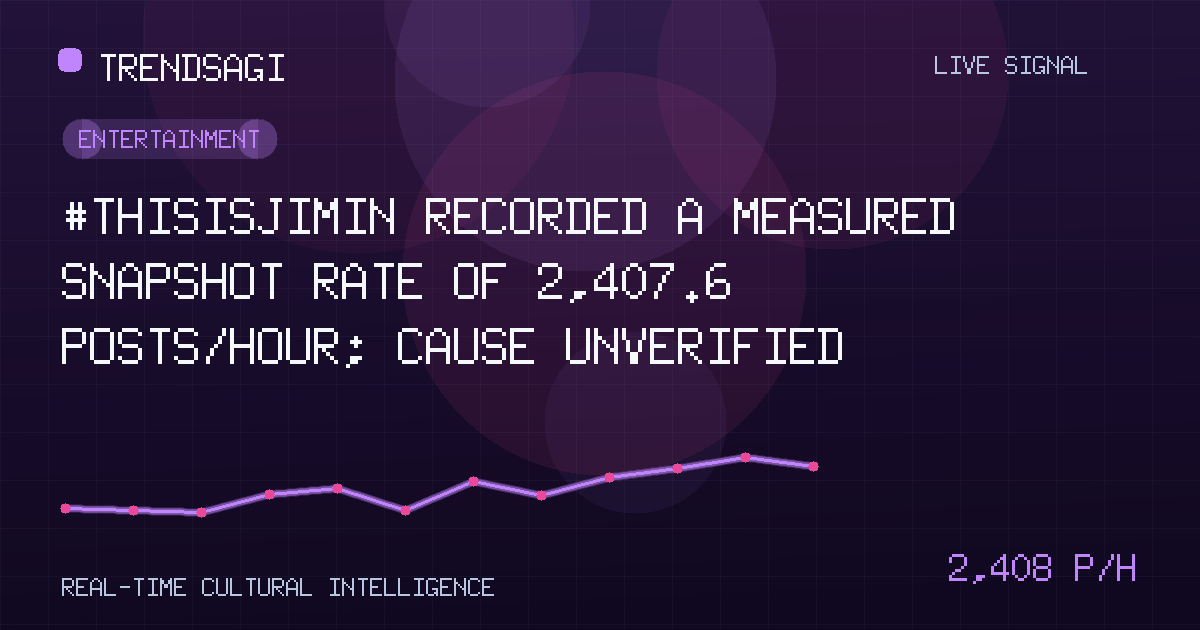
#thisisjimin recorded a measured snapshot rate of 2,407.6 posts/hour; cause unverified
#thisisjimin logged 1,894 posts in the latest snapshot and a measured 2,407.6 posts/hour; the cause remains unverified.
Automated briefing. Generated from stored signal measurements and source-backed research; it is not manually reviewed. Read the methodology and limitations.
Metrics in this briefing are a snapshot associated with its publication date and may not reflect current conditions.
What changed
#thisisjimin showed rapid sampled activity, but no verified public catalyst has been established for the movement. The defensible conclusion is limited: the entertainment-category hashtag registered substantial change around the latest observation. That warrants closer investigation, but it does not prove a particular release, appearance, controversy, or fan campaign caused the activity.
At 2026-09-28T10:56:17Z, the latest snapshot contained 1,894 posts. Across three stored observations in an exact 1,808-second window, the measured change was 2,407.6 posts/hour. This is a measured snapshot rate, not a live rate, forecast, reach figure, engagement measure, or count of unique people.
| Measure | Latest observation |
|---|---|
| Observation time | 2026-09-28T10:56:17Z |
| Measured snapshot rate | 2,407.6 posts/hour |
| Latest snapshot volume | 1,894 posts |
The rate and volume describe different things. Snapshot volume is the number of posts present at the latest observation, while posts per hour summarizes measured change across the stored comparison window. The two figures should not be treated as interchangeable, divided, or combined. The available record also does not include a longer baseline showing whether this rate is normal for the hashtag.
Why this topic may be moving
No verified, time-aligned public event can be connected confidently to the observed increase from the information available for this briefing. The hashtag and its Entertainment classification establish the subject area, but neither explains the timing. Assigning the movement to an announcement, media appearance, controversy, or scheduled fan activity without supporting evidence would be speculation.
Several explanations should be tested rather than assumed:
- A scheduled entertainment event may have prompted coordinated fan participation.
- New official material, reporting, or public activity may have given participants a reason to post.
- A milestone, anniversary, or fan-led initiative may have increased normal conversation.
- A controversy or disputed claim may have driven reaction, sharing, and counter-posting.
- Platform recommendation, repetition, automated activity, or unrelated use of the hashtag may account for part of the measured change.
These are investigation paths, not verified findings. A reliable explanation would need a source whose subject and timing match the observation window.
A high measured posting rate can show where an analyst should look, but it cannot establish why the activity happened without a verified catalyst.
Why it matters
For editors, the signal identifies a fast-moving conversation that may merit timestamped reporting. However, publishing a causal headline before verifying the catalyst could turn ordinary fandom activity into a false news event.
- Entertainment and social editors should determine whether the burst is event-specific, a broader fandom reaction, or a misleading aggregation of unrelated posts.
- Talent and community teams can use the signal to identify recurring fan behaviors, but should not interpret raw volume as audience size or approval.
- Brand and reputation teams should check whether the hashtag is being used constructively, critically, or in connection with an unverified claim before responding.
- Audience researchers need account-level data to separate unique participants, repeated posters, media amplification, and possible coordinated behavior.
- Platform and trend teams should compare the observation with adjacent windows and a longer baseline before classifying it as a sustained trend.
The immediate value is prioritization: this hashtag merits inspection. The rate alone does not establish newsworthiness, sentiment, virality, or the seriousness of any claim.
What to watch next
- Inspect the activity at source. Review a time-bounded sample around 2026-09-28T10:56:17Z. Record whether posts point to one event, repeat the same media, use identical wording, include claims requiring correction, or cover unrelated subjects. A shared topic strengthens the event explanation; fragmented content suggests broader or noisier use.
- Find time-aligned verification. Check official accounts and reputable publishers for material clearly connected to the hashtag and close to the observation window. General similarity is not enough; the source must concern the same subject and plausibly explain the timing.
- Separate volume from participation. Count distinct accounts, repeat posters, original posts, reposts, media attachments, and links. Snapshot volume cannot answer these questions by itself.
- Test for coordination. Look for overlapping account networks, synchronized wording, repeated media, or unusually similar posting sequences. Those patterns can justify a coordination inquiry, but they do not prove automation or organized influence.
- Check persistence. Compare the next comparable observation with this one. A similarly high measured rate would support sustained attention; a sharp reduction would indicate that the initial signal was brief. Neither outcome should be forecast from the current figures.
- Watch for an authoritative response. A clarification, correction, statement, or confirmed event tied to the same timestamp would be a concrete signal that the movement has an identifiable cause.
The most useful next signal is not another unlabeled spike. It is a verified event, a repeated content pattern, or account-level evidence that explains who was posting and what connected those posts.
Methodology and limitations
This briefing uses the latest observation at 2026-09-28T10:56:17Z and the supplied measurement derived from three stored observations across an exact 1,808-second window. The reported 2,407.6 posts/hour is a measured snapshot rate, while 1,894 is the latest snapshot volume. The narrow observation set does not provide seasonality, a historical baseline, or proof that the pattern continued after the snapshot.
Hashtag activity can include original posts, replies, reposts, quotations, automated behavior, spam, and unrelated meanings. It cannot by itself establish sentiment, geography, identity, unique-person count, engagement, organic reach, or causation. No external catalyst has been included because a reliable, time-aligned explanation could not be verified. Stronger reporting should preserve the exact timestamps, add adjacent-window comparisons, examine the underlying posts, and attach verified context before using definitive causal language.
Track This Topic for New Signals
Set alerts for future velocity or sentiment changes around this topic.
Explore Tracking PlansAbout TrendsAGI research
TrendsAGI's automated research pipeline publishes dated signal snapshots, methodology notes, and practical workflows for teams evaluating cultural momentum. Read how signals are scoped, scored, and limited in our research methodology.