15-minute window · 3 observations · Measured Oct 1, 2026, 12:36 AM UTC · Provider: go_recent_snapshot_v2
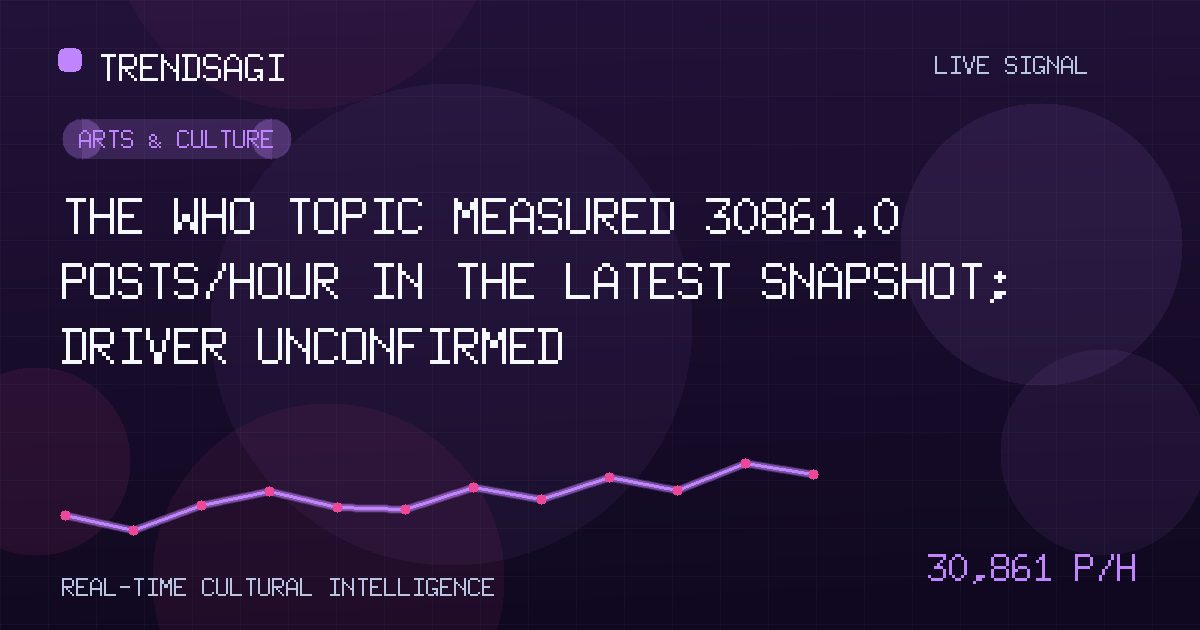
The Who topic measured 30861.0 posts/hour in the latest snapshot; driver unconfirmed
The Who snapshot measured 30861.0 posts/hour and 18,000 posts, with the trigger unverified and practical checks for interpreting the change.
Automated briefing. Generated from stored signal measurements and source-backed research; it is not manually reviewed. Read the methodology and limitations.
Metrics in this briefing are a snapshot associated with its publication date and may not reflect current conditions.
What changed
The topic labeled The Who, categorized under Arts & Culture, registered a measured snapshot rate of 30861.0 posts/hour. The rate covers an exact 900-second window using 3 stored observations. It is the clearest measured change in the signal, but it does not establish what caused the increase.
The reason for the movement is not verified. No independently verified public context was available for this briefing, so attributing the change to a concert, release, anniversary, controversy, or another specific event would be unsupported. The same snapshot contained 18,000 posts; that is captured post volume, not a rate, audience size, reach, engagement count, or number of unique people.
| Measure | Observation |
|---|---|
| Observation time | 2026-10-01T00:36:41Z |
| Measured snapshot rate | 30861.0 posts/hour |
| Measurement basis | Exact 900-second window using 3 stored observations |
| Snapshot volume | 18,000 posts |
Why this topic may be moving
This is a topic-level velocity signal, not an event record. A rise of this kind can follow a scheduled announcement, a performance or release, renewed circulation of older material, a controversy, or a coordinated recirculation. Those are hypotheses to test, not verified explanations of this observation.
The signal does not include a verified event, source-level account of the activity, or representative post sample. The label also needs validation: records assigned to The Who may concern the named act, its work or members, or ordinary uses of the same phrase. Aggregates alone cannot separate those possibilities or identify which one dominates the measured change.
- First-party catalyst: Check whether the band or another responsible organization published an announcement, scheduled appearance, release, or ticketing update before activity accelerated.
- Media cascade: Determine whether credible reporting supplied a repeatable story that fans and other accounts then amplified. Several reports would be stronger evidence than repeated copying of one unsupported claim.
- Revival of existing material: Look for renewed circulation of older clips, songs, images, or discussions. Resurfacing can produce rapid volume without a newly announced event.
- Classification or automation artifact: Consider duplicate submissions, automated accounts, spam, or phrase-level matches that inflated the topic bucket without representing distinct attention.
Until one of these mechanisms is corroborated, the defensible description is a high-velocity topic spike with an unknown driver.
A measured posting spike is evidence of changed activity, not proof of its cause, sentiment, audience size, or commercial impact.
Why it matters
For communications and community teams monitoring The Who, the immediate priority is identifying the originating item. A verified announcement, performance, release, or disputed claim would require a different response from a burst caused by repetition, automated posting, or an imprecise topic label.
Media, archive, and rights teams should also distinguish original material from copied clips and quotations. A high volume of posts may create a need to trace source use, but the aggregate count does not show which material is circulating, who owns it, or whether any legal issue exists.
For analysts, the episode illustrates the distance between monitoring metrics and public significance. The measured snapshot rate shows how quickly topic-linked records accumulated during its defined window. It does not reveal sentiment, geography, language, organic participation, or whether the movement will persist beyond that snapshot.
What to watch next
The most useful follow-up work would test origin, composition, and durability rather than searching for a dramatic headline automatically.
- Inspect the underlying records: Review posts captured during the exact 900-second window, beginning with the earliest repeated wording, images, claims, or references. Shared originating accounts would help separate an initial catalyst from downstream copying.
- Classify a representative sample: Label records as announcement, news, fan discussion, criticism, tribute, commerce, spam, or unrelated phrase use. A dominant category would provide a more credible explanation than the topic total alone.
- Corroborate the alleged trigger: Seek a first-party statement or schedule and independent reporting from identifiable publishers. A trigger should match the timing and subject matter of the post cluster before it is presented as the cause.
- Check neighboring snapshots: Compare the next available observations to determine whether activity persists, recedes, or jumps again. That will show whether this is a sustained trend, a brief burst, or only a window-specific acceleration.
- Audit signal quality: Look for duplicate text, bulk reposting, coordinated timing, low-information accounts, and entity confusion. These checks are essential before interpreting the rate as broad public interest.
- Watch for downstream confirmation: Official acknowledgement, additional credible coverage, or independently measured audience behavior would strengthen the interpretation. None should be inferred directly from 18,000 captured posts or 30861.0 posts/hour.
Methodology and limitations
The observation is anchored to 2026-10-01T00:36:41Z. The measured snapshot rate is 30861.0 posts/hour across an exact 900-second window using 3 stored observations. It is a window-specific change metric and should not be described as a live rate, forecast, reach figure, engagement measure, or count of unique people.
The 18,000 figure answers a separate question: how many posts were present in the latest snapshot. Volume and rate are not interchangeable. A topic can have a large captured volume without a sharp change, or a high measured change rate within a comparatively short observation window.
No prior baseline, raw-post sample, geographic breakdown, sentiment analysis, or verified trigger is provided here. Consequently, the spike cannot be compared with a normal level, assigned to a particular event, or treated as representative of the entire audience. The cause remains unknown pending the checks above.
Track This Topic for New Signals
Set alerts for future velocity or sentiment changes around this topic.
Explore Tracking PlansAbout TrendsAGI research
TrendsAGI's automated research pipeline publishes dated signal snapshots, methodology notes, and practical workflows for teams evaluating cultural momentum. Read how signals are scoped, scored, and limited in our research methodology.