899-second window · 3 observations · Measured Sep 7, 2026, 10:55 PM UTC · Provider: go_recent_snapshot_v2
Constitutional Discourse Surge: Analyzing 'The King' in Law and Government
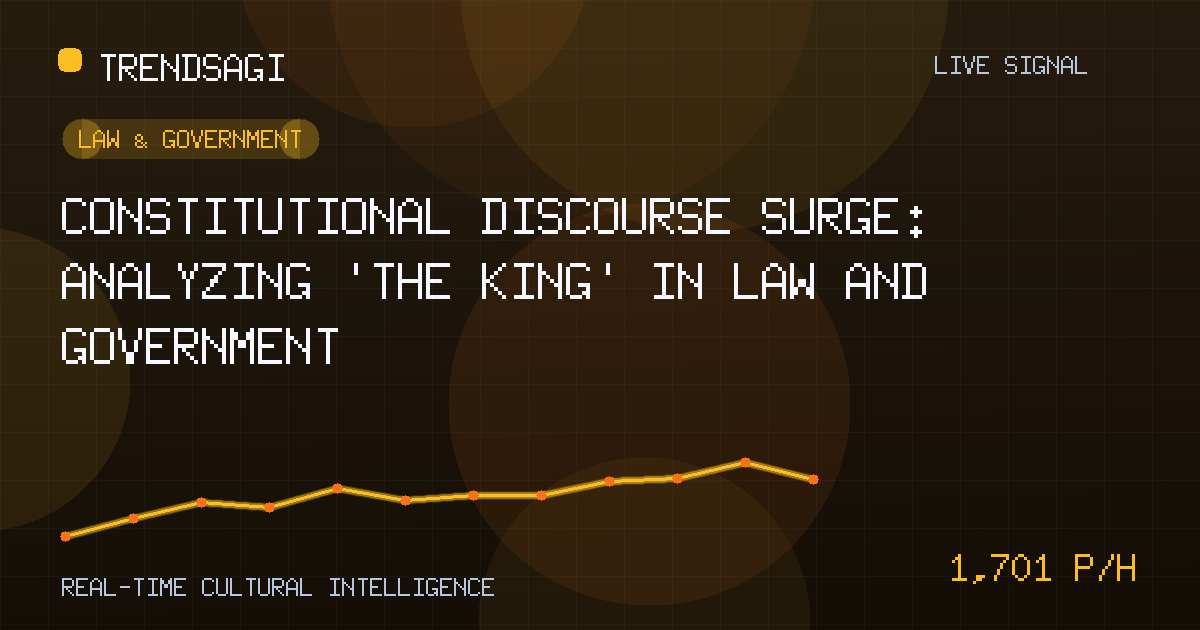
A sharp rise in Law & Government discourse regarding 'The King' was recorded on Sept 7, 2026, with a snapshot rate of 1,701.1 posts/hour. Analysis for legal
Automated briefing. Generated from stored signal measurements and source-backed research; it is not manually reviewed. Read the methodology and limitations.
Metrics in this briefing are a snapshot associated with its publication date and may not reflect current conditions.
What changed
On September 7, 2026, the topic "The King" experienced a significant surge in activity within the Law & Government category. A measured snapshot rate of 1701.1 posts/hour was recorded, with the total snapshot volume reaching 2482 posts by the late evening. This spike represents a concentrated burst of interest, likely driven by the intersection of constitutional milestones and ongoing legal debates regarding sovereign authority. While the term "The King" can refer to diverse subjects, its classification under Law & Government points to a focus on the institutional role of the monarchy or the legal doctrine of sovereign immunity.
| Observation Time | Measured Snapshot Rate (posts/hour) | Snapshot Volume |
|---|---|---|
| 2026-09-07T22:55:35Z | 1701.1 | 2482 |
Why this topic may be moving
As of late September 2026, the specific catalyst for this surge remains unverified by a single breaking news event from major publishers. However, the timing is highly suggestive of a recurring constitutional window. September 8 marks the anniversary of the accession of King Charles III to the British throne. The eve of this anniversary, September 7, frequently sees a rise in administrative and legal discussions regarding the "Crown-in-Parliament," the status of the monarchy in Commonwealth realms, and the annual legislative agendas that involve the King’s Speech or its equivalent in various jurisdictions.
In the United States, "The King" is frequently invoked as a legal metaphor within the context of executive power and sovereign immunity. Following landmark judicial precedents concerning the scope of presidential authority, legal scholars and government analysts often use the term to debate the boundaries of the "unitary executive." The spike may reflect a reaction to a specific lower court ruling or a high-profile legal brief that references these monarchical comparisons in a modern governance framework. Without a specific verified report from a publisher like the Associated Press or Reuters as of this snapshot, the movement is best characterized as a peak in institutional discourse rather than a single external news shock.
The legal fiction of 'The King' serves as the cornerstone for modern concepts of the state. When we see a surge in this category, we are often witnessing a stress test of constitutional norms, where the abstract power of the sovereign meets the practical constraints of 21st-century law.
Why it matters
For legal professionals, policy analysts, and constitutional scholars, this signal indicates a period of heightened sensitivity to traditional power structures. When "The King" trends in a Law & Government context, it often precedes or accompanies significant debates on executive overreach, the transition of power, or the removal of colonial-era legal frameworks in the Commonwealth.
This signal is particularly relevant for:
- Constitutional Litigators: Who may be tracking shifts in how sovereign immunity is framed in public and legal discourse.
- International Relations Specialists: Monitoring the stability of the monarchy's role in the UK and its impact on the Commonwealth of Nations.
- Government Affairs Professionals: Who must navigate the administrative changes that occur during legislative sessions opened or influenced by the Crown's formal duties.
The high rate of change (1701.1 posts/hour) suggests that the conversation is not merely academic but is likely being fueled by a current event that has captured the attention of a professional or highly engaged audience. This level of volatility typically implies that a legal decision, a government announcement, or a widely circulated white paper has entered the public sphere, demanding an immediate interpretative response from the Law & Government community.
What to watch next
To understand the trajectory of this signal, observers should look for concrete legal developments in the following 48 to 72 hours. Key watch signals include:
- Commonwealth Constitutional Reform: Watch for statements from nations like Australia, Jamaica, or Canada regarding the transition to a republic, which often use the anniversary of the accession as a springboard for legislative proposals.
- Supreme Court Dockets: In the US, monitor upcoming filings that address the limits of executive immunity or the application of the "Major Questions Doctrine," which frequently involve arguments about the nature of sovereign authority.
- The King's Speech and Legislative Openings: Check official government gazettes in the United Kingdom and other parliamentary systems for the release of new policy priorities that are traditionally framed as the monarch's agenda.
- Public Sentiment Polling: Look for data from organizations like YouGov or Ipsos regarding the popularity and perceived legitimacy of the monarchy, as these figures often drive the political will for constitutional reform.
Methodology and limitations
This report is based on a measured snapshot of 2482 posts observed at 2026-09-07T22:55:35Z. The measured snapshot rate of 1701.1 posts/hour was calculated using three distinct observations over an exact 899-second window. It is important to note that this represents a specific moment in time and does not constitute a total daily volume or a forecast of future growth.
The Law & Government category tag ensures that the data is filtered for professional and administrative contexts, but it cannot entirely exclude the possibility of linguistic overlap. While "The King" is a distinct legal term of art, it may occasionally capture high-volume pop culture discourse if that discourse uses formal legal language (e.g., discussions of copyright law or trademark disputes involving famous figures). This signal establishes the intensity of the topic's presence in the digital record but does not, on its own, identify the sentiment or the specific document causing the spike. Further verification through primary legal databases and official government channels is recommended for high-stakes decision-making.
Track This Topic for New Signals
Set alerts for future velocity or sentiment changes around this topic.
Explore Tracking PlansAbout TrendsAGI research
TrendsAGI's automated research pipeline publishes dated signal snapshots, methodology notes, and practical workflows for teams evaluating cultural momentum. Read how signals are scoped, scored, and limited in our research methodology.