1739-second window · 3 observations · Measured Oct 2, 2026, 8:54 PM UTC · Provider: go_recent_snapshot_v2
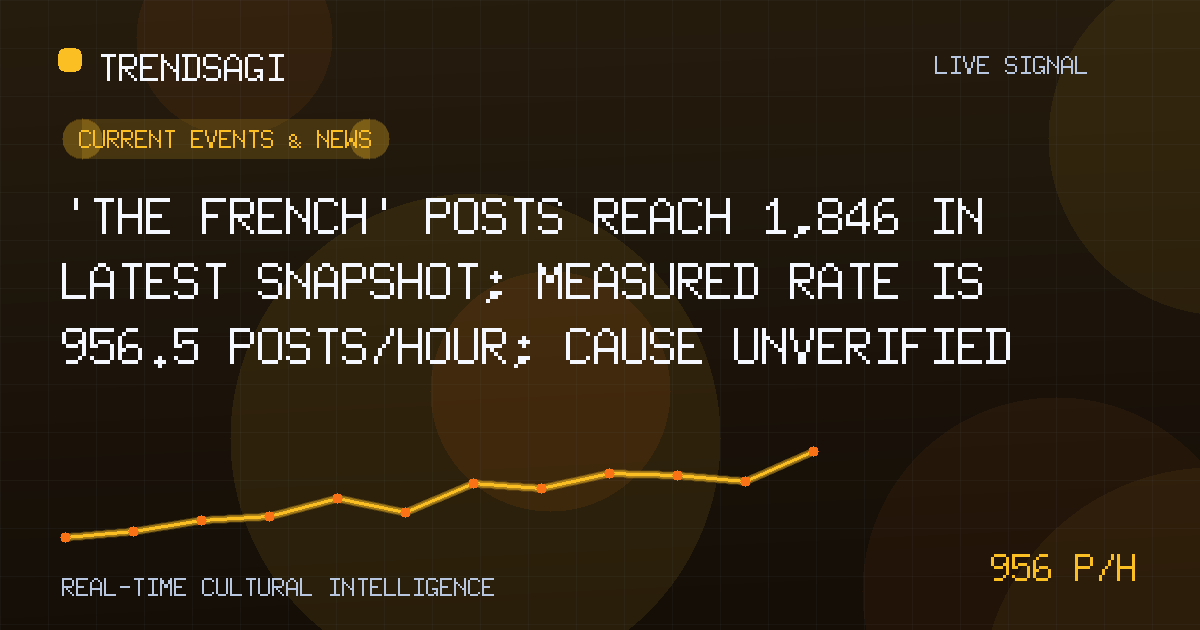
‘The French’ posts reach 1,846 in latest snapshot; measured rate is 956.5 posts/hour; cause unverified
A 1,846-post snapshot and 956.5 posts/hour measured rate show a “The French” burst; its referent and catalyst remain unverified, so these checks come next.
Automated briefing. Generated from stored signal measurements and source-backed research; it is not manually reviewed. Read the methodology and limitations.
Metrics in this briefing are a snapshot associated with its publication date and may not reflect current conditions.
What changed
The stored signal shows a concentrated increase in posts associated with the label “The French.” The latest snapshot volume was 1,846 posts. However, the available evidence does not identify what the label refers to or establish a verified news catalyst behind the increase. It should not yet be read as evidence of a broader wave of attention to France, French people, or the French language.
Across an exact 1,739-second window built from 3 stored observations, the measured snapshot rate was 956.5 posts/hour. That figure describes the pace within this stored measurement window. It is not a live or current rate, forecast, reach, engagement figure, or count of unique people.
| Signal measure | Stored value |
|---|---|
| Observation time | 2026-10-02T20:54:25Z |
| Measured snapshot rate | 956.5 posts/hour |
| Latest snapshot volume | 1,846 posts |
Taken together, the observations establish a notable burst inside the monitoring record, but they do not establish the burst’s subject, source, or cause. The immediate editorial need is verification, not a confident explanation.
Why this topic may be moving
No verified public context in the record establishes why the label is moving. A topic classification and a volume spike can show that a monitor detected activity, but neither identifies the event that produced it. Without contemporaneous reporting or another verified public development tied to the same subject and timing, assigning a cause would be speculation.
The label is also semantically incomplete. It may function as shorthand, a quoted phrase, a title, or a monitoring tag, but its wording alone does not resolve those possibilities. Capitalization does not prove that a particular person, place, language, or cultural subject is intended.
Possible explanations to test include a genuine news conversation, a community phrase gaining repeated use, concentration among high-output accounts, or a monitoring system grouping posts that only look related. None of these mechanisms is confirmed by the available signal.
That uncertainty changes the interpretation. A verified catalyst would support a story about public attention. Without one, the defensible conclusion is only that the label accumulated content rapidly during the measured window.
The count establishes how much content the monitor associated with the label, not what that content means. Until post-level evidence connects the volume to a specific subject, “The French” is an observation target rather than an explained event.
Why it matters
Editors and communications teams should care because a fast-moving but ambiguous label can trigger the wrong workflow. Assigning the signal to France news, culture, or language coverage without inspecting posts risks publishing an irrelevant update or missing the actual story. The appropriate response is to hold the alert for semantic validation.
Analysts and trend teams should also care because volume alone can reward false positives. A repeated phrase, copied source, or classification error may look like momentum until the underlying posts are sampled. The number is useful for directing attention, but not for sizing audience demand.
Communities and organizations associated with the possible subject should care as well. Misreading an ambiguous spike can affect messaging, public reactions, and reputational decisions. No communications response should be based on this signal alone.
What to watch next
The most useful follow-up checks separate genuine public attention from repetition, ambiguity, and monitoring artifacts.
- Referent: Inspect original posts across different accounts, not only the most visible items. Determine whether “The French” is being used literally, as shorthand, inside quoted text, or inconsistently.
- Distribution: Check whether the activity is spread across independent contributors or dominated by a small number of sources. Broad participation would support a stronger interpretation than repeated output from one source.
- Repetition: Look for copied passages, near-identical posts, quote chains, and recycled wording. Separating original discussion from duplication can materially change the apparent significance of the volume.
- Public verification: Use Google Search to look for contemporaneous reporting or an official statement that names the same subject and aligns with the observed timing. An unrelated result should not be treated as the cause.
- Persistence: Examine whether later observations remain elevated or quickly subside. A sustained burst with consistent meaning is more informative than a single sharp measurement window.
- Adjacent language: Review related names, phrases, spellings, and quoted wording that may reveal the intended subject. If posts point to different subjects, the label should not be treated as one coherent trend.
The strongest follow-up evidence would combine repeated snapshots, diverse contributors, consistent semantics, and a verified public development. If those conditions do not emerge, the signal should remain classified as an unresolved or transient monitoring anomaly.
Methodology and limitations
The change statistic comes from 3 stored observations across an exact 1,739-second window ending at 2026-10-02T20:54:25Z. The 956.5 posts/hour value is the measured snapshot rate for that interval. The 1,846 figure is the volume in the latest snapshot; it is neither a rate nor a total for the full interval.
The record does not provide enough post-level or account-level evidence to establish unique participants, sentiment, geography, language, source credibility, organic conversation, automated behavior, or the reason the measured rate changed. The snapshot volume also cannot be interpreted as reach or engagement.
The signal can establish that the monitoring system associated 1,846 posts with the label and recorded a measured rate of 956.5 posts/hour during the stated window. It cannot establish causation or a durable trend. With no verified catalyst, the responsible conclusion is that “The French” is moving rapidly in the stored signal while its meaning and driver remain unresolved.
Track This Topic for New Signals
Set alerts for future velocity or sentiment changes around this topic.
Explore Tracking PlansAbout TrendsAGI research
TrendsAGI's automated research pipeline publishes dated signal snapshots, methodology notes, and practical workflows for teams evaluating cultural momentum. Read how signals are scoped, scored, and limited in our research methodology.