1791-second window · 3 observations · Measured Oct 2, 2026, 12:26 PM UTC · Provider: go_recent_snapshot_v2
“The Fever” registers 827 posts in latest sports snapshot; catalyst unverified
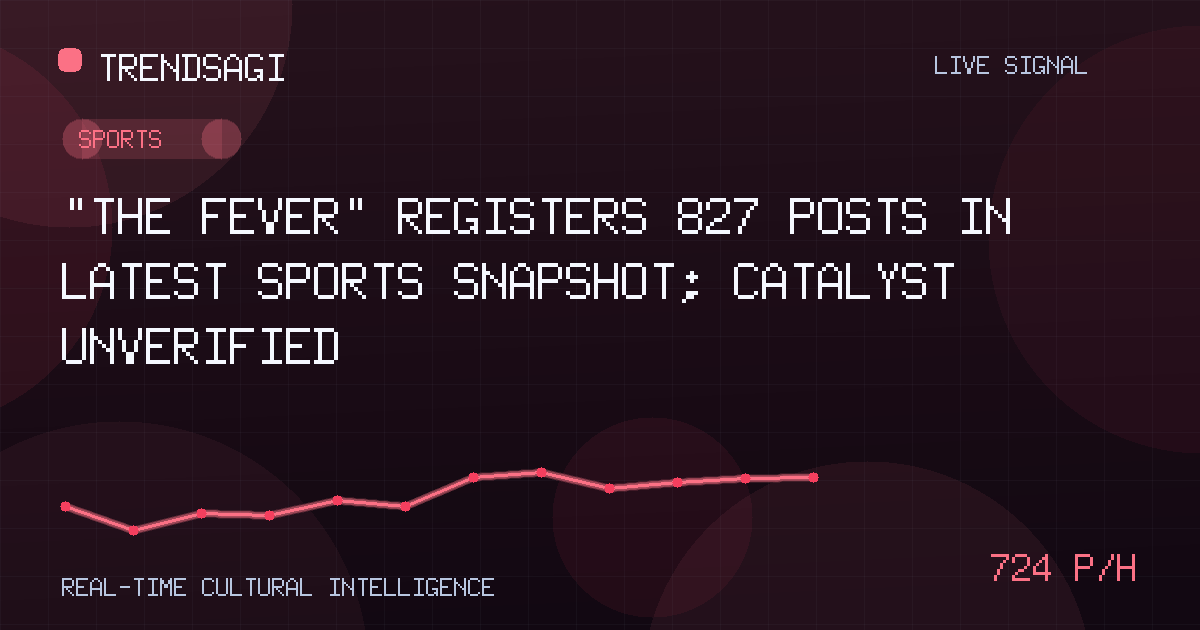
The latest “The Fever” snapshot has 827 posts and a measured rate of 723.8 posts/hour; the sports catalyst remains unverified.
Automated briefing. Generated from stored signal measurements and source-backed research; it is not manually reviewed. Read the methodology and limitations.
Metrics in this briefing are a snapshot associated with its publication date and may not reflect current conditions.
What changed
“The Fever” showed a concentrated burst of sports-related conversation in the latest stored snapshot, but the available record does not identify a verified catalyst. The snapshot contains 827 posts, and the measured snapshot rate is 723.8 posts/hour. That is enough to justify closer monitoring, not enough to claim that a particular game, team, player, injury, controversy, or fan phrase caused the activity.
The 723.8 posts/hour figure was measured over an exact 1791-second window using 3 stored observations. It is not a live or current rate, forecast, reach estimate, engagement total, or unique-person count. The two figures answer different questions: 827 is the latest snapshot volume, while 723.8 posts/hour is the measured pace of change in the stored series. The signal establishes movement in the monitored conversation; it does not establish the story behind it.
| Observation time | Measured snapshot rate | Latest snapshot volume |
|---|---|---|
| 2026-10-02T12:26:56Z | 723.8 posts/hour | 827 posts |
Why this topic may be moving
The cause remains unverified. The stored category is Sports, but the signal description is blank, and the label alone does not identify the team, person, event, or phrase behind the posts. No publisher-backed explanation is available in the verified context used for this briefing, so assigning the burst to a specific trigger would be premature.
- A game result, schedule event, roster move, injury update, or postgame reaction could create a fast sports conversation, but none is confirmed here.
- A viral fan post, chant, clip, or reaction could spread through the label faster than formal coverage; that is a mechanism to test, not a finding.
- Copied or quoted posts could inflate apparent participation if one item is repeated across many accounts.
- The label could refer to more than one entity, causing separate conversations to appear as one topic.
Until the exact posts and public reporting are matched, the responsible conclusion is simple: attention is concentrated in the sample, but its cause and meaning remain open questions.
A measured posting rate can locate a conversation that deserves attention, but it cannot identify the event, establish authenticity, or show whether participants agree.
Why it matters
For a sports desk, the immediate risk is a misattribution: publishing a confident explanation for “The Fever” before resolving the label could attach the right volume to the wrong story. The rate is useful for triage because it shows where to look first. It is not useful by itself as evidence of importance, sentiment, or audience size.
Who should care
- Editors and reporters should identify the referent and verify the claimed catalyst before publication.
- Social and community teams should determine whether discussion is organic, duplicated, misleading, or focused on an unresolved question.
- Trend and audience analysts should keep snapshot volume, measured rate, unique accounts, and engagement as separate measures rather than blending them.
Readers also need caution: a large pile of posts can reflect repetition and coordinated sharing as well as broad independent interest. None of those possibilities should be presumed from this signal alone.
What the signal can and cannot establish
Read narrowly, it supports a limited set of conclusions:
- It can show cadence within the stored series. The measured snapshot rate was 723.8 posts/hour across the specified 1791-second window.
- It can show latest sample size. The snapshot contained 827 posts.
- It can prioritize verification. The pace makes this topic worth checking against original posts and public reporting.
- It cannot establish why the conversation began, whether it is positive or negative, or whether the label refers to one entity.
- It cannot establish unique participants, geography, influence, engagement, future persistence, or organic reach.
What to watch next
- Resolve the label. Review a representative set of posts from the exact observation period, record the named entities and links they cite, and group posts by what “The Fever” appears to mean. Keep ambiguous examples visible rather than forcing a classification.
- Verify the catalyst. Use Google Search to locate public reporting close to the timestamp, then attribute the explanation to its publisher and confirm that the wording, entity, and event timing fit. A search snippet alone is not enough.
- Test provenance. Look for repeated text, common source links, quotation chains, and account overlap. These can indicate amplification, but they do not prove automation or manipulation.
- Separate measures. On the next stored observation, record snapshot volume and measured posts/hour independently. Do not turn 827 into a rate or use the present rate as a forecast.
- Classify the content. Code a sample for news, reaction, question, complaint, praise, and reuse only if those categories are supported by the actual posts. Report counts with their sample size.
Concrete watch signals
- A named sports event and the phrase “The Fever” appear together in reporting published near the observation time.
- Independent original posts explain the same trigger without relying on one copied item.
- Later stored observations show whether the measured pace persists, cools, or changes; keep each observation separate.
- The sample shifts from one repeated source toward distinct accounts discussing the same verified subject.
Methodology and limitations
The latest observation is timestamped 2026-10-02T12:26:56Z. The measured rate comes from 3 stored observations across an exact 1791-second window; the latest snapshot volume is 827 posts. Because the signal provides no descriptive context and no verified external catalyst is established here, this briefing does not attribute the movement to a specific event.
The rate is a retrospective measurement of this stored series, not a live or current rate or prediction. It also has no supplied comparison baseline, so it cannot show how unusual the pace is relative to the topic's normal history. The signal does not expose the underlying post text, account uniqueness, geography, sentiment, engagement, or collection coverage. Those gaps limit causal and audience conclusions; they do not invalidate the measured figures.
Track This Topic for New Signals
Set alerts for future velocity or sentiment changes around this topic.
Explore Tracking PlansAbout TrendsAGI research
TrendsAGI's automated research pipeline publishes dated signal snapshots, methodology notes, and practical workflows for teams evaluating cultural momentum. Read how signals are scoped, scored, and limited in our research methodology.