894-second window · 2 observations · Measured Oct 8, 2026, 2:56 AM UTC · Provider: go_recent_snapshot_v2
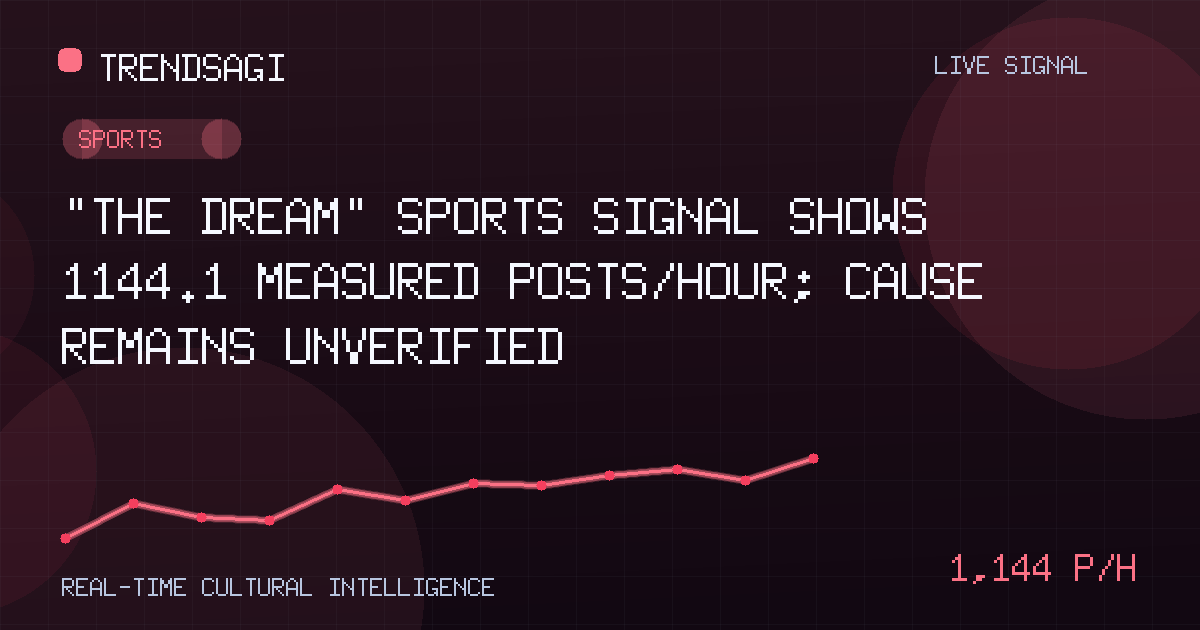
“The Dream” sports signal shows 1144.1 measured posts/hour; cause remains unverified
“The Dream” sports signal shows 1144.1 measured posts/hour and 1058 snapshot posts; editors should verify identity, timing, and cause before acting.
Automated briefing. Generated from stored signal measurements and source-backed research; it is not manually reviewed. Read the methodology and limitations.
Metrics in this briefing are a snapshot associated with its publication date and may not reflect current conditions.
What changed
The available record shows a concentrated short-window spike around the topic label “The Dream,” but it does not identify the people, teams, events, or media artifacts behind those posts. The latest snapshot contained 1058 posts, making this a priority for verification rather than a ready-to-publish sports story.
The measured snapshot rate was 1144.1 posts/hour over an exact 894-second window using 2 stored observations, measured at 2026-10-08T02:56:34Z. This is a historical snapshot measure, not a live rate, forecast, reach figure, engagement count, or count of unique people.
| Metric | Recorded value |
|---|---|
| Observation time | 2026-10-08T02:56:34Z |
| Measured snapshot rate | 1144.1 posts/hour |
| Latest snapshot volume | 1058 posts |
Together, these figures establish that the monitored label was producing heavy post activity during the measured interval. They do not establish why it happened, whether the posts were original, whether the label referred to one subject, or whether the activity continued after the window.
Why this topic may be moving
No verified public context currently ties the movement to a specific announcement, match, performance, release, or controversy. The category assignment says “Sports,” but that is a routing classification rather than proof of the referent. “The Dream” could be a nickname, title, quotation, organization name, or reused phrase; this record cannot select among those possibilities.
Several non-exclusive explanations remain plausible and testable:
- Event-linked reaction: A game, result, roster development, interview, or other sports event could have prompted discussion, but no such trigger has been verified.
- Entity collision: The same phrase may be attached to different subjects, causing unrelated conversations to be aggregated under one broad label.
- Platform amplification: A popular account, recommendation cycle, repost chain, or community migration could have accelerated visibility without a single originating event.
- Repetition or automation: Duplicate text, coordinated posting, or automated activity could inflate apparent momentum. The current count alone cannot distinguish those patterns from organic conversation.
- News pickup: A newly published report or quotation could have encouraged reaction, although no publisher has been verified as the source of the increase.
Because the label is broad and the measurement window is short, the signal is a trigger to verify identity and timing—not proof of a meaningful sports event or its cause.
Why it matters
The immediate value is triage. A high-volume label can attract editorial attention, but ambiguity creates a risk of attaching a consequential headline to the wrong person, team, game, or cultural reference.
- Sports desks and social editors should determine what “The Dream” denotes before treating the signal as event coverage or commissioning a causal explanation.
- Audience and trend analysts need a stable entity definition and additional observations. The measured snapshot rate shows movement during the interval, but it does not provide a baseline, duration, or evidence of persistence.
- Brand-safety and community teams should inspect whether the label has shifted from a sports context into unrelated or potentially sensitive uses before responding to the apparent surge.
- Publishers and readers benefit from explicit uncertainty. Presenting the label as a verified sports event without resolving its identity could misdirect coverage and public interpretation.
What to watch next
The next checks should separate a real, sustained topic from an ambiguous or duplicated burst:
- Resolve the referent: Review a representative sample of posts and their context. Record which names, teams, players, events, or quotations consistently appear with “The Dream.” A stable referent is a prerequisite for a meaningful trend.
- Find a time-aligned public trigger: Look for a dated announcement, report, match result, interview, or publication close to the observed activity. Any external fact used in later coverage should be attributed to the publisher that reported it.
- Check persistence: Compare subsequent snapshots collected under the same query, language, geography, and platform settings. Continued activity after the 894-second window would support a sustained conversation; silence after the interval would point toward a short spike.
- Measure composition: Distinguish original posts from quotes, replies, reposts, and duplicates. Also examine whether activity comes from many independent accounts or is concentrated in a small amplification chain.
- Watch for topic drift: Track whether the sports share remains dominant or whether the phrase is being absorbed by music, entertainment, politics, or other uses. A category mismatch would change both the explanation and the audience.
- Test integrity signals: Look for repeated wording, unusually synchronized timing, abrupt volume jumps, or unexplained changes in collection scope. These are warning signs, not automatic proof of automated behavior.
Decision rule: Escalate from monitoring to reporting only when the entity is resolved, a public trigger is verified, and later observations show that the activity persists. Until then, describe the pattern as an unexplained short-window signal.
Methodology and limitations
This briefing is based on the supplied observation timestamp, the latest snapshot volume of 1058 posts, and the reported measured snapshot rate of 1144.1 posts/hour. That rate was measured over an exact 894-second window using 2 stored observations. The snapshot volume is a count at the observation time; it is not itself a rate.
The available record does not specify the collection platform, query construction, deduplication method, geographic or language scope, historical baseline, or account-authentication controls. It also cannot show how many unique people posted, how many people saw the content, or how much engagement occurred. The limited number of observations means the data cannot establish seasonality, a normal level of activity, or the likely duration of the movement.
Most importantly, the signal establishes a change in monitored post activity but not its cause. Until the label and a time-aligned public trigger are independently verified, any narrative explanation would go beyond the evidence.
Track This Topic for New Signals
Set alerts for future velocity or sentiment changes around this topic.
Explore Tracking PlansAbout TrendsAGI research
TrendsAGI's automated research pipeline publishes dated signal snapshots, methodology notes, and practical workflows for teams evaluating cultural momentum. Read how signals are scoped, scored, and limited in our research methodology.