15-minute window · 3 observations · Measured Sep 11, 2026, 11:40 PM UTC · Provider: go_recent_snapshot_v2
The Bill snapshot: 1,600 posts and 1,680.4 posts/hour measured over 900 seconds on Sep 11, 2026
The Bill had 1,600 stored posts and a 900-second rate of 1,680.4 posts/hour at Sep 11, 2026; cause unverified.
Automated briefing. Generated from stored signal measurements and source-backed research; it is not manually reviewed. Read the methodology and limitations.
Metrics in this briefing are a snapshot associated with its publication date and may not reflect current conditions.
What changed
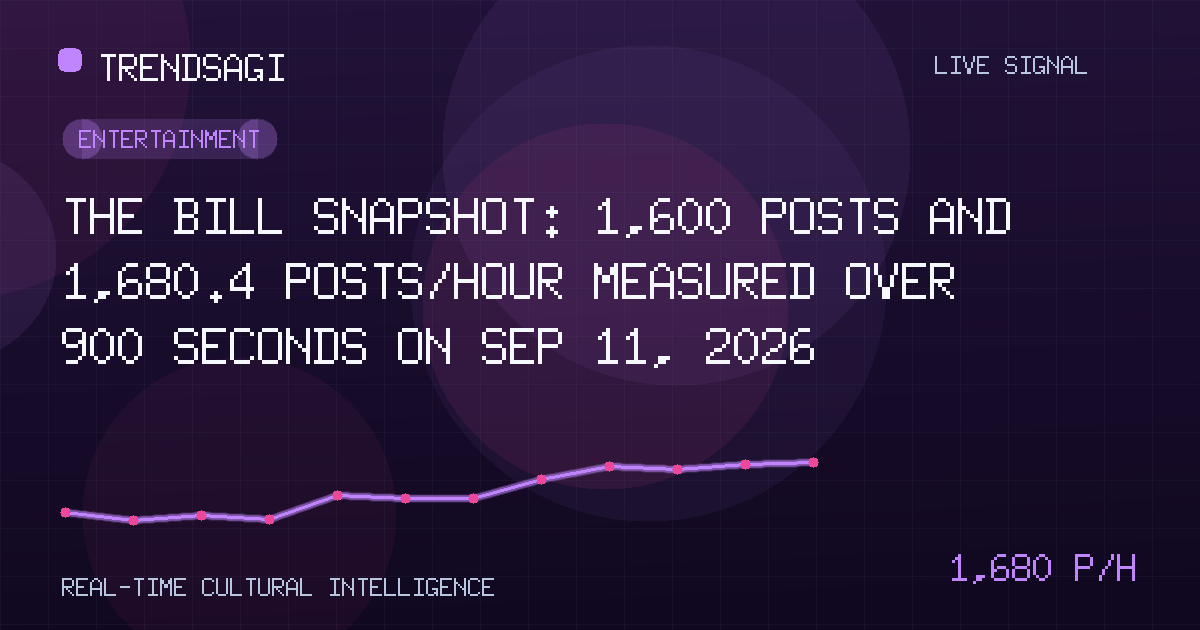
The Bill is showing a strong short-window post signal in the stored entertainment feed. At 2026-09-11T23:40:45Z, the latest snapshot volume was 1,600 posts, and the measured snapshot rate was 1,680.4 posts/hour across an exact 900-second window using three stored observations.
This is not a forecast, a live rate, a reach metric, or a count of unique people. It is a measured observation from a very short window. The practical takeaway is that “The Bill” was generating enough posts to stand out in the feed at that moment, but the stored signal alone does not explain why.
| Observation time | 2026-09-11T23:40:45Z |
|---|---|
| Measured snapshot rate | 1,680.4 posts/hour over 900 seconds |
| Snapshot volume | 1,600 posts |
Why this topic may be moving
The stored category is “Entertainment,” which suggests the topic may be tied to a title, episode, release, actor, music, or cultural reference rather than a political, sports, or business event. However, the label “The Bill” is broad, and no stored description was provided. Without verified public context, the exact trigger remains unclear.
- An entertainment release or premiere could produce rapid post bursts if a title, episode, or promotional asset goes public.
- A shared meme, audio clip, or fan reaction could make the phrase travel faster than the underlying show or work.
- A platform-specific event, such as a scheduled drop, livestream, or algorithmic push, could compress many posts into a short observation window.
- Another unrelated “The Bill” could be generating the signal, which is a real limitation when the phrase is generic.
Because the cause is not established, the safest interpretation is that the signal is notable but unexplained. It should be treated as a prompt for verification, not as confirmed news.
Why it matters
Short-window post rates can be useful when a topic is too new to have traditional coverage. A rate of 1,680.4 posts/hour over 900 seconds suggests a high velocity conversation, but velocity alone is weak evidence of cultural importance. The same phrase can spike because of a real entertainment event or because of a small, repetitive loop.
Editors, social media analysts, and brand or franchise teams should care because entertainment spikes can become search demand, fan coordination, or PR issues quickly. If the topic is a property with commercial stakes, early awareness can support monitoring, response, or editorial planning. If it is an ambiguous phrase, the value is in preventing false attribution.
For a reader tracking emerging entertainment signals, the question is not only whether the number is large, but whether it is coherent. A spike with a clear subject, repeated by varied sources, and backed by an external cue is far more actionable than a generic phrase spike that may be a platform artifact.
The signal says the topic was posting quickly at one point in time; it does not say the topic is growing, that the posts are high-quality, or that the event has broad public significance.
That distinction matters because a single 15-minute window can be distorted by bots, reposts, scheduled content, a single viral asset, or a narrow fan community. The stored volume of 1,600 posts is also a snapshot, not a cumulative total for the entire event unless the measurement system defines it that way.
What to watch next
- Duration: Does the rate remain above baseline over the next several 900-second observations, or does it fade after one spike?
- Source mix: Are posts coming from many distinct accounts, creators, and regions, or from a small cluster of reposts?
- Content shape: Do posts mention a specific episode, film, actor, song, meme, or release, or do they use “The Bill” without context?
- Platform movement: Does the phrase appear in news, trending lists, fan forums, or search queries after the initial spike?
- Authoritative confirmation: Does an official entertainment page, broadcaster, studio, artist, or reputable outlet confirm the associated event?
A good next check is to look for a named entity: a specific show title, episode number, premiere date, artist, or production company. If none appears, the topic should remain categorized as an unverified entertainment signal rather than a confirmed story.
Methodology and limitations
The briefing relies on the stored signal values only. The observation time was 2026-09-11T23:40:45Z. The snapshot volume was 1,600 posts. The measured change rate was 1,680.4 posts/hour over an exact 900-second window using three stored observations. These values are presented as recorded; they are not transformed into reach, engagement, followers, unique users, or future forecasts.
The main limitation is that “The Bill” is not sufficiently specific to confirm the subject. In entertainment, that phrase could attach to multiple works, people, or meme uses. The stored description was empty, so the briefing does not assert a cause. The short 900-second window also makes the rate sensitive to brief bursts; it may overstate longer-term momentum if it is not repeated in later observations.
For a stronger conclusion, compare this observation with the topic's recent baseline, inspect post samples for a common referent, and verify the associated event through public, authoritative coverage. Until then, the defensible conclusion is: a high short-window entertainment post signal was observed, but the trigger is not yet confirmed.
Track This Topic for New Signals
Set alerts for future velocity or sentiment changes around this topic.
Explore Tracking PlansAbout TrendsAGI research
TrendsAGI's automated research pipeline publishes dated signal snapshots, methodology notes, and practical workflows for teams evaluating cultural momentum. Read how signals are scoped, scored, and limited in our research methodology.


