899-second window · 3 observations · Measured Sep 27, 2026, 11:51 PM UTC · Provider: go_recent_snapshot_v2
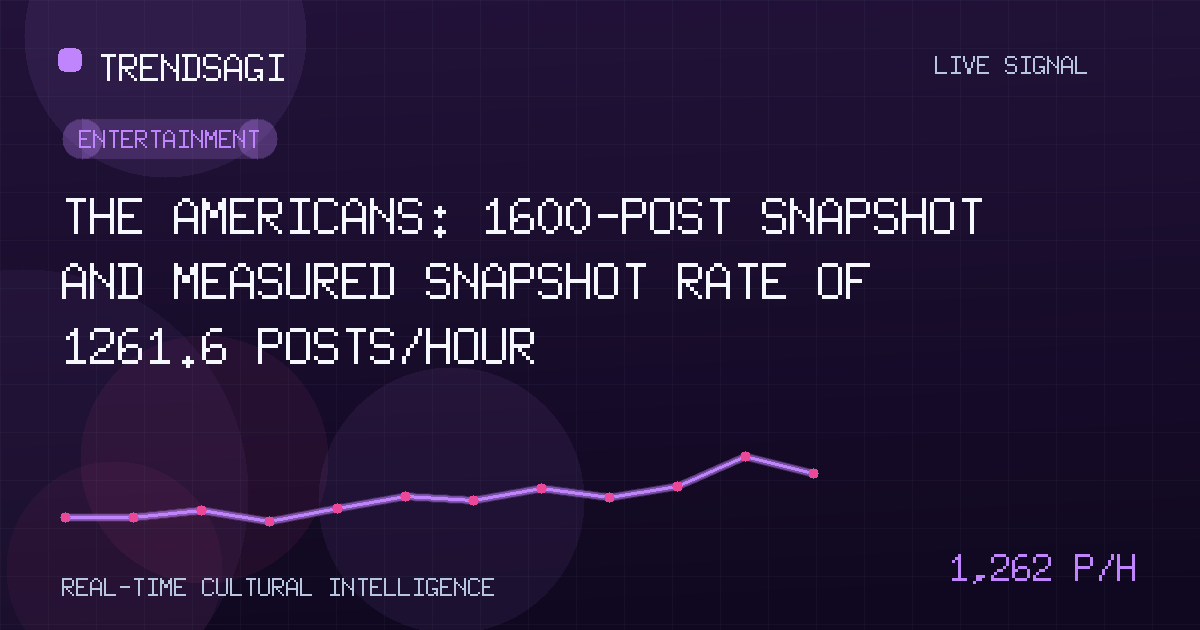
The Americans: 1600-post snapshot and measured snapshot rate of 1261.6 posts/hour
“The Americans” has a 1600-post snapshot and a measured snapshot rate of 1261.6 posts/hour. The cause is unverified; review the evidence and next checks.
Automated briefing. Generated from stored signal measurements and source-backed research; it is not manually reviewed. Read the methodology and limitations.
Metrics in this briefing are a snapshot associated with its publication date and may not reflect current conditions.
What changed
At 2026-09-27T23:51:50Z, the stored entertainment signal labeled “The Americans” recorded a latest snapshot volume of 1600 posts. Across an exact 899-second window using 3 stored observations, the measured snapshot rate was 1261.6 posts/hour. Those values quantify short-window activity inside the monitored signal, but they do not identify the people, work, event, or claim behind the posts.
The direct answer is limited: the signal merits source inspection, but it does not verify why the topic is moving. The 1261.6 posts/hour figure is a measured snapshot rate—not a live or current rate, forecast, reach figure, engagement estimate, or unique-person count. The 1600 figure is snapshot volume, not a rate. No specific public catalyst can be verified from the stored information, so the cause remains unclear.
| Measure | Stored value |
|---|---|
| Observation time | 2026-09-27T23:51:50Z |
| Measured snapshot rate | 1261.6 posts/hour |
| Exact measurement window | 899 seconds |
| Stored observations | 3 |
| Latest snapshot volume | 1600 posts |
The table preserves those measures separately; it does not imply that 1600 is the post count inside the 899-second measurement window.
What the signal can establish
The record establishes that the monitoring system associated posts with this label at the stated time and routed the signal under Entertainment. It also supplies the measured rate, exact window, and observation count. It does not establish that the posts concerned an identifiable entity, shared a common interpretation, or arose organically. “Entertainment” is a category assignment, not proof that a particular show, song, performer, release, or controversy caused the activity.
- Identity remains unresolved: The stored description is empty, so the label itself is the only available subject reference.
- Scale has a defined but limited meaning: 1600 is the latest snapshot volume; 1261.6 posts/hour is the supplied short-window rate. Neither is audience size.
- Direction cannot be generalized: Without a comparable prior baseline, the record does not support calling this a record, a long-term surge, or a sustained trend.
Why this topic may be moving
Without post-level evidence, every catalyst would be a hypothesis. A dated announcement, new creative work, episode-related exchange, clip, controversy, audience reaction, promotion, or change in matching rules could produce a concentrated burst. None of these explanations is verified for this signal.
The label is also semantically unresolved. It does not disclose whether the monitoring system intended a specific title, act, or phrase, or whether it pooled separate usages. If unrelated conversations were combined, the rate would describe mixed activity rather than a coherent event. Recurring entity-specific terms in source posts could resolve that issue, but no post sample is included in the canonical record.
A defensible causal account requires alignment among the posts, their timestamps, and an external event. A public statement or news report should be treated as an explanation only if it explicitly concerns the same subject and falls at the relevant time. Until then, “unclear” is more accurate than attaching the nearest entertainment story.
The signal establishes measured posting activity, not the identity of the conversation or the event that caused it. A catalyst claim should wait until the posts themselves show a shared reference.
Why it matters
For editors, this is a triage alert. The measured 1261.6 posts/hour rate says the monitored stream changed quickly enough to inspect, while the empty description and broad label do not support a causal headline. The next step is to examine representative posts, not enlarge the metric into a trend claim.
- Media and culture teams can use the signal to decide where source review should begin.
- Public-relations teams need entity resolution before attributing activity to a campaign or named participant.
- Analysts need raw observations, matching settings, and a baseline before comparing periods or testing explanations.
- Readers should not treat 1600 as 1600 unique participants or extrapolate 1261.6 beyond its measured window.
The practical value is prioritization: the signal indicates where to look and which evidence to collect. It does not yet explain the movement.
What to watch next
The next review should prioritize checks that can confirm or reject the signal’s basic premise.
- Resolve the entity: Look for recurring names, work titles, official-account references, and terms that distinguish the intended meaning. A shared referent is the initial requirement.
- Audit collection and matching: Preserve the exact query, filters, platform scope, language, geography, original post text, timestamps, and treatment of duplicates or automated activity.
- Find a time-aligned catalyst: Compare post timestamps with dated official announcements or reputable reporting that explicitly names the same subject. Proximity alone is not evidence of causation.
- Test persistence: Add comparable observation windows under unchanged settings. Check whether activity continues, reverses, or shifts to another label; the current snapshot resolves none of those outcomes.
- Check concentration: Determine whether posts come from many distinct accounts or a narrow set, and whether near-identical content is repeated. This helps verification without converting volume into unique-person reach.
- Build a baseline and separate measures: Compare earlier windows using the same method. Keep posting volume distinct from comments, reposts, reactions, and link shares, and check whether the same resolved subject appears in other monitored channels.
Methodology and limitations
The canonical record reports a latest snapshot volume of 1600 posts at 2026-09-27T23:51:50Z. It also supplies a measured snapshot rate of 1261.6 posts/hour across an exact 899-second window from 3 stored observations. This briefing uses those values as provided and performs no extrapolation.
The rate and snapshot remain distinct. The record does not provide the underlying post sample, the relationship between the latest snapshot and the rate window, the calculation beyond the stated measurement, or enough metadata to reconcile the values. Accordingly, 1600 is not presented as a rate, and 1261.6 is not converted into a longer-period estimate.
Limitations include the short window, 3 observations, broad label, empty description, and absence of post-level context. No baseline, platform definition, geographic scope, language scope, sentiment measure, engagement data, or account-deduplication method is supplied. The rate can therefore describe change in the monitored stream without proving a wider cultural shift.
No external fact is used as an unsupported explanation, and no publisher is cited because no catalyst could be verified. The defensible takeaway is that the stored signal confirms measured short-window posting activity under an ambiguous label; its cause, reach, and persistence remain unresolved.
Track This Topic for New Signals
Set alerts for future velocity or sentiment changes around this topic.
Explore Tracking PlansAbout TrendsAGI research
TrendsAGI's automated research pipeline publishes dated signal snapshots, methodology notes, and practical workflows for teams evaluating cultural momentum. Read how signals are scoped, scored, and limited in our research methodology.