1005-second window · 3 observations · Measured Oct 4, 2026, 11:55 AM UTC · Provider: go_recent_snapshot_v2
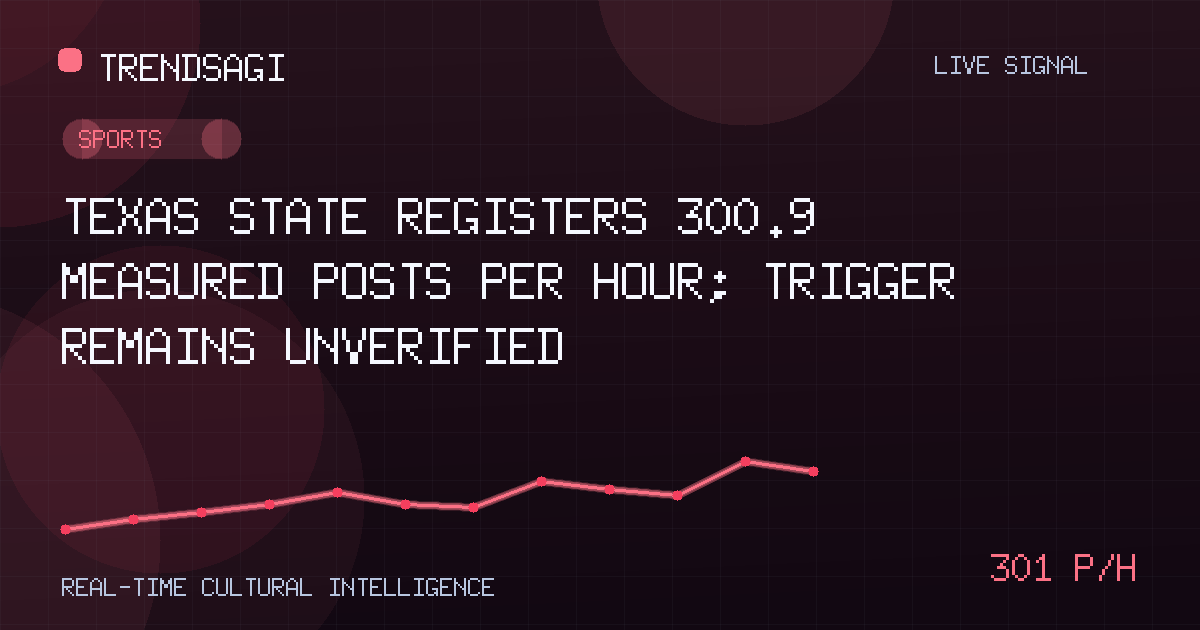
Texas State registers 300.9 measured posts per hour; trigger remains unverified
Texas State showed 300.9 measured posts per hour and 125 posts in the latest snapshot; the trigger remains unverified.
Automated briefing. Generated from stored signal measurements and source-backed research; it is not manually reviewed. Read the methodology and limitations.
Metrics in this briefing are a snapshot associated with its publication date and may not reflect current conditions.
What changed
Texas State registered a measured posting-velocity change in the stored observations, but the reason is not verified. The measured snapshot rate was 300.9 posts/hour over an exact 1005-second window using 3 stored observations. The latest snapshot volume was 125 posts. These are distinct measures: the rate describes posting velocity during the observed window, while the other describes the volume in the latest snapshot.
The defensible conclusion is narrow: the Texas State label was recorded as a sports-category signal at that moment, but the record does not show whether discussion concerned Texas State University athletics, another entity, or a broader sports topic. No game, roster move, injury, award, or announcement should be presented as the cause without event-level evidence.
| Observation time | Measured posts/hour | Latest snapshot volume |
|---|---|---|
| 2026-10-04T11:55:38Z | 300.9 posts/hour | 125 posts |
The 300.9 figure is a measured snapshot rate, not a live or current rate, forecast, reach estimate, engagement count, or count of unique people. The observation endpoint was 2026-10-04T11:55:38Z.
Why this topic may be moving
The stored signal description is blank, and no public report or official announcement has been verified as a trigger for this briefing. That makes the cause unclear rather than merely unknown. The Sports category narrows the context, but it does not resolve the identity of the topic.
- Athletics interpretation: Conversation could center on a game, player, coach, roster, injury, result, or school announcement. None is identified in the record.
- Label collision: Texas State may denote a university or another organization. Even within sports, several subtopics could carry the same label.
- Reaction pattern: Attention could arise from scheduled coverage, a breaking update, a social post, or repeated discussion. These are possibilities to test, not verified causes.
Without matching post text or a confirmed event, selecting one of these explanations would add a story the signal cannot support.
What the signal can establish
The strongest conclusion is that the stored record associated a measured posting-velocity change with this label during the specified window. It is a useful prompt for verification and monitoring.
- It establishes the label, the Sports category, the observation time, the 3-point measurement window, the supplied rate, and the latest snapshot volume.
- It does not establish who posted, whether people were unique, or whether the posts were original rather than replies or duplicates.
- It does not establish sentiment, engagement, reach, location, or whether discussion was favorable, critical, or neutral.
- It does not show whether all posts referred to one event, and it cannot distinguish a news trigger from slang, repetition, or unrelated use of the label.
A measured posting rate can identify where to look next; it cannot identify the fact that caused the activity.
No earlier comparable rate was supplied, so this briefing does not claim a percentage increase, historical record, or comparison with a normal Texas State baseline.
Why it matters
For sports editors, the signal is valuable because it compresses triage: a topic may deserve attention before its cause is known. The correct next move is verification, not publication of a speculative explanation.
- Newsrooms and reporters: Use the signal to find the underlying posts and test whether a single confirmed event links them.
- Fans and communities: Treat the rate as awareness that conversation is occurring, not evidence that an announcement is accurate or broadly supported.
- University or team communications: Monitor for questions, misinformation, or recurring themes before deciding whether a public response is warranted.
- Community and trend teams: Check persistence, duplication, account behavior, and topic identity before escalating the signal.
The practical value is prioritization: the signal indicates where verification resources may be best spent, while offering no basis for audience-size, sponsorship, or performance conclusions.
What to watch next
The next useful evidence should resolve identity, timing, and cause rather than merely add more volume.
- Resolve the label. Inspect representative post text and links for consistent references to the same entity, sport, team, or event. A category tag alone is insufficient.
- Locate the first wave. Compare the earliest stored timestamps with the timing of any relevant announcement. A reaction beginning after a verified post would be stronger evidence than an unexplained simultaneous rise.
- Confirm a trigger. Look for an official statement, named source, game result, roster report, or credible local coverage that many posts independently reference. Do not treat one repeated claim as confirmation.
- Test persistence. Review the next comparable observation windows. Sustained posting activity would suggest an ongoing conversation; a rapid return toward the prior pattern would suggest a short reaction.
- Audit content quality. Separate original posts from replies, quotes, duplicates, and unrelated uses of Texas State. Check whether multiple accounts appear to repeat identical wording, without assuming automation.
- Track qualitative shifts. Note whether verified facts, questions, criticism, praise, or confusion dominate. Sentiment labels should follow the content rather than substitute for it.
Escalation is justified only when the label resolves to a real topic and a verified trigger explains a meaningful share of the observed activity. Otherwise, the signal should remain a watch item.
Methodology and limitations
The supplied rate is 300.9 posts/hour, measured over an exact 1005-second window from 3 stored observations and recorded at 2026-10-04T11:55:38Z. The separate latest snapshot contains 125 posts. Because calculation details and earlier comparison values were not supplied, none are reconstructed or inferred here.
No external event claim is included because a public cause could not be verified. The briefing also cannot assess authenticity, unique authors, sentiment, engagement, or reach from aggregate activity alone. The category may help route research, but the broad topic label remains the largest interpretive uncertainty.
Track This Topic for New Signals
Set alerts for future velocity or sentiment changes around this topic.
Explore Tracking PlansAbout TrendsAGI research
TrendsAGI's automated research pipeline publishes dated signal snapshots, methodology notes, and practical workflows for teams evaluating cultural momentum. Read how signals are scoped, scored, and limited in our research methodology.