996-second window · 2 observations · Measured Sep 14, 2026, 11:10 PM UTC · Provider: go_recent_snapshot_v2
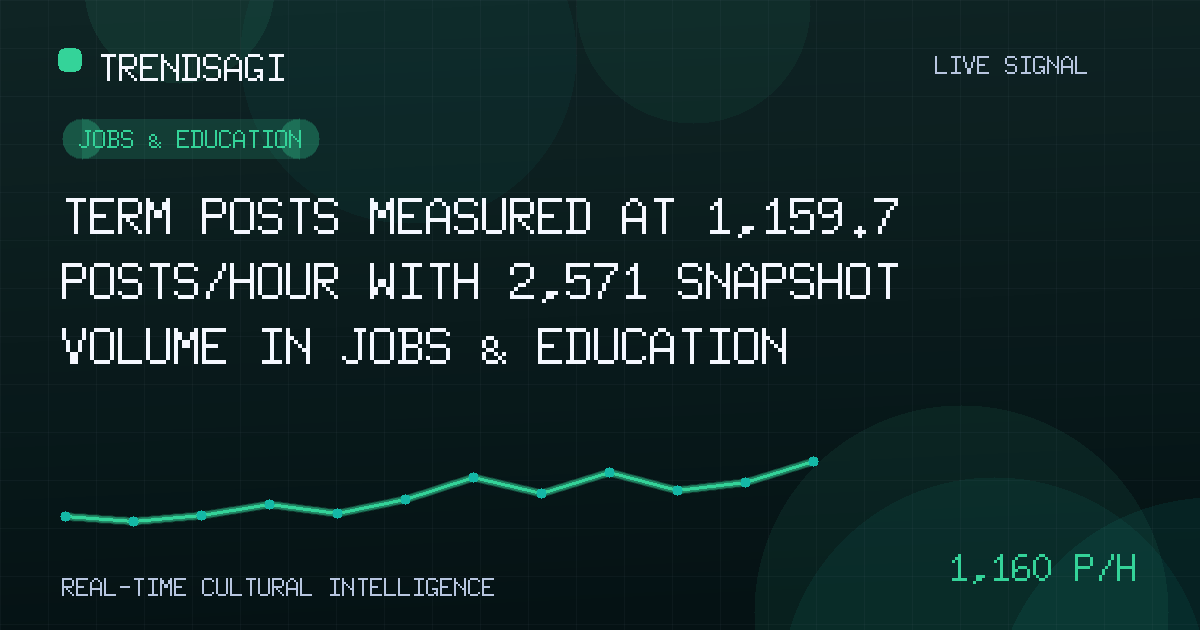
Term posts measured at 1,159.7 posts/hour with 2,571 snapshot volume in Jobs & Education
Term in Jobs & Education shows 1,159.7 measured posts/hour and 2,571 posts; a checkable spike, not a confirmed cause.
Automated briefing. Generated from stored signal measurements and source-backed research; it is not manually reviewed. Read the methodology and limitations.
Metrics in this briefing are a snapshot associated with its publication date and may not reflect current conditions.
What changed
The Jobs & Education signal labeled “Term” shows a fast-moving post volume in a stored snapshot. At 2026-09-14T23:10:33Z, the latest snapshot volume was 2,571 posts, and the stored two-observation measurement put the change rate at 1,159.7 posts/hour over an exact 996-second window.
The direct answer is that the topic moved quickly in the observed window, but the available signal does not identify a confirmed cause. It can establish that posts associated with “Term” were being generated at a high measured snapshot rate, not that 2,571 is a current live count, unique-person count, engagement level, or forecast. The practical next step is to inspect the underlying posts for repeated employers, universities, policy names, course calendars, job titles, or labor terms.
| Observation time | Measured posts/hour | Snapshot volume |
|---|---|---|
| 2026-09-14T23:10:33Z | 1,159.7 | 2,571 posts |
Why this topic may be moving
Because the label is broad, “Term” could refer to academic term cycles, contract or employment terms, policy or governance term limits, or legal and institutional language. The Jobs & Education category makes academic calendars and labor-related meanings the most relevant first hypotheses. The stored signal alone does not verify any of those interpretations.
- Seasonal education activity may appear around term starts, course registration, grading deadlines, faculty hiring, or student orientation.
- Employment and education discussions may spike when job postings, offer letters, internship agreements, union language, or workplace policy changes use the word prominently.
- A single account, campaign, template, or automated post could inflate a short window without a broader public cause.
If the movement is real, it may come from a specific institution, employer, regulator, or news story. If it is noise, it may come from duplicate content, repeated templates, a narrow community, or a measurement artifact.
What the signal can and cannot establish
The stored values are useful for timing and scale only. They establish when the observation was taken, how many posts were in the latest snapshot, and what measured change rate was calculated from two stored observations. They do not establish why the topic is moving, who is posting, whether the posts are original, whether the audience is unique, or whether the activity is positive, negative, or neutral.
The rate should be read as a measured snapshot rate. It is not a live rate, a current trend, a forecast, a reach metric, an engagement metric, or a count of unique people. The snapshot volume is a count of posts in that stored observation, not a rate and not a measure of total public discussion.
The useful question is not only how fast the posts are appearing, but whether the content changes from generic term mentions to specific job, school, policy, or labor signals.
For a reader, the value is in the follow-up checks. A spike in a broad label is only meaningful after the underlying language is examined.
Why it matters
“Term” sits at the intersection of education, work, and institutional rules. If the posts involve school calendars, the signal could affect student planning, faculty scheduling, hiring timelines, and institutional communications. If the posts involve employment or contract language, the signal could matter for recruiters, HR teams, labor analysts, and workers trying to understand offer conditions.
- Education teams should watch for term-start logistics, registration deadlines, course offerings, faculty workload, and student support changes.
- Employment teams should watch for new job families, contract clauses, internship terms, severance or leave language, and collective bargaining activity.
- Policy and compliance readers should watch for institutional rule changes, governance calendars, or legal terminology that may affect planning.
Even without a confirmed cause, a fast-moving label is a prompt to verify before acting. The risk is not the spike itself; the risk is assigning a cause that the data does not support.
Practical next checks
- Read the highest-signal posts and note whether “term” refers to a school term, a job term, a legal term, or an administrative term.
- Compare the same label across the prior 24 hours, seven days, and the same time of day in earlier days.
- Identify repeated entities: university names, employer names, ministry or department names, course codes, job titles, or policy phrases.
- Check whether the spike comes from many independent accounts or a small number of accounts and automated templates.
- Look for verified public context: institutional calendars, job boards, labor notices, education news, or official announcements that match the dominant wording.
- If no matching public context appears, keep the cause labeled unclear rather than selecting a likely explanation.
These checks turn a raw volume spike into a usable story. The goal is to separate a meaningful institutional or labor shift from a temporary content cluster.
What to watch next
- Whether the measured rate persists across additional independent observation windows, which would make the movement less likely to be a one-off burst.
- Whether posts begin naming a specific university, employer, ministry, regulator, job category, or policy change.
- Whether the language shifts from generic mentions to concrete deadlines, contract clauses, hiring decisions, course changes, or enforcement actions.
- Whether reputable public sources confirm the same event, calendar, or policy behind the posts.
- Whether the volume decays quickly, suggesting a template, event, or short-cycle discussion rather than a sustained trend.
A single confirmed entity, repeated in multiple posts and supported by public context, would be the strongest sign that the topic is moving for a real reason. Without that, the signal should remain an early warning, not a conclusion.
Methodology and limitations
The observation time was 2026-09-14T23:10:33Z. The latest snapshot volume was 2,571 posts. The stored two-observation measurement reported 1,159.7 posts/hour over an exact 996-second window, measured at the same timestamp. Those values are presented as stored observations; no numbers were transformed or re-derived beyond what was supplied.
The main limitation is that the stored description is empty and the topic label is broad. Without post text, platform metadata, account details, location data, or verified public context, the cause cannot be established. The rate is a measurement from two stored observations, not a live current rate. The snapshot volume is a point-in-time count, not a rate, forecast, unique-person count, or measure of public reach.
For decision-making, use this briefing to trigger checks, not to assert a cause. The next evidence needed is specific content language and matching public context that can confirm what “Term” is actually referring to.
Track This Topic for New Signals
Set alerts for future velocity or sentiment changes around this topic.
Explore Tracking PlansAbout TrendsAGI research
TrendsAGI's automated research pipeline publishes dated signal snapshots, methodology notes, and practical workflows for teams evaluating cultural momentum. Read how signals are scoped, scored, and limited in our research methodology.


