1794-second window · 3 observations · Measured Oct 4, 2026, 8:06 PM UTC · Provider: go_recent_snapshot_v2
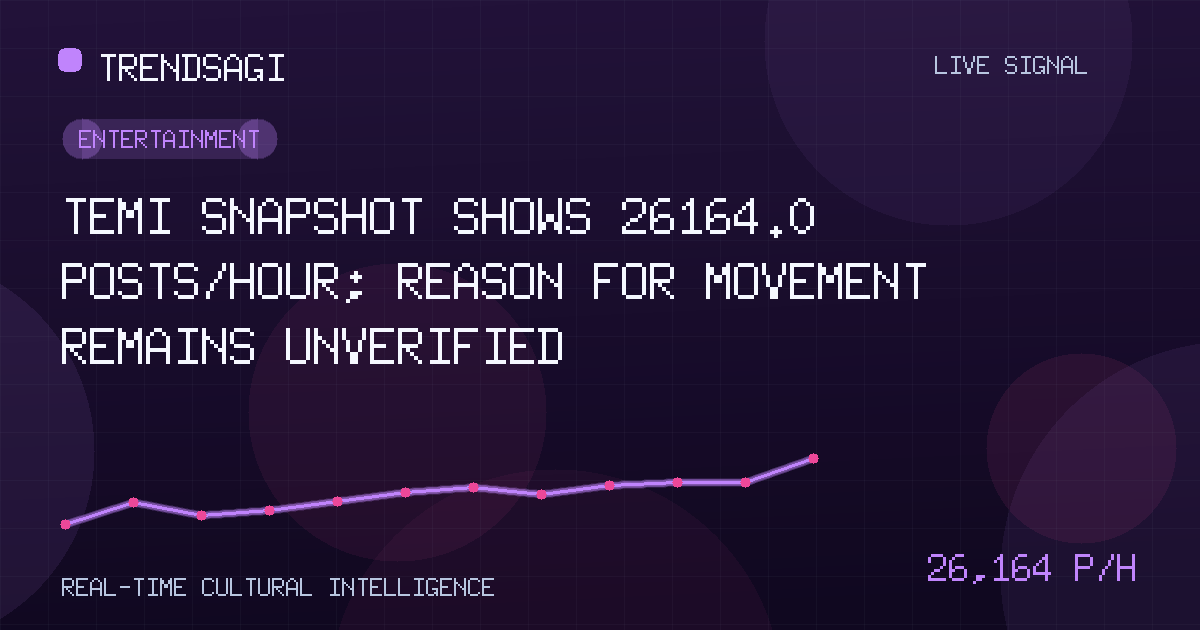
Temi snapshot shows 26164.0 posts/hour; reason for movement remains unverified
Temi shows 26164.0 posts/hour in a 1794-second snapshot window, but the catalyst and entity behind the label remain unverified.
Automated briefing. Generated from stored signal measurements and source-backed research; it is not manually reviewed. Read the methodology and limitations.
Metrics in this briefing are a snapshot associated with its publication date and may not reflect current conditions.
What changed
The monitored topic labeled Temi shows high short-window posting activity, but the reason for the movement is not verified. The latest stored snapshot contains 14400 posts. That is a reason to inspect the conversation, but not enough to claim that a particular release, controversy, personality, product, or other event caused the activity. The record also does not resolve which Temi the label represents.
The measured snapshot rate was 26164.0 posts/hour over an exact 1794-second window using 3 stored observations, with the latest observation timestamped 2026-10-04T20:06:31Z. This is a measured pace for that sample window, not a live rate, forecast, total audience, engagement count, or measure of unique people. The direct finding is the numerical posting velocity within the monitored sample; its explanation remains open.
| Observation time | 2026-10-04T20:06:31Z |
|---|---|
| Measured snapshot rate | 26164.0 posts/hour |
| Latest snapshot volume | 14400 posts |
The two headline figures should not be conflated. Snapshot volume, 14400 posts, is the size of the stored observation; posts/hour describes pace during the stated measurement window. Without the collection and counting definitions, the hourly figure should not be compared directly with the snapshot total, added to it, or interpreted as an estimate of future activity.
Why this topic may be moving
The signal carries an entertainment category but no topic description, entity identifier, or verified public catalyst. There is therefore no evidence-backed answer yet to why Temi is moving. Several explanations could fit a sharp rise in a broadly matched social label, but they are checks rather than conclusions:
- Entity collision: Temi may be matching different people, works, brands, accounts, or conversations that the monitoring system has grouped together.
- Event discovery: An announcement, episode, performance, clip, or controversy may have arrived near the measured window. The record does not identify one.
- Distribution effect: A highly followed account, recommendation system, repost cycle, or repeated wording may have increased visibility without an equivalent rise in distinct participation.
- Measurement effect: Duplication, automated activity, keyword ambiguity, or a collection boundary could affect volume. None has been established here.
A fast post count can justify closer verification, but it does not by itself justify a causal headline or an assumed connection to a familiar Temi.
Why it matters
For editors and media teams, the immediate risk is a false causal frame. A numerical rise can encourage a newsroom to attach the label to the nearest familiar entity or event. That would turn an ambiguous monitoring signal into an unsupported story. The useful editorial action is to resolve identity and timing before writing a why.
For brand, communications, and community teams, the signal may matter if it reflects genuine audience attention, but it could also be noise. Teams associated with the relevant Temi should check whether the conversation is organic, whether the activity persists, and whether it is positive, critical, or largely neutral. The supplied figures cannot answer those questions.
For analysts, the episode illustrates why volume and velocity need separate treatment. A 14400-post snapshot can be large while still representing duplicated material, a narrow community, or a keyword bucket. Conversely, a high measured rate can arise during a short interval without establishing a durable trend. Reach, influence, and business impact should not be inferred.
What to watch next
Before treating Temi as an event-driven trend, run the following checks in sequence:
- Resolve the entity. Review the earliest and most representative posts, inspect linked profiles or topics where available, and test whether the same Temi appears throughout the sample. Do not merge variants until their context matches.
- Establish timing. Compare post onset with the exact measurement window and earlier stored observations. A catalyst that predates the activity may be background rather than the trigger; one appearing at onset becomes a stronger lead.
- Trace provenance. Identify the first credible original post, then follow reprints and reactions. Note whether momentum comes from many originating accounts or repeated copies of one item.
- Seek confirmation. Look for a timestamped statement or publication from the relevant official person, organization, platform, or rights holder. Independent coverage can corroborate an event, but repetition of one post is not independent confirmation.
- Test breadth. Check whether participants span different communities and whether discussion adds original reactions. Concentration in one account or source would narrow the likely explanation.
- Check persistence. Use later snapshots to see whether posting remains fast, fades quickly, or shifts to a different Temi. A durable change is more informative than a single burst.
Methodology and limitations
The rate is a supplied measurement based on 3 stored observations across exactly 1794 seconds, with the latest observation at 2026-10-04T20:06:31Z. It is not a continuously observed average and should not be described as current after that timestamp. The snapshot volume of 14400 is not a rate. The available record does not state how posts were collected, deduplicated, weighted, or assigned to the topic.
No prior baseline is supplied, so the data does not establish how the rate compares with normal Temi activity or whether it is accelerating. It also lacks geographic, platform, demographic, sentiment, and unique-author breakdowns. No public trigger has been verified, so this briefing makes no causal attribution. Treat the result as a monitoring alert that warrants identity and source checks, not as proof of a news event.
Track This Topic for New Signals
Set alerts for future velocity or sentiment changes around this topic.
Explore Tracking PlansAbout TrendsAGI research
TrendsAGI's automated research pipeline publishes dated signal snapshots, methodology notes, and practical workflows for teams evaluating cultural momentum. Read how signals are scoped, scored, and limited in our research methodology.