15-minute window · 3 observations · Measured Sep 26, 2026, 3:51 PM UTC · Provider: go_recent_snapshot_v2
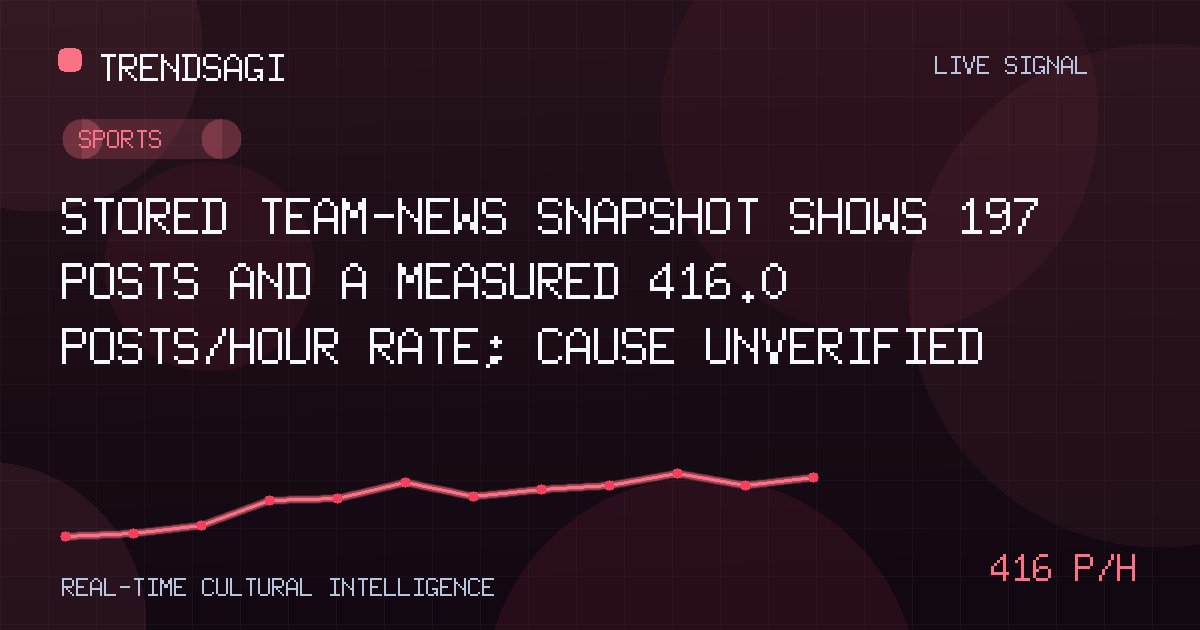
Stored team-news snapshot shows 197 posts and a measured 416.0 posts/hour rate; cause unverified
The team-news snapshot shows 197 posts and a measured 416.0 posts/hour rate; the briefing explains what is known, unknown, and worth checking next.
Automated briefing. Generated from stored signal measurements and source-backed research; it is not manually reviewed. Read the methodology and limitations.
Metrics in this briefing are a snapshot associated with its publication date and may not reflect current conditions.
What changed
The latest stored team-news snapshot contains 197 posts and shows a measured snapshot rate of 416.0 posts per hour. The cause is not identifiable from the supplied record, so the signal is a prompt to verify the broad feed, not confirmation that a particular team has breaking news. No team, competition, match, player, club, or event is specified; the defensible conclusion concerns captured post activity, not a verified sporting development.
The measured snapshot rate of 416.0 posts per hour covers an exact 900-second window based on 3 stored observations, with the latest snapshot observed at 2026-09-26T15:51:25Z. It is not a live rate, a forecast, an estimate of reach or engagement, or a count of unique people. The 197 posts are snapshot volume, not a rate.
| Measure | Stored observation |
|---|---|
| Observation time | 2026-09-26T15:51:25Z |
| Measured snapshot rate | 416.0 posts/hour |
| Snapshot volume | 197 posts |
Why this topic may be moving
The cause remains unclear. The record supplies a broad topic label and a Sports category, but it does not connect the burst to an identifiable announcement or event. Naming an injury, transfer, result, lineup change, or club statement as the trigger would therefore be speculation.
Many mechanisms could create this pattern: genuine breaking information, rapid reaction to an earlier post, repetition by media accounts, or aggregation of unrelated team stories. A label broad enough to cover team news may also combine discussion about many clubs. Without entity-level records and verified public context, those explanations cannot be separated.
A concentrated team-news burst is a reason to investigate, not proof that a team has issued confirmed news.
The appropriate working interpretation is an unresolved discussion burst: enough captured activity to investigate, but not enough attribution to explain it as confirmed team news.
What the signal can establish
The useful reading is deliberately narrow. The stored data establish the size and measured speed of the captured burst, which is enough to prioritize follow-up but not to explain what lies behind it.
- Observed collection: The latest stored snapshot contained 197 posts.
- Measurement: The stored rate was 416.0 posts/hour over the exact 900-second window using 3 observations.
- Monitoring value: The change provides a reason to inspect entities, timing, and sources before interpretation.
It does not establish:
- Subject: The signal does not identify the team, sport, league, match, player, or club behind the posts.
- Cause: No verified event or announcement is linked to the onset of activity.
- Audience: Post volume is not a count of unique people, impressions, or engagement.
- Quality: The signal does not assess whether posts are accurate, original, automated, or duplicated.
- Representativeness: The collection may not reflect all public conversation about teams or any particular sport.
Why it matters
Sports editors and club social-media teams can use the rate to prioritize a verification queue. They cannot use it, by itself, to write a specific team-news headline or amplify an unconfirmed claim.
The distinction is especially important because a broad label may pool unrelated clubs and stories. A high-volume burst can reflect repetition rather than broad independent confirmation, so apparent momentum can be misleading.
For monitoring analysts, the next value comes from resolving entities and source types. For fans and other time-sensitive readers, the rate is an alert to check, not evidence that a roster, injury, transfer, or match status has changed.
What to watch next
A practical verification pass should move from broad volume to attributable evidence:
- Resolve the entity. Inspect post text and metadata for team names, players, competitions, fixtures, hashtags, and source domains. Check aliases carefully; a shared word such as team is not enough to merge stories.
- Separate content types. Distinguish original posts, replies, quoted reposts, automated headline posts, reactions, and duplicate syndication. Keep a deduplicated view so repeated copying is not mistaken for independent confirmation.
- Build the timeline. Use timestamps to find the earliest attributable claim and the sequence that followed. The latest post is an endpoint, not proof of where the discussion began.
- Verify the claim. Check relevant official team, league, or player channels and credible publishers. Attribute a specific fact only when a retrieved source explicitly supports it, and record the publication time.
- Test persistence. Compare later stored windows using the same topic definition and collection method. Determine whether activity remains concentrated or quickly fades, and flag any change that could reflect collection coverage rather than public interest.
Concrete watch signals include:
- High-volume records share a clearly resolved team, fixture, or event.
- An official update is timestamped near the start of the burst.
- Independent credible publishers converge on the same claim.
- Activity remains elevated after automated and duplicated posts are separated.
- Entity labels remain stable across later snapshots.
Methodology and limitations
The latest stored observation is timestamped 2026-09-26T15:51:25Z and contains 197 posts. The stored 416.0 posts per hour was measured over the exact 900-second window using 3 stored observations. A rate based on that sequence may be sensitive to sampling boundaries, and the component observations are not supplied, so statistical uncertainty cannot be quantified here.
The stored signal contains no explanatory event attribution. Without a named entity and verified public evidence connecting that entity to the activity, the cause remains unclear; naming one would be guesswork. The findings therefore describe captured post volume and its measured snapshot rate only. They do not establish sentiment, authenticity, unique audience, wider public interest, or real-world consequences.
Track This Topic for New Signals
Set alerts for future velocity or sentiment changes around this topic.
Explore Tracking PlansAbout TrendsAGI research
TrendsAGI's automated research pipeline publishes dated signal snapshots, methodology notes, and practical workflows for teams evaluating cultural momentum. Read how signals are scoped, scored, and limited in our research methodology.