30-minute window · 3 observations · Measured Sep 24, 2026, 11:36 PM UTC · Provider: go_recent_snapshot_v2
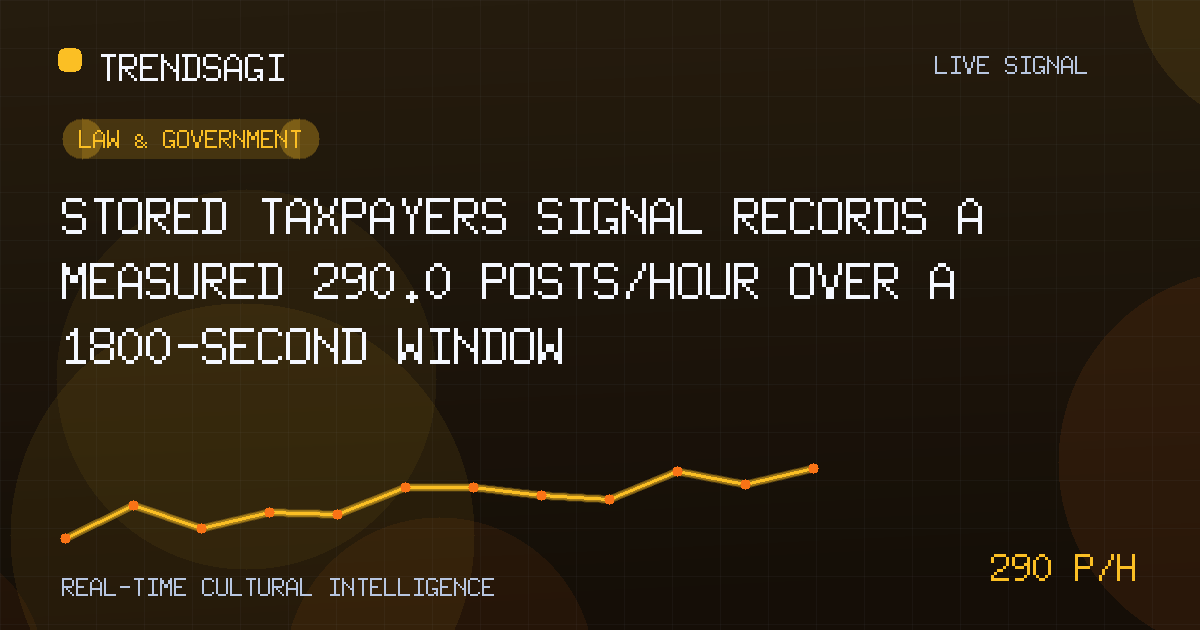
Stored taxpayers signal records a measured 290.0 posts/hour over a 1800-second window
The taxpayers signal shows 473 posts and a measured 290.0 posts/hour in a 1800-second window, plus checks for causes, limits, and next steps.
Automated briefing. Generated from stored signal measurements and source-backed research; it is not manually reviewed. Read the methodology and limitations.
Metrics in this briefing are a snapshot associated with its publication date and may not reflect current conditions.
What changed
The stored topic labeled “Taxpayers” contains 473 posts in its latest snapshot. Its measured change rate is 290.0 posts/hour across an exact 1800-second window ending at 2026-09-24T23:36:44Z, based on 3 stored observations. This establishes a time-bounded burst of recorded activity, not a verified news trend or a change in public opinion.
The reason for the movement is still unclear. No verified public context has been established for this signal, so it would be misleading to name a law, announcement, deadline, or political dispute as the driver. The stored category, “Law & Government,” provides classification rather than an event record; the posts themselves must be checked before assigning a cause.
| Observation time | 2026-09-24T23:36:44Z |
|---|---|
| Measured change rate | 290.0 posts/hour |
| Latest snapshot volume | 473 posts |
| Measurement window | Exact 1800 seconds; 3 stored observations |
What the signal can establish
The defensible conclusion is narrow: the stored sample’s count changed at a measurable pace during the specified interval. That is enough to prioritize inspection, but no baseline is supplied for judging whether the pace or volume is unusually high. The signal also does not show whether the posts are independent contributions, quotations, or repeated links.
- The trigger is unknown: No specific event has been matched to the discussion. Even a close timing match would require corroboration before establishing a shared cause.
- The audience is unknown: The 473-post volume is not a count of unique people, and the signal supplies no verified demographic or geographic breakdown.
- The subject mix is unknown: Without reviewing and coding the posts, it is not possible to assign an overall sentiment, policy position, or single subtopic to the label “Taxpayers.”
- Persistence is untested: The 1800-second window cannot establish whether activity continued, declined, or followed a recurring pattern outside this observation.
The important distinction is between activity and explanation. A measured rate documents a change in the stored count; it does not identify the event, the people involved, or the significance of the discussion without further evidence.
Why this topic may be moving
Several mechanisms could produce the pattern, but they are hypotheses to test, not verified findings. “Taxpayers” is a broad label: the same sample could combine reactions to official policy, personal tax questions, political argument, and incidental uses of the word. Without inspecting the posts, those explanations cannot be ranked reliably.
- A specific event: An announcement, court ruling, legislative development, or budget report could prompt reactions. The underlying record and the timing of the earliest relevant posts would need to match the observation.
- A calendar effect: A filing deadline, payment date, scheduled debate, or speech could concentrate attention. None of these is confirmed here as the driver.
- Reposting or repeated wording: Many posts may circulate one claim or quotation. Volume could then reflect repetition rather than an equally broad range of new contributions; the stored count cannot distinguish those patterns.
Why it matters
For people tracking government and policy, the signal is best treated as a prompt to investigate—not a referendum. A concentrated conversation may help surface the language and concerns worth checking, but an unclassified sample cannot establish a national mood, electoral preference, or economic effect.
- Journalists: Look for a documented event and multiple independent contributions before describing the conversation as a response to it.
- Policy teams: Separate reactions to a named proposal from general tax sentiment; identify the specific measure under discussion.
- Service providers: Check whether the posts raise operational questions about payments, filing, or access rather than assuming political intent.
- Researchers and editors: Preserve the sample, coding rules, and collection scope so this observation can be compared responsibly.
What to watch next
- Identify the trigger. Review the earliest substantive posts in the window, trace their citations to a primary record or reputable report, and check whether the event’s publication time fits the sequence. An explanation published afterward cannot establish what caused earlier posts.
- Disambiguate the label. Code which posts concern tax policy, personal finance, elections, or incidental uses of the word. Track named bills, agencies, deadlines, and disputed claims so a mixed discussion is not summarized as one issue.
- Audit repetition. Compare post wording, quotation blocks, and cited domains. Many near-duplicates would favor a recirculation explanation; varied original posts converging on a claim would warrant a different summary. Neither pattern is established yet.
- Test persistence. Gather adjacent observations under the same collection rules and look for continued activity, a decline, or recurrence. Keep platform and query scope visible; without that context, comparisons can be misleading.
- Separate authors from posts. Where available data permit, count visible accounts separately and review a sample for sentiment and factual themes. Do not infer demographics, representativeness, or agreement from post volume.
Methodology and limitations
The reported rate is a measured snapshot statistic based on 3 stored observations over the exact 1800-second window. Snapshot volume and change rate answer different questions: one is the number of posts in the latest stored snapshot; the other is the measured pace of change during the window. They should not be substituted for each other.
The figures do not reveal post provenance, sentiment, unique authors, or platform coverage. No baseline, verified event match, or post-level classification is supplied, so the signal cannot establish causation, representativeness, or persistence. These values describe the stated observation, not a live/current rate, forecast, reach, engagement, or unique-person count. Reuse should retain the timestamp, window, observation count, and any known collection scope; comparisons require consistent definitions.
Track This Topic for New Signals
Set alerts for future velocity or sentiment changes around this topic.
Explore Tracking PlansAbout TrendsAGI research
TrendsAGI's automated research pipeline publishes dated signal snapshots, methodology notes, and practical workflows for teams evaluating cultural momentum. Read how signals are scoped, scored, and limited in our research methodology.