888-second window · 3 observations · Measured Sep 30, 2026, 2:56 AM UTC · Provider: go_recent_snapshot_v2
Tatis snapshot holds 1,074 posts; measured rate is 2,937.9 posts/hour
Tatis logged 1,074 posts in the latest snapshot, with a measured 2,937.9 posts/hour rate; editors should verify cause and persistence.
Automated briefing. Generated from stored signal measurements and source-backed research; it is not manually reviewed. Read the methodology and limitations.
Metrics in this briefing are a snapshot associated with its publication date and may not reflect current conditions.
What changed
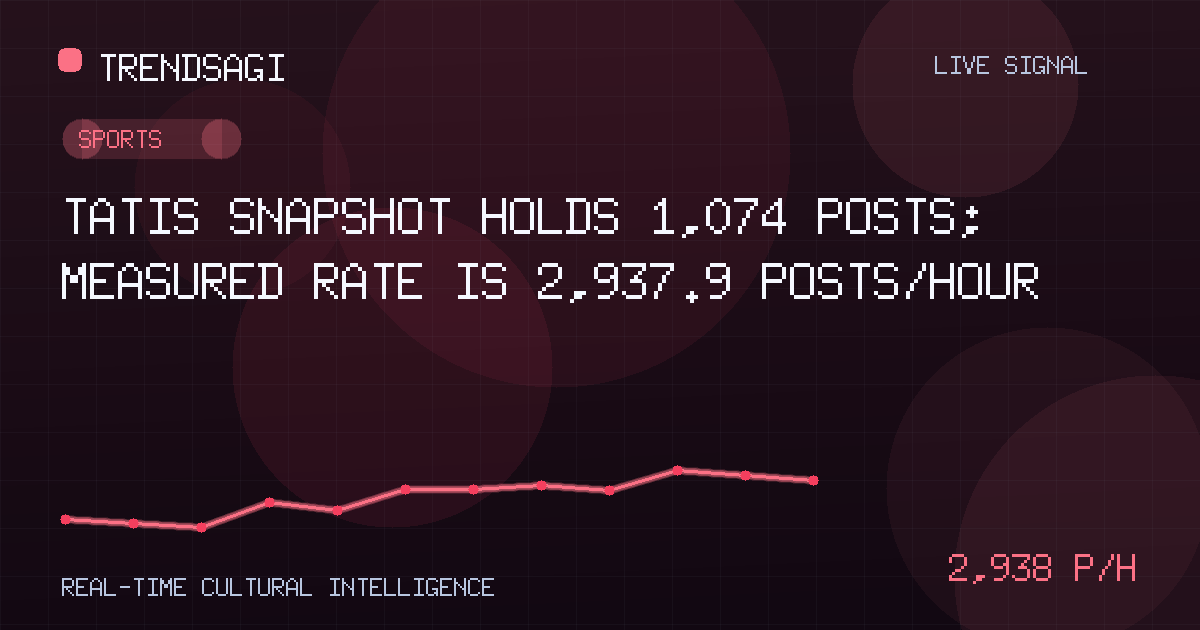
The Tatis signal contained 1,074 posts in the latest snapshot, observed at 2026-09-30 02:56:09 UTC. Across three stored observations, its measured snapshot rate was 2,937.9 posts/hour over an exact 888-second window.
The defensible reading is that the monitored collection was accumulating posts quickly during that historical window. The snapshot total and the rate are separate measures: the first is the volume at the observation time, while the second describes the measured change rate across the stored window. Neither establishes a live or current rate, unique participants, reach, sentiment, or the event behind the activity.
| Metric | Recorded value |
|---|---|
| Observation time | 2026-09-30 02:56:09 UTC |
| Measured snapshot rate | 2,937.9 posts/hour |
| Latest snapshot volume | 1,074 posts |
No verified public context establishes why Tatis was moving. The topic label also has no stored description, so a specific person, team, game, or news issue should not be treated as confirmed.
Why this topic may be moving
Several mechanisms could produce a short, high-volume topic signal. The stored observations do not distinguish among them:
- A new sports event: A scheduled appearance, result, injury report, roster move, contract development, or disciplinary matter could trigger timely posts. None of those events is verified here, so they remain possibilities rather than explanations.
- A media or social cascade: A notable clip, post, or exchange may have prompted reaction and repost volume. A cascade can make the feed look broad even when relatively few accounts account for much of the activity.
- Entity ambiguity: The label Tatis may map to more than one person or topic. Unless the underlying posts are checked, a baseball-focused interpretation cannot safely be applied to every item.
- Collection effects: Changes in matching, ranking, or the mix of captured sources could affect the post total. Duplicate copies and automated activity may also contribute.
A useful explanation must satisfy three tests: it must concern the same entity, begin before the measured rise, and be supported by public evidence. Without all three, the cause remains unclear.
A measured rate says how quickly posts accumulated in the stored collection; it does not say how many people were involved, what they believed, or why they posted.
Why it matters
This signal is best treated as an editorial triage flag. It says the label deserves checking at the recorded time; it does not say that a news event occurred or that public opinion turned in one direction.
- Sports editors should verify entity and timing before using Tatis in a headline, live file, or breaking-news alert.
- Player, team, and league communications teams should distinguish attention from controversy. Attention can be neutral, and a negative reaction wave is not implied by volume alone.
- Audience and platform teams should inspect repetition, coordination, and misinformation before treating the feed as a broad demand signal.
- Researchers and analysts need a longer baseline, source mix, and account-level deduplication before drawing conclusions about intensity or sentiment.
For readers, the key distinction is between a measured post count and a verified development. The number can justify further checking, but it cannot supply facts that the underlying posts and public reporting do not support.
What to watch next
The next checks should turn a fast-moving label into a testable account of what happened:
- Test persistence. Compare the next observation with this one using the same 888-second definition and collection method. Track both latest snapshot volume and measured posts/hour; do not collapse them into one figure. A rate near this benchmark would indicate continued activity, while a lower rate would show that the initial burst faded.
- Resolve the entity. Review a representative sample for matching names, teams, locations, and context. If posts refer to different people or uses of Tatis, split the signal rather than reporting a combined trend.
- Build the timeline. Identify when matching posts first accelerated, then look for a verified public event or first-party announcement that preceded that change. A report published after the rise may reflect it rather than cause it.
- Inspect concentration and duplication. Break the signal down by platform and account, and check for repeated text, quote-posts, automated behavior, or a small set of highly active accounts. This shows whether breadth is real or whether repetition is driving the total.
- Separate narrative from sentiment. Code a sample for factual reporting, reaction, criticism, support, and unrelated use. Similar volumes can accompany very different meanings.
- Watch for a second wave. Continued discussion after the initial burst, an official correction, or verified follow-on reporting would be more informative than another wave of the same copied post.
Methodology and limitations
The signal contains 1,074 posts in the latest snapshot at 2026-09-30 02:56:09 UTC. The measured snapshot rate of 2,937.9 posts/hour comes from three stored observations across an exact 888-second window. It is a historical description of this dataset, not a current forecast.
No previous baseline is supplied, so the data cannot establish that activity is unusually high, record-setting, or accelerating compared with a normal period. Posts may not be unique, original, human-generated, or relevant; they do not measure engagement, reach, or audience size. The topic-level label also lacks the detail needed to confirm identity and context.
No verified public context was available to establish the cause. The appropriate conclusion is therefore narrow but useful: Tatis registered 1,074 posts in the latest snapshot and a measured 2,937.9 posts/hour rate at the recorded observation, while cause and persistence still require verification.
Track This Topic for New Signals
Set alerts for future velocity or sentiment changes around this topic.
Explore Tracking PlansAbout TrendsAGI research
TrendsAGI's automated research pipeline publishes dated signal snapshots, methodology notes, and practical workflows for teams evaluating cultural momentum. Read how signals are scoped, scored, and limited in our research methodology.


