871-second window · 3 observations · Measured Oct 5, 2026, 10:52 AM UTC · Provider: go_recent_snapshot_v2
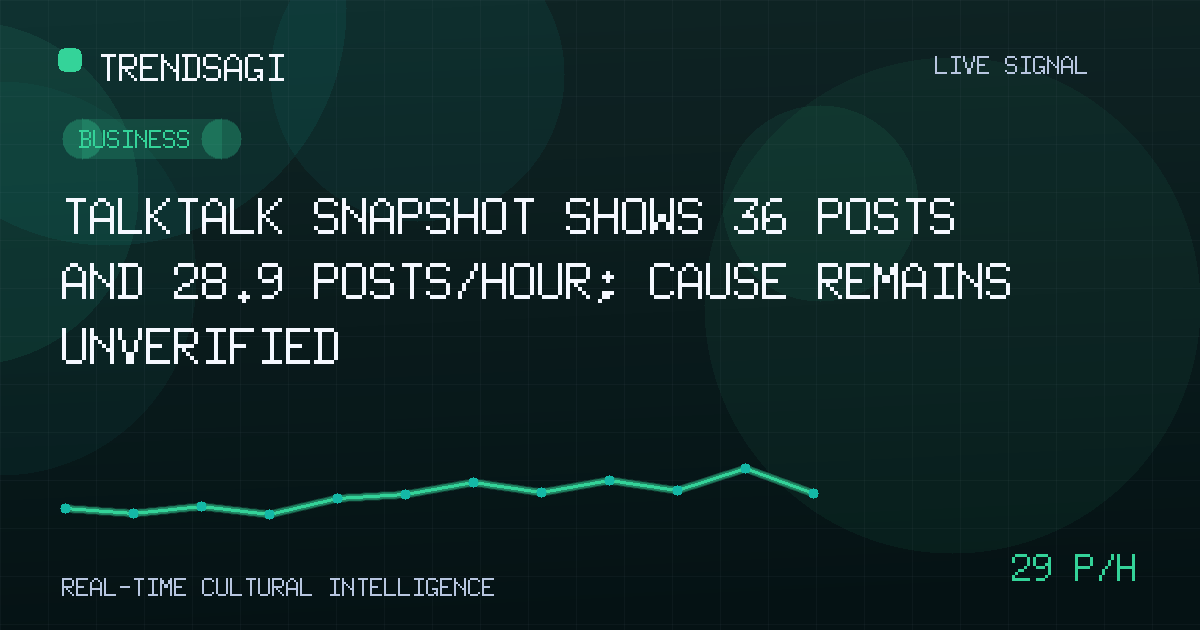
TalkTalk snapshot shows 36 posts and 28.9 posts/hour; cause remains unverified
TalkTalk's latest snapshot shows 36 posts and a measured 28.9 posts/hour, while the cause remains unverified; here are the checks that matter next.
Automated briefing. Generated from stored signal measurements and source-backed research; it is not manually reviewed. Read the methodology and limitations.
Metrics in this briefing are a snapshot associated with its publication date and may not reflect current conditions.
What changed
TalkTalk is moving in the latest business-category snapshot, but the available evidence does not establish why. The signal records 36 posts at the observation point and a measured change rate of 28.9 posts/hour. The defensible conclusion is that the monitored TalkTalk signal registered a measured change in posting activity during the window; the trigger, audience, and business significance remain unproven.
The 28.9 posts/hour figure is a measured snapshot rate over an exact 871-second window using 3 stored observations, observed at 2026-10-05T10:52:12Z. It is not a live or current rate, forecast, reach, engagement total, or unique-person count. The separate 36-post figure is snapshot volume and should not be substituted for the rate.
| Observation time | Measured posts/hour | Snapshot volume |
|---|---|---|
| 2026-10-05T10:52:12Z | 28.9 posts/hour | 36 posts |
Why this topic may be moving
No verified public context in the material used for this briefing ties the movement to a named announcement, report, campaign, operational issue, or other event, so the cause remains unclear. The business label says how the signal was categorized, not what prompted it. A cluster can reflect original reactions, repeated commentary around one story, customer discussion, promotional activity, or unrelated uses of the same name. Volume alone cannot distinguish among those possibilities.
Verification should therefore work backward from timing rather than backward from popularity. A useful check sequence is:
- Identify the earliest visible posts in the cluster and record their timestamps and source types.
- Check whether a primary statement or credible report appeared close enough to the cluster to plausibly explain it.
- Separate original reactions from reposts, quoted text, automated activity, and multiple posts from the same account.
- Compare the accounts repeating the claim with the account that first introduced it.
- Look for a later observation that tests whether activity persisted after the initial burst.
The signal establishes a change in observed TalkTalk posting activity, not the identity or importance of the event behind it. Any stronger claim requires timed public evidence connecting specific posts to a verified catalyst.
Why it matters
For corporate, brand, customer-experience, media, and competitive-intelligence readers, the immediate value is triage: a compact rise in posts can justify checking for a developing story, not treating that rise as the story. The key business question is whether the cluster coincides with a verified change in products, operations, communications, policy, or reputation. Without that link, the rate has little standalone decision value.
Teams should also resist equating more posts with more importance. A large reaction to a single external item can produce more posts than an operational problem; a small number of highly authoritative posts can matter more than a broad but repetitive cluster. The right interpretation depends on source diversity, persistence, and concrete consequences, none of which is supplied in this snapshot.
What the signal can and cannot establish
It can establish:
- The monitored topic label was TalkTalk and the stored category was Business.
- Latest snapshot volume was 36 posts at the stated observation time.
- The measured change rate was 28.9 posts/hour over the exact 871-second window using 3 stored observations.
It cannot establish:
- Why the movement occurred or whether a genuine new event exists.
- How many different people participated.
- Whether the discussion was positive, negative, or neutral.
- Reach, impressions, or engagement.
- The geographic or language distribution of the posts.
- Whether posts were independent, duplicated, quoted, or automated.
- Whether the burst persisted or produced a business effect.
What to watch next
The most useful next observations are concrete and comparable:
- Persistence: Whether another valid snapshot shows activity at or above the measured 28.9 posts/hour reference point, using the same counting method.
- Volume versus rate: Whether later snapshots recur at the 36-post volume scale; compare volume with volume and rate with rate.
- Source diversity: Whether independent customers, company-related voices, media accounts, and other participants are represented rather than one post dominating.
- Verified linkage: Whether a dated primary announcement or credible report explains the timing and is cited by multiple independent posts.
- Conversation shape: Whether discussion shifts from repeating a headline to distinct claims, first-hand reports, or competing interpretations.
- Business consequence: Whether the cluster is followed by a confirmed operational, customer, regulatory, financial, or competitive development. A social burst alone is not enough.
A sustained trend call would require repeated comparable observations; an explanation would additionally require a verified catalyst. If the rate fades and no external event can be tied to the cluster, the safest description remains a brief posting spike rather than a sustained TalkTalk trend.
Methodology and limitations
This briefing reports the supplied values without recalculation or conversion: observation time 2026-10-05T10:52:12Z, snapshot volume of 36 posts, measured change rate of 28.9 posts/hour, an exact 871-second measurement window, and 3 stored observations. Snapshot volume and measured rate are retained as separate measures because the record does not define a common counting period or explain how they relate.
The evidence is aggregate and time-stamped, not a post-level archive. It does not disclose collection coverage, deduplication, account identity, geography, language, sentiment, or the observation history before the stated window. Only 3 stored observations underpin the rate, so the supplied series cannot establish persistence or seasonality. No verified external explanation was available in the material used; accordingly, this briefing does not attribute the movement to any public event. Readers should not extend the finding beyond the observation time without a new comparable snapshot.
Track This Topic for New Signals
Set alerts for future velocity or sentiment changes around this topic.
Explore Tracking PlansAbout TrendsAGI research
TrendsAGI's automated research pipeline publishes dated signal snapshots, methodology notes, and practical workflows for teams evaluating cultural momentum. Read how signals are scoped, scored, and limited in our research methodology.