854-second window · 2 observations · Measured Oct 8, 2026, 7:53 PM UTC · Provider: go_recent_snapshot_v2
“Talarico” politics signal records 3002.7 posts/hour; cause remains unverified
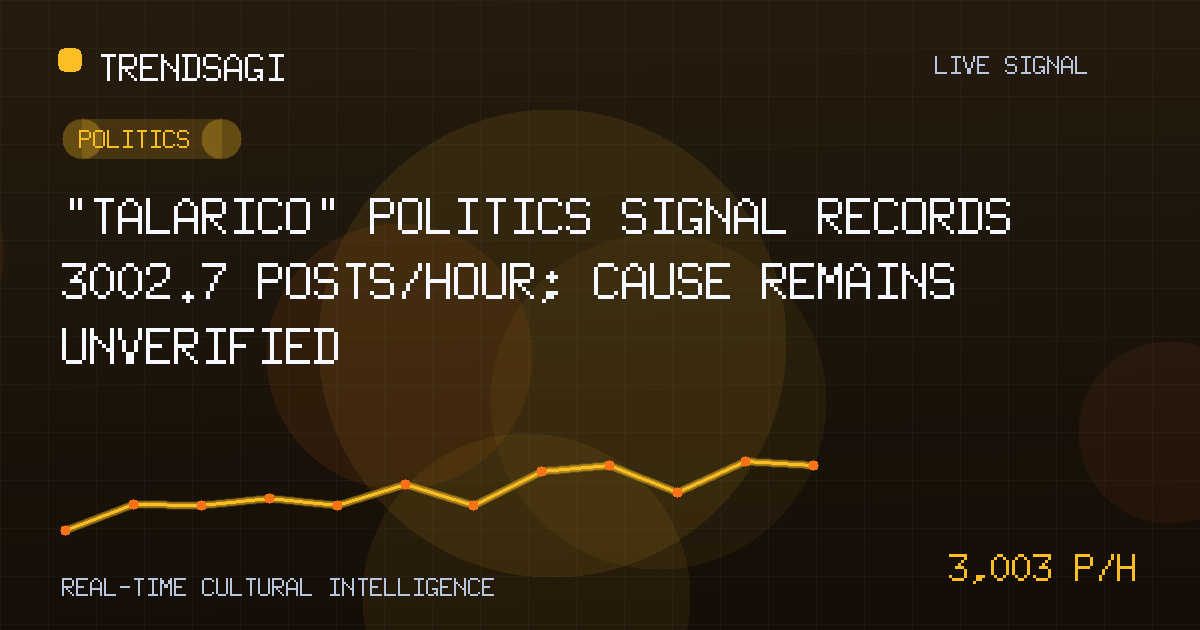
The stored “Talarico” politics signal recorded 3002.7 posts/hour; here is what changed and what must be verified before drawing conclusions.
Automated briefing. Generated from stored signal measurements and source-backed research; it is not manually reviewed. Read the methodology and limitations.
Metrics in this briefing are a snapshot associated with its publication date and may not reflect current conditions.
What changed
The stored Politics signal labeled “Talarico” shows rapid post accumulation, but the available record does not establish which person, organization, place, or event the name denotes. The defensible conclusion is that activity around the label increased within the monitored collection during the measured window; the reason remains unclear, and no political trigger has been verified.
The snapshot observation time is 2026-10-08T19:53:19Z. It records a measured snapshot rate of 3002.7 posts/hour over an exact 854-second window based on 2 stored observations. The latest snapshot volume is 1600 posts. That volume is a separate count, not a rate, forecast, reach figure, engagement measure, or unique-person count.
| Observation time | 2026-10-08T19:53:19Z |
|---|---|
| Measured snapshot rate | 3002.7 posts/hour |
| Latest snapshot volume | 1600 posts |
Why this topic may be moving
No verified public context in the record links “Talarico” to a dated event, and no supporting signal description accompanies the Politics category. It would be inaccurate to attribute the rise to a speech, election, investigation, controversy, or other political development without evidence.
- Referent ambiguity: The label may concern more than one subject, or it may omit a first name, role, or location needed to distinguish them.
- An uncaptured trigger: A public event may have prompted the posts, but the snapshot does not show what respondents were discussing.
- Repetition rather than broad discussion: Increased volume can be amplified by repeated wording, coordinated posting, or automated accounts. The counts cannot resolve that possibility.
- Classification mismatch: Politics is the stored category, not proof that the posts form a coherent political conversation.
A measured rise in posts associated with an ambiguous name is a prompt to investigate the label, not evidence for a causal news claim.
Why it matters
Editors and reporters should treat this signal as a verification queue, not a story premise. Describing Talarico as the cause of a political reaction would add both a subject and a causal claim that the record does not support.
Political monitoring teams should resolve the identity before escalating the signal. A label-level surge can combine unrelated names, duplicated material, or a category error, causing an otherwise measurable burst to become a false positive.
Researchers and communications teams need the underlying text, timestamps, account information, and cited sources before drawing conclusions about sentiment, geography, authenticity, or significance. General readers should not interpret 1600 posts as 1600 participants or as proof that a particular event occurred.
What the signal can and cannot establish
The signal supports three narrow findings: the monitored collection contained 1600 posts associated with “Talarico” at the stated observation time; the change between the stored observations measured 3002.7 posts/hour across the specified window; and the system classified the signal as Politics. Those facts make the label worth checking.
They do not identify the intended Talarico, establish that the posts were related, or reveal a shared opinion. The record also cannot determine whether participants were independent, whether material was duplicated, where activity occurred, whether sentiment was positive or negative, or whether any post influenced public life.
Only 2 stored observations cover the rate calculation. Without a longer baseline, the signal cannot show whether this level is unusual for the label, whether momentum is accelerating, or whether the burst persisted after the snapshot.
What to watch next
- Resolve the identity. Inspect the sampled posts for full names, roles, locations, and consistent spelling. Determine whether they converge on one subject or mix several unrelated uses of the label.
- Trace the earliest available material. Identify what appeared first and which references later posts reused. Separate claims that cite an identifiable source from repetition or unsupported speculation.
- Verify a public trigger. Look for a public statement, official record, or reputable report that explicitly connects the resolved subject to a dated event. Until then, describe the cause as unverified.
- Audit content and account patterns. Check for repeated wording, near-duplicate sequences, reposted text, and concentrated posting. Volume alone does not demonstrate broad or organic discussion.
- Collect later observations. Compare subsequent snapshots with this exact 854-second window to determine whether the burst persists, fades, or shifts to another label. Record whether the Politics classification remains appropriate.
- Corroborate before relabeling. If identity and trigger are confirmed, recast the signal around the verified event. If the name remains ambiguous or the activity is repetition-heavy, treat it as a monitoring anomaly rather than a political trend.
Methodology and limitations
The 3002.7 posts/hour figure is a measured snapshot rate supplied from 2 observations over an exact 854-second window ending at 2026-10-08T19:53:19Z. It is not a live or current rate, forecast, reach estimate, engagement total, or unique-person count. The 1600-post figure is the separate latest snapshot volume.
No verified external explanation accompanies the snapshot, so no publisher or public actor is cited as the cause. The short observation window, limited number of stored measurements, missing signal description, and unresolved identity constrain every substantive conclusion. The result establishes increased labeled activity, not what the label means or why it moved.
Track This Topic for New Signals
Set alerts for future velocity or sentiment changes around this topic.
Explore Tracking PlansAbout TrendsAGI research
TrendsAGI's automated research pipeline publishes dated signal snapshots, methodology notes, and practical workflows for teams evaluating cultural momentum. Read how signals are scoped, scored, and limited in our research methodology.


