884-second window · 3 observations · Measured Oct 6, 2026, 2:56 PM UTC · Provider: go_recent_snapshot_v2
“Take Out” shows a short-window post burst, but the trigger is unverified
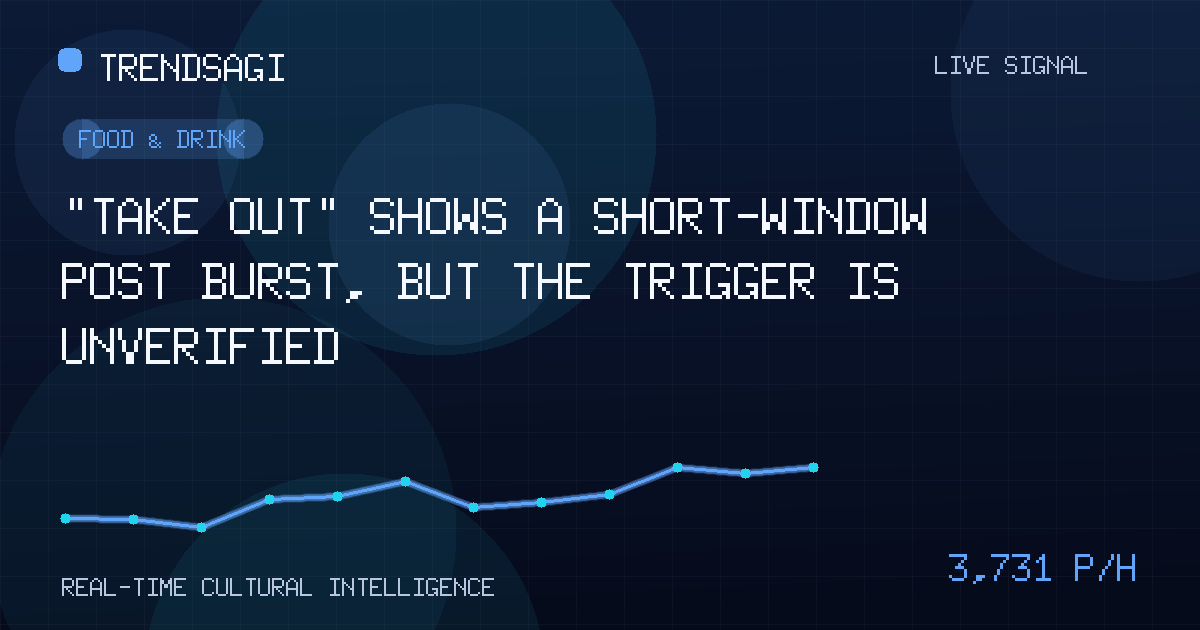
The “Take Out” signal measured 3731.4 posts/hour over 884 seconds and showed 2973 posts at the latest snapshot; its cause remains unverified.
Automated briefing. Generated from stored signal measurements and source-backed research; it is not manually reviewed. Read the methodology and limitations.
Metrics in this briefing are a snapshot associated with its publication date and may not reflect current conditions.
What changed
The stored “Take Out” signal shows a sharp short-window burst in posts associated with the label. The measured snapshot rate was 3731.4 posts/hour over an exact 884-second window using 3 stored observations, and the latest snapshot contained 2973 posts at 2026-10-06T14:56:18Z. That figure is a measured snapshot rate, not a live or current rate, forecast, reach, engagement total, or unique-person count.
The direct conclusion is narrow: activity under this topic label accelerated during the measured window, but the record does not show why. It includes no signal description or post-level evidence, and no independently verified public context was available to connect the movement to a particular event, promotion, news story, or seasonal effect. The stored Food & Drink category makes restaurant takeout plausible, but it does not prove that interpretation.
| Measure | Stored value |
|---|---|
| Observation time | 2026-10-06T14:56:18Z |
| Measurement window | 884 seconds |
| Stored observations | 3 |
| Measured snapshot rate | 3731.4 posts/hour |
| Latest snapshot volume | 2973 posts |
Why this topic may be moving
“Take Out” can be used in more than one context, so the label may combine commercial food talk with unrelated uses of the phrase. Several drivers remain possible, but none can be confirmed from the supplied signal:
- A shared prompt: A public conversation, scheduled activity, or cultural moment could have prompted a cluster of posts.
- A temporary commercial push: A restaurant, retailer, or platform campaign could have increased repeated mentions, although no campaign is identified.
- A seasonal influence: Changes in ordinary behavior around meals, weather, or holidays could contribute, but the record contains no evidence identifying one.
- A labeling effect: The collection rule may have captured a broader phrase or unrelated meanings, creating volume without a matching rise in takeout intent.
These are investigation hypotheses, not causes. Choosing among them requires inspecting the actual posts and finding independent corroboration. Until then, describing the burst as a takeout demand event would go beyond the evidence.
Why it matters
For food and drink publishers, restaurants, retailers, and marketplace teams, the immediate value is knowing where to investigate next—not making an immediate operating or media decision. The rate shows that the stored system detected concentrated activity, but it does not reveal whether those posts contained actionable consumer intent.
- Commercial teams should look for consistent references to ordering, availability, menus, prices, delivery or collection, and identifiable locations before treating the signal as a demand indicator.
- Editors and social teams should check whether a general phrase is being mistaken for a category-specific trend and correct the label if the sample shows semantic drift.
- Analysts should preserve the distinction between post volume, posting rate, reach, and human audiences; none should be substituted for another.
- Decision-makers should avoid changing staffing, inventory, promotions, or spend based on this snapshot alone because persistence and commercial meaning are unverified.
The signal is actionable as a prompt to investigate, not as evidence that takeout orders or market demand have increased.
What to watch next
A useful follow-up should turn the alert into a testable sequence. The strongest next checks are:
- Persistence: Check whether comparable activity appears in subsequent snapshots and same-duration windows. A brief cluster is less persuasive than a sustained pattern.
- Semantic mix: Review a raw sample and classify likely intent, such as food ordering, restaurant discussion, an unrelated phrase use, or ambiguous content. Report the dominant pattern with examples.
- Source concentration: Determine whether posts are broadly distributed or concentrated among a small set of accounts, platforms, regions, or languages.
- Entity linkage: Look for repeated brands, dishes, locations, apps, or offers that can explain the timing. Repeated entities would make the signal more actionable than generic phrase repetition.
- Commercial confirmation: Compare the social burst with first-party order activity, site traffic, menu searches, or other evidence that people are actively using takeout services.
- External corroboration: Look for verified reporting or an official announcement tied to the same timing and wording. Retain only a source-backed explanation that matches what the posts actually discuss.
- Rate–volume consistency: Keep comparing the measured posting rate with the separate snapshot volume rather than converting one into the other or assuming the rate will continue.
Methodology and limitations
The rate is a supplied measurement, not an estimate created for this briefing: 3731.4 posts/hour across an exact 884-second window and 3 stored observations. The 2973-post figure is the volume in the latest snapshot at 2026-10-06T14:56:18Z. They answer different questions and should remain separate.
The record does not include a normal baseline, a comparison rate, raw post text, account counts, geography, platform mix, sentiment, duplication controls, or category-classification rules. It therefore cannot establish unique participants, audience size, purchasing behavior, sentiment, geographic concentration, or how long the pattern will last. It also cannot show whether the topic label perfectly matches the stored Food & Drink category. Because no cause was verified, the defensible conclusion is a measured burst awaiting semantic and external validation.
Track This Topic for New Signals
Set alerts for future velocity or sentiment changes around this topic.
Explore Tracking PlansAbout TrendsAGI research
TrendsAGI's automated research pipeline publishes dated signal snapshots, methodology notes, and practical workflows for teams evaluating cultural momentum. Read how signals are scoped, scored, and limited in our research methodology.


