905-second window · 3 observations · Measured Oct 6, 2026, 12:56 PM UTC · Provider: go_recent_snapshot_v2
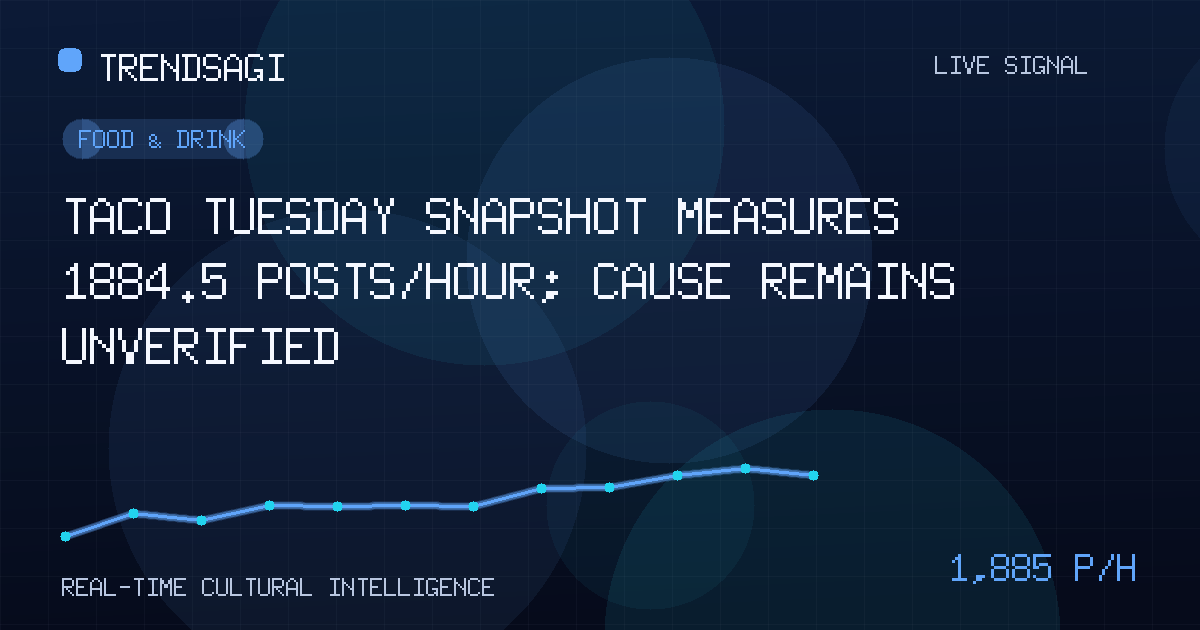
Taco Tuesday snapshot measures 1884.5 posts/hour; cause remains unverified
Taco Tuesday showed 1884.5 measured posts/hour over 905 seconds; the 1074-post snapshot indicates velocity, while its cause remains unverified.
Automated briefing. Generated from stored signal measurements and source-backed research; it is not manually reviewed. Read the methodology and limitations.
Metrics in this briefing are a snapshot associated with its publication date and may not reflect current conditions.
What changed
Direct answer: The stored signal for Taco Tuesday records a measured snapshot rate of 1884.5 posts/hour at the observation timestamp of 2026-10-06T12:56:24Z. The figure shows how quickly records accrued in the captured window, but it does not identify why the topic was moving or whether that activity will continue.
The measured change is 1884.5 posts/hour across an exact 905-second window using 3 stored observations. The latest snapshot contains 1074 posts. Rate and volume answer different questions: the rate describes accumulation velocity during the measured window, while snapshot volume describes the records present at the latest capture. Neither measure is a count of unique people.
| Observation time | Measured snapshot rate | Latest snapshot volume |
|---|---|---|
| 2026-10-06T12:56:24Z | 1884.5 posts/hour | 1074 posts |
Why this topic may be moving
The cause remains unclear. The stored category is Food & Drink, but that is a classification, not evidence that a particular food event occurred. The signal has no stored description and no verified public context that can be tied to a publisher and to the timing. It would be premature to attribute the activity to a restaurant campaign, menu launch, public event, celebrity post, or seasonal effect.
- A scheduled food promotion could concentrate posting, but no particular promotion has been verified.
- A limited number of accounts could generate repeated or closely timed content; without account-level records, concentration cannot be tested.
- A broader social conversation may use Taco Tuesday as a general label rather than an actual meal reference; raw text is needed to distinguish those uses.
- Collection effects cannot be ruled out without fuller source and collection documentation.
The measured rate establishes collection velocity at the observed moment. It does not establish audience size, commercial demand, organic attention, or a causal event.
These are hypotheses, not explanations. A useful causal claim needs time-matched evidence from the records or a verified public source. Repetition by one account, participation by many accounts, and independent media coverage would support very different interpretations.
Why it matters
Food and drink editors should care because a short-window burst may merit checking, but not automatically a trend headline. The available record lacks the baseline, duration, and distribution needed to distinguish a sustained topic from a momentary cluster. Calling it a broad consumer movement would go beyond the evidence.
Restaurants, food brands, and grocery teams should treat the signal as a prompt for verification rather than evidence of customer demand. Before changing a calendar, publishing a timely response, or adjusting a social plan, they need to know whether the posts concern a relevant promotion, product, audience, or geography. Post velocity alone cannot establish sales interest or campaign performance.
Social editors and trend analysts can use the signal to prioritize inspection. Its practical value is diagnostic: the rate tells them where to look first, while the snapshot volume provides a separate measure of the material available for review. The next analytical step is to determine whether that material represents broad participation or repeated content from a narrow source.
What to watch next
Seven checks would materially improve the briefing:
- Inspect post composition: Determine whether records are original posts, replies, reposts, duplicate text, or incidental uses of the phrase. Separate exact-label mentions from broader conversations about food.
- Test account concentration: Identify how much of the activity comes from the most active accounts and whether original contributions appear across unrelated accounts.
- Build a comparable baseline: Compare earlier and later observations collected under the same rules. This is necessary before describing the signal as elevated, sustained, or changing direction.
- Verify a public catalyst: Use Google Search to look for time-matched restaurant promotions, menu announcements, events, or relevant publisher reporting. Attribute a cause only when a credible public source supports both the claim and its timing.
- Check relevance by geography and language: A campaign meaningful in one market should not be presented as a global Food & Drink trend without supporting records.
- Review available engagement fields: Responses, likes, or shares may help characterize discussion, but they should not be substituted for reach, unique people, or commercial outcomes.
- Track topic specificity: Look for accompanying menu items, products, restaurants, locations, or events that would connect the label to a concrete development.
Concrete signs of a more durable signal would include persistence across independently collected windows, wider participation beyond a few accounts, original content rather than repetition, and a verified time-matched catalyst. A shift from the broad label to specific products or organizations would also improve interpretability. If those checks fail, the activity is best described as an unexplained short-window cluster rather than an established trend.
Methodology and limitations
The rate of 1884.5 posts/hour was measured over an exact 905-second window using 3 stored observations associated with the stated snapshot time. The 1074 posts represent latest snapshot volume. The two figures are separate and should not be used to recalculate or reinterpret one another.
The 1884.5 posts/hour figure is a measured snapshot rate, not a live or current rate, forecast, reach estimate, engagement measure, or unique-person count. No prior baseline is supplied, so the record does not establish how the topic compares with normal activity. The available signal also does not include raw post text, account identities, platform, geography, language, engagement, or paid-versus-organic classification. As a result, authenticity, sentiment, audience composition, commercial relevance, and cause remain unresolved. The signal is a monitoring lead, not proof of a broad or sustained market trend.
Track This Topic for New Signals
Set alerts for future velocity or sentiment changes around this topic.
Explore Tracking PlansAbout TrendsAGI research
TrendsAGI's automated research pipeline publishes dated signal snapshots, methodology notes, and practical workflows for teams evaluating cultural momentum. Read how signals are scoped, scored, and limited in our research methodology.